Get Full Government Meeting Transcripts, Videos, & Alerts Forever!
Get email alerts on the Child Welfare topic
No spam. Unsubscribe anytime.
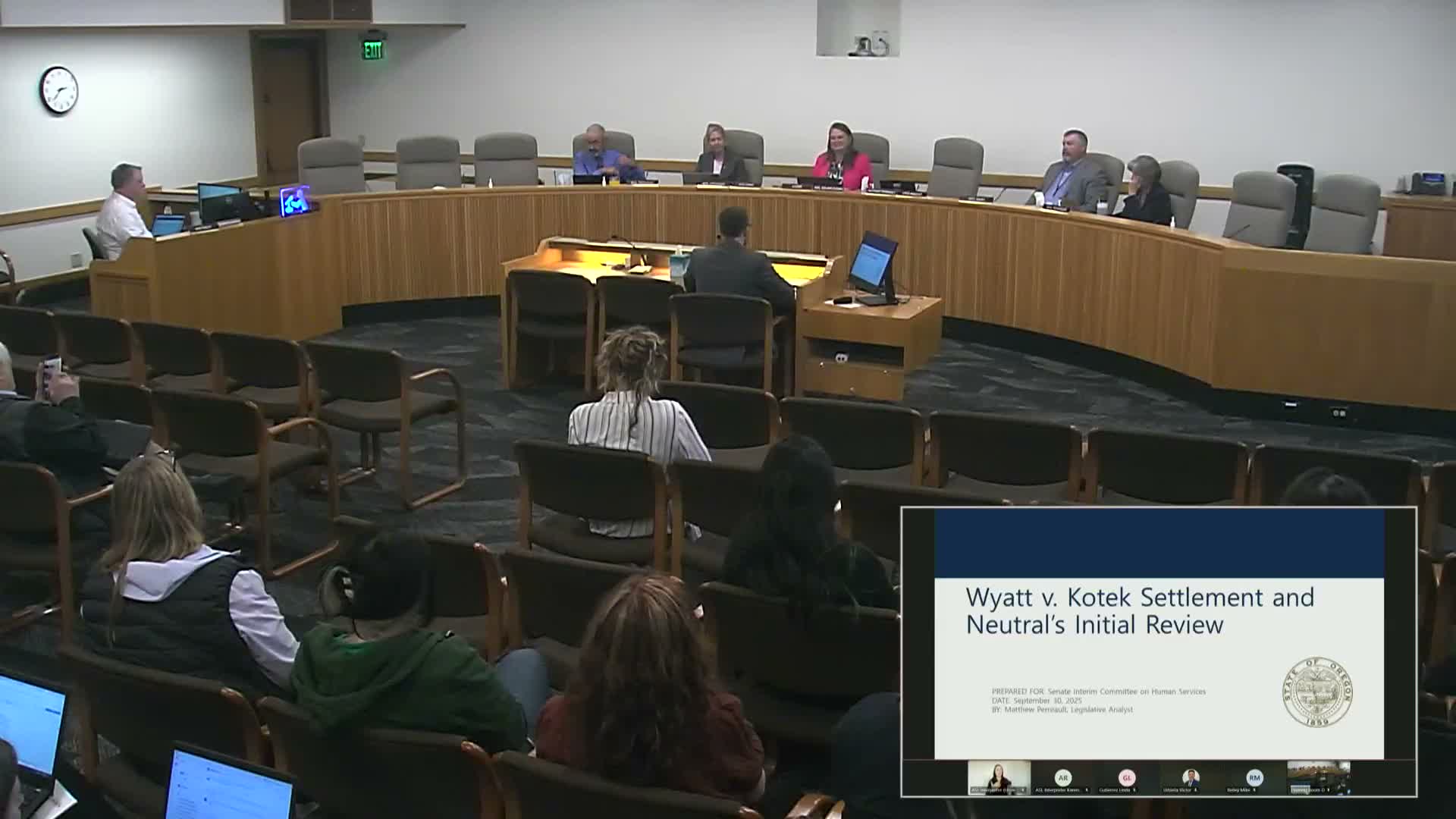
Senate committee hears overview of Wyatt v. Kotek settlement and Ninth Circuit ruling expanding "child in care"
Summary
Legislative analysts and counsel told the Senate Committee on Human Services that the Wyatt v. Kotek settlement sets measurable outcomes for Oregon's child-welfare system and that a published Ninth Circuit opinion broadened the scope of "child in care" to include children in DHS legal custody even when physically with parents, potentially increasing DHS duties and exposure to civil claims.
An analyst with the Legislative Policy and Research Office briefed the Senate Committee on Human Services on Sept. 30 about the Wyatt v. Kotek class-action settlement, the neutral's July 2025 initial review, and the specific metrics the state must meet under the agreement.
"For the record, my name is Matthew Pro," the analyst said, and summarized the neutral's report, which lists 10 ultimate outcomes and 14 associated measurements. Key quantitative targets include a maltreatment-in-care rate goal of 9.07 per 100,000 days by Sept. 30, 2029, and a foster-care reentry rate target of 5.6 or fewer by Sept. 2028, both with sustained performance periods. The review pairs federal Child and Family Services Review (CFSR) methodology with qualitative case-review measures for areas such as placement quality and timely case plans.
Committee counsel Laurie Ann Sills followed with an explanation of a recently published Ninth Circuit opinion that resolved a dispute over who counts as a "child in care" under the settlement. "The Ninth Circuit reversed the district court, finding that child in care includes children who are in the legal custody of DHS regardless of whether the child is placed in substitute care or with the child's parent," Sills said. She explained the decision rests on the court's conclusion that when DHS holds legal custody it assumes responsibility for virtually all aspects of the child's life, creating a "special relationship" and triggering affirmative duties under the Fourteenth Amendment.
Sills told the committee the holding extends beyond the settlement itself because the Ninth Circuit's published opinion is controlling authority in the circuit. She said that, as a result, foster children in DHS legal custody but placed in their parents' homes may have a cause of action under 42 U.S.C. 1983 or potential claims under Oregon's Tort Claims Act if the state fails to protect them from third-party harm.
Committee members used the exchange to raise implementation questions. One senator asked whether the ruling would obligate DHS to pay all costs arising while a child remains in legal custody but physically with parents; counsel said she did not know offhand and suggested the committee seek follow-up on liability and customary practice. The counsel and analyst also described how the neutral will annually assess whether DHS has made "sufficient and sustained good faith and meaningful efforts" toward the settlement's concrete metrics; arbitration and judicial review are available if the neutral finds the state out of substantial compliance.
The committee did not take any votes on statutory changes during the session. The presentations closed with committee members requesting the settlement agreement, initial complaint, fairness-hearing transcript and the neutral's initial review be made available in the legislative information system for further study.
The committee moved on to other informational items and invited legal and agency staff to provide follow-up materials on liability and implementation timelines.