Get Full Government Meeting Transcripts, Videos, & Alerts Forever!
Get email alerts on the Hr1 Business topic
No spam. Unsubscribe anytime.
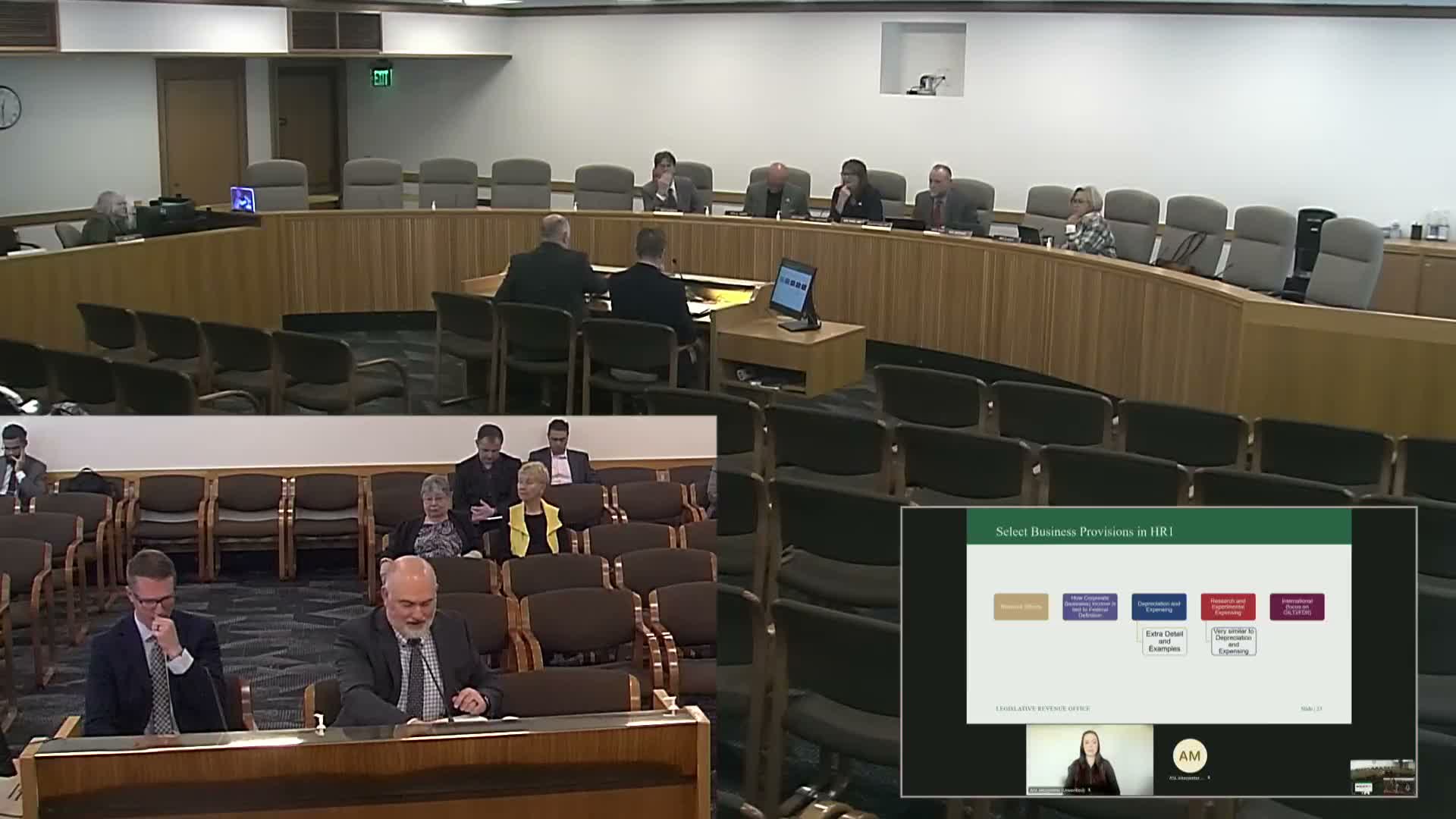
LRO outlines HR 1 business provisions: 100% expensing restored, qualified production property and international tax changes
Summary
Legislative Revenue Office staff told lawmakers HR 1 restores 100% bonus depreciation (expensing), expands expensing for some production property, raises section 179 limits and alters international provisions (GILTI/FDII), with implications for business cash flow and state revenue timing.
John Hart of the Legislative Revenue Office told the House Committee on Revenue that HR 1 makes several business-oriented tax changes that will affect the timing of deductions and, by extension, Oregon revenue in the short run.
Hart explained depreciation basics under MACRS and said HR 1 restored 100% bonus depreciation (expensing) for a broad range of property; "100% bonus depreciation is called expensing, because the full depreciable value is treated as an expense in a single year," he said. He illustrated how expensing shifts tax benefits toward the first year of an asset’s life, improving short-term cash flow for businesses even though total tax deductions over the life of the asset remain the same.
HR 1 also created a limited expensing rule for certain qualified production property (real property used for manufacturing/refining agricultural or chemical products if construction begins in 01/2025–2028 and placed in service before 2031) and raised section 179 expensing limits (to $2.5 million starting in 2025 with a $4 million phaseout threshold). Hart flagged there is limited IRS guidance yet on qualified production property and that some administrative detail remains to be clarified.
On research and experimental costs, Hart said HR 1 restores immediate expensing for domestic research and allows retroactive expensing for 2022–2024; larger companies will claim additional deductions on 2025 returns while smaller firms (<$31M average receipts) may amend earlier returns for refunds.
Hart also summarized international tax changes (GILTI/FDII) and said Oregon’s treatment will not map perfectly to federal rules; some federal deduction adjustments and allocation changes complicate state impacts. Committee members asked whether disconnecting from federal depreciation changes would make Oregon more attractive to businesses; Hart said disconnecting makes the state relatively less attractive for individual corporations on balance but that revenue trade-offs depend on how the state would use regained revenue.
LRO emphasized these provisions change timing and distribution of tax liabilities and offered to provide further analysis on decoupling options and administrative implications for tax-year applicability.
Hart closed by noting LRO is treating much of this at a high level and flagged points where additional guidance and statutory choices will determine final state impacts.