Get Full Government Meeting Transcripts, Videos, & Alerts Forever!
Get email alerts on the Cco Financing And Cmhp Capacity topic
No spam. Unsubscribe anytime.
COOs and community mental health leaders warn of funding squeeze and capacity gaps
Summary
Coordinated care organizations and community mental health program leaders told the House committee that recent investments increased utilization but that CCOs face unsustainable costs, crisis stabilization centers lack operational funding, and predatory telehealth and transition risks threaten community providers' viability.
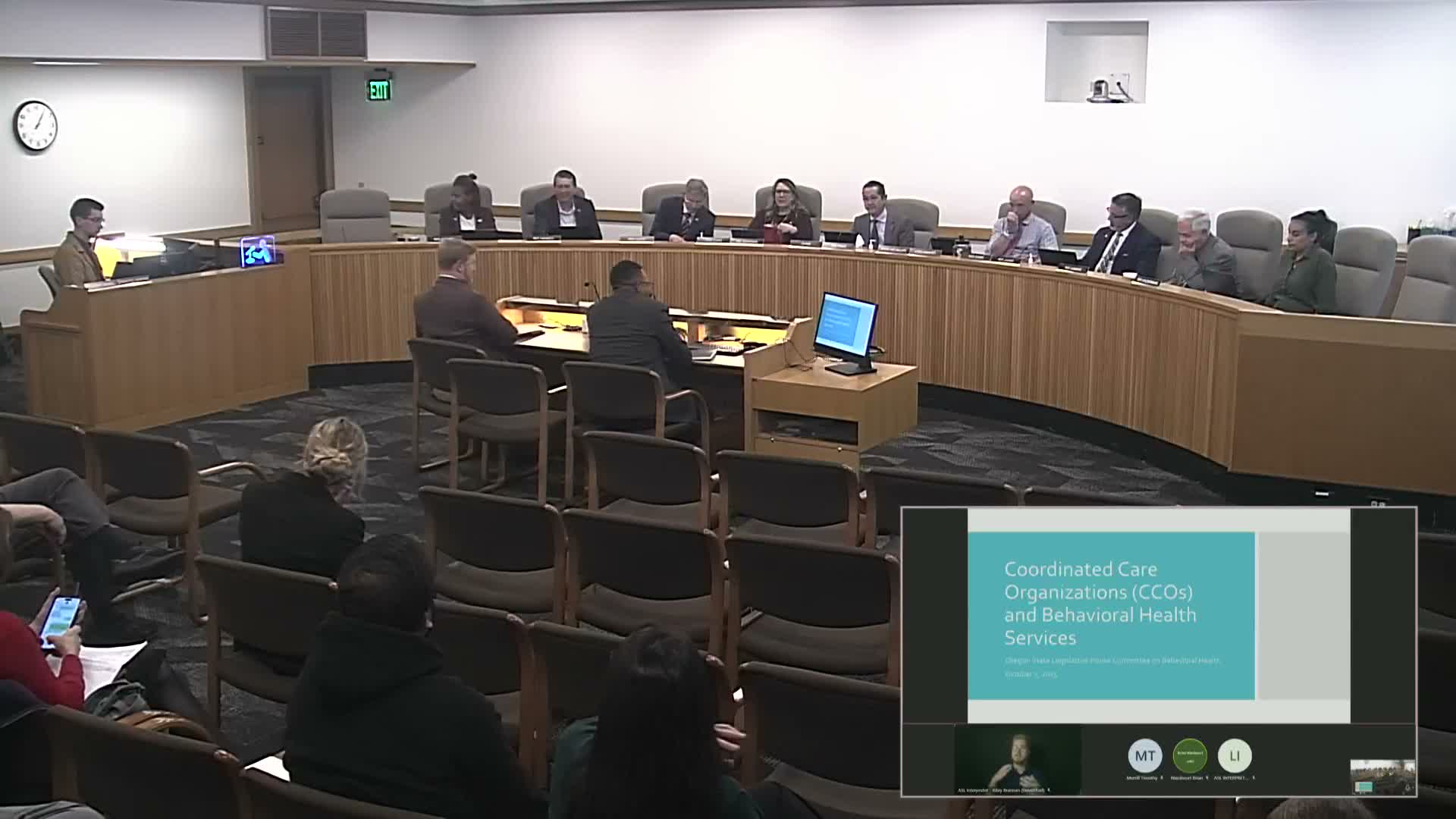
Representatives from Oregon's coordinated care organizations and community mental health programs used the committee's informational hearing to describe how recent investments have driven utilization while exposing funding and operational strains across the safety net.
Jeremiah Rigsby of CareOregon said CCOs receive global budgets from OHA and have reinvested pandemic-era and CCO funds (CareOregon cited roughly $150 million) into workforce retention and community clinics. Those investments, combined with state appropriations, produced a reported 30–40% rise in behavioral health utilization. Rigsby said CCOs'medical-loss ratios climbed well above targets (he reported figures up to about 120%), creating large operating losses for some CCOs and forcing hard choices about network design and sustainability.
Rick Blackwell of PacificSource emphasized coordination obligations in CCO contracts and pointed to implementation complexities: mismatches among program rules (for example, fidelity-based programs like Intensive In-Home Behavioral Health Treatment), interactions between directed payments and billing rules for board-registered associates, and administrative burdens that impede streamlined local delivery.
Todd Jeter (IHN) and Courtney Johnston (Trillium) raised immediate operational concerns: crisis stabilization centers built with capital funding but without secured operating funds cannot "turn the lights on," workforce shortages hinder mobile crisis teams (which can require two-person teams with a master's-level clinician), and predatory national telehealth providers are billing high-volume codes without local coordination, drawing dollars away from local safety-net providers.
Cheryl Ramirez, executive director of the Association of Oregon Community Mental Health Programs, described CMHPs'funding mix: roughly 60% Medicaid (largely routed through CCO contracts), about 30% state general fund through county financial assistance agreements, and the remainder a mix of federal grants, county general funds and other sources. Ramirez cited a $65 million funding gap in aid-and-assist and signaled a broader funding shortfall that OHA's phase 2 cost study will detail in December.
Speakers urged policy steps the committee might consider: fund operations for crisis stabilization centers, finalize associate-billing rules that require supervised team-based practice, place guardrails on telehealth-only providers in CCO networks, align funding for crisis services across OHA and CCOs, and protect continuity of care during potential CCO transitions or Medicaid eligibility changes.
Committee members acknowledged the long list of policy options and discussed consolidating ideas into a focused committee bill or a coordinated set of measures. No committee bill was introduced during the hearing.