Get Full Government Meeting Transcripts, Videos, & Alerts Forever!
Get email alerts on the Hr1 Personal topic
No spam. Unsubscribe anytime.
LRO explains HR 1 personal-tax changes: overtime, tip deductions, vehicle interest and charitable rules
Summary
Legislative Revenue Office staff briefed the House Revenue Committee on HR 1’s personal-tax provisions, including new overtime and tip-income deductions, limits on charitable deductions, a qualified vehicle loan interest deduction, and how many provisions may flow into Oregon via federal-to-state connections.
The Legislative Revenue Office told the House Committee on Revenue on Oct. 1 that HR 1 includes multiple new personal-tax provisions that will affect Oregon either directly through the state’s connection to the federal taxable-income definition or indirectly through changes to the federal tax subtraction.
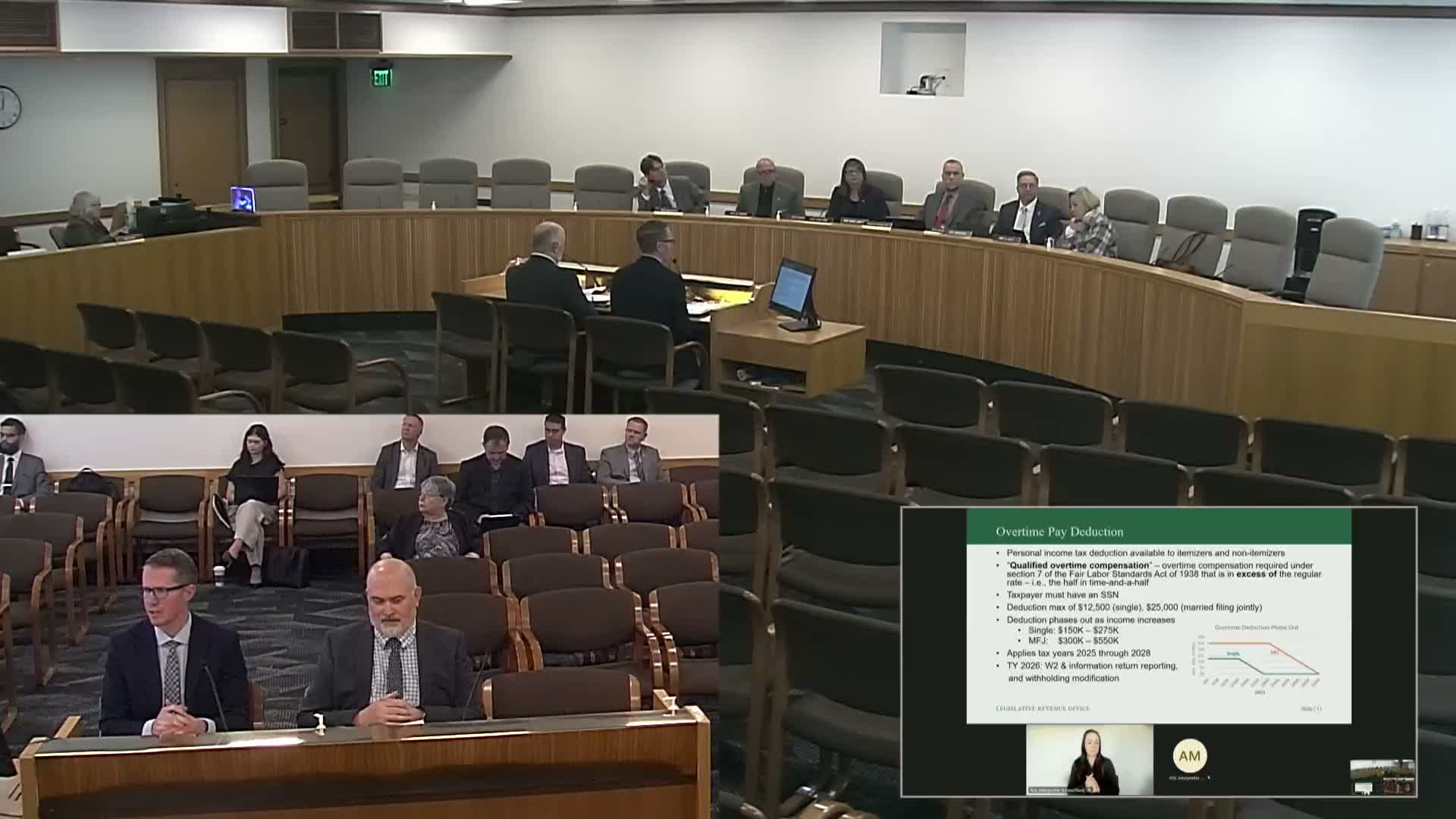
Kyle Easton (LRO) described an overtime pay deduction available to both itemizers and non-itemizers that allows a deduction for the incremental portion of overtime pay—"the half in the time and a half of overtime." He said the deduction has caps of $12,500 for single taxpayers and $25,000 for married couples filing jointly and noted phaseouts tied to income (single filing phases down beginning above $150,000 and to zero at $275,000). Easton said the provision is temporary under current law for tax years 2025–2028 and that withholding changes may begin in 2026.
Easton also described a tip-income deduction (available to itemizers and non-itemizers) that requires an SSN, includes a $25,000 cap with phaseouts and will be subject to Treasury rulemaking about qualifying occupations. He said preliminary LRO analysis suggests roughly half of the benefit in Oregon might go to taxpayers with incomes under $60,000, but offered to provide more detailed distributional tables.
Other personal provisions covered by LRO included a qualified vehicle loan interest deduction (a $10,000 cap and a requirement that the vehicle have final assembly in the U.S.), a charitable-deduction floor for itemizers (contributions must exceed 0.5% of AGI to be deductible) and a modest deduction for non-itemizers (up to $1,000 single / $2,000 joint). Easton noted some provisions are extensions or restorations of earlier federal law and that many of the changes were already embedded in the state’s most recent revenue forecast.
Committee members asked about the income distribution of benefits and equity concerns; Easton and LRO staff said the office’s published estimates are generally static and that some additional modeling (including some dynamic or behavioral components) is possible but not part of the baseline revenue-impact statements. LRO offered to follow up with more granular distributional data on the overtime and tip provisions.
The discussion underscored that tax changes enacted at the federal level can have different distributional effects in Oregon because of differences in state credits, tax rates and the federal tax subtraction.