Get Full Government Meeting Transcripts, Videos, & Alerts Forever!
Get email alerts on the Insurance Parity topic
No spam. Unsubscribe anytime.
Insurance regulator: many plans meet parity on paper but fall short in practice
Summary
The Division of Financial Regulation told the committee that insurers often meet behavioral-health parity 'as written' but fail to show parity 'in operation'; the division recommended continued reporting and scrutiny of prior-authorization and formulary differences.
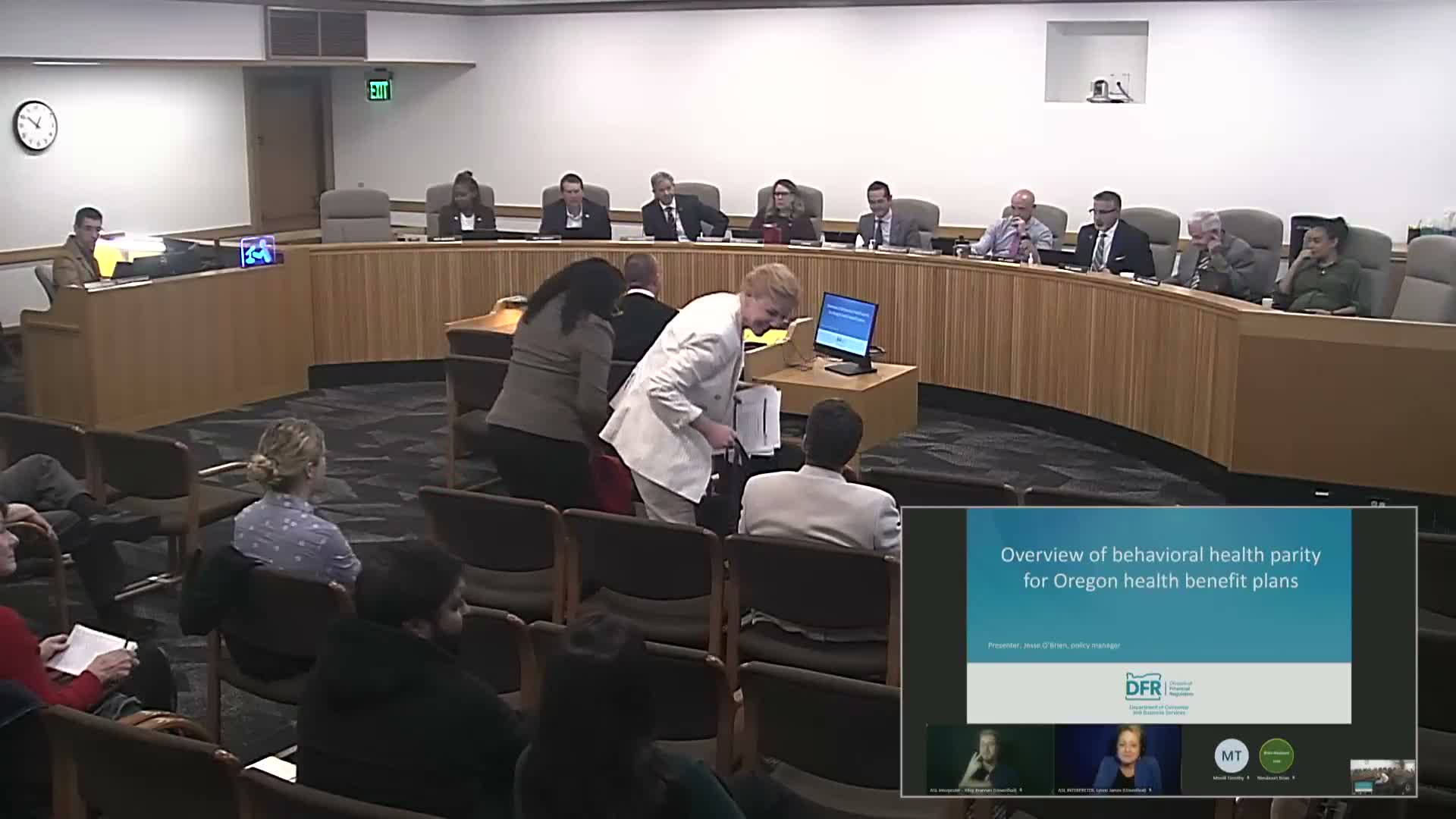
Jesse O'Brien, policy manager with the Division of Financial Regulation at the Oregon Department of Consumer and Business Services, briefed the House Interim Committee on Behavioral Health on Sept. 15 parity reporting and findings.
O'Brien explained the federal Mental Health Parity and Addiction Equity Act (MHPAEA) framework and Oregon's implementation through state law and recent updates, including House Bill 3046. He described two main review standards that DFR applies: parity "as written," which looks at insurer policies and procedures, and parity "in operation," which requires evidence of how non-quantitative treatment limits (NQTLs) are applied in practice.
DFR's recent review found many carriers meet the as-written standard but fall short on showing parity in operation. O'Brien flagged areas for further inquiry including prior-authorization denial rates, formulary differences and inconsistent report quality across insurers. He emphasized that quantitative divergences in reports do not automatically indicate legal violations, but they merit stakeholder follow-up and clearer reporting.
O'Brien also thanked the legislature for passing Senate Bill 824 earlier in the year, which reinstates reporting elements that help DFR monitor parity and said the division will continue refining reporting expectations with carriers.
Committee members acknowledged parity issues are technically complex and discussed how parity requirements intersect with provider reimbursement, network adequacy and consumer experience. No regulatory enforcement actions were announced at the hearing; the presentation concluded with an offer to provide fuller data and reports to committee members.