Get Full Government Meeting Transcripts, Videos, & Alerts Forever!
Get email alerts on the Workforce Credential topic
No spam. Unsubscribe anytime.
Stakeholders recommend bachelor's-level credential to expand youth behavioral-health workforce
Summary
Presenters from the Ballmer Institute and partners recommended that Oregon adopt a licensed bachelor's-level behavioral health and wellness practitioner credential (HB 4,151 work), overseen by the Board of Psychology, to increase early-identification services and diversify the workforce while preserving supervision and scope limits.
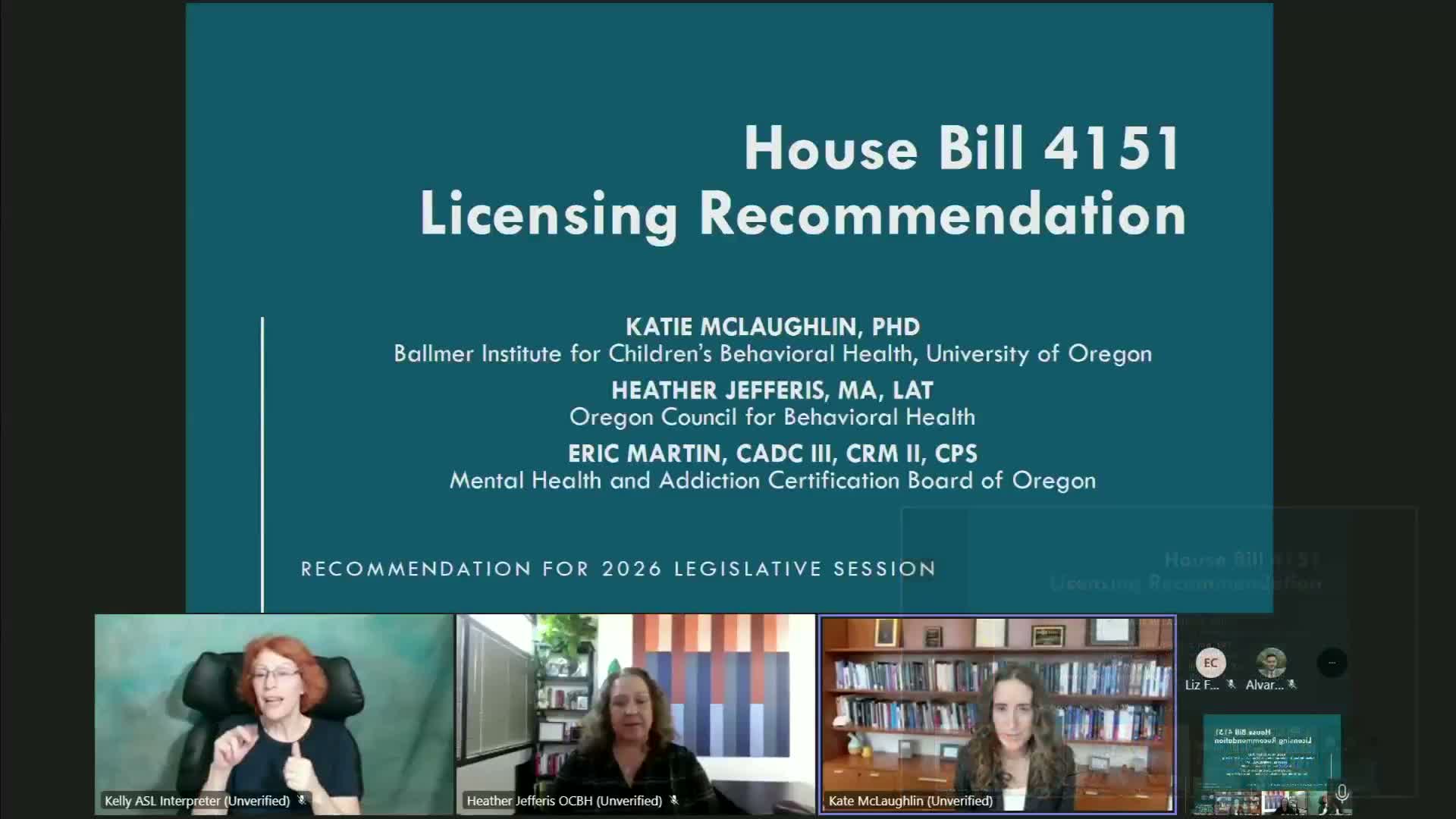
A subcommittee convened under House Bill 4,151 recommended creating a licensed bachelor's-level behavioral health and wellness practitioner credential to expand youth-focused, prevention-oriented services in schools, pediatric practices and community settings.
Dr. Kate McLaughlin (Ballmer Institute, University of Oregon) outlined the legislative recommendation: establish a credential for graduates of applied bachelor's programs that include supervised fieldwork; the scope would emphasize early identification, prevention and short-term intervention but explicitly exclude diagnosis, psychotherapy, neurocognitive testing and medication management. The role would require formal supervision by a master's-level or higher licensed clinician.
"We envision these folks being most likely to work after being credentialed in pediatric primary care, schools, community-based organizations and mental-health agencies," McLaughlin said, adding that the credential is intended to professionalize applied bachelor's roles and enable reimbursement by OHP and private insurers.
Heather Jeffress (Oregon Council for Behavioral Health) and Eric Martin (Mental Health & Addiction Certification Board of Oregon) described employer need for applied training and the likelihood that a credential would improve recruitment, retention and cultural representation among entry-level staff. Presenters cited state evidence that reducing entry barriers increases workforce diversity: qualified mental-health associates (bachelor-level) have more racial and ethnic diversity than master's-level providers in Oregon.
The presenters proposed that the mental-health regulatory agency (MHRA) place the credential within the Board of Psychology to reduce regulatory complexity and leverage existing oversight. They said Nevada and other Western states have recently adopted similar bachelor's-level credentials.
Chair Reynolds said the committee expects a committee bill in the 2026 short session and that the short session timing is intended to align credentialing with the Ballmer Institute's inaugural undergraduate graduating class.