Get Full Government Meeting Transcripts, Videos, & Alerts Forever!
Get email alerts on the Ed Boarding Youth topic
No spam. Unsubscribe anytime.
OHSU, OHA tell senators youth psychiatric "boarding" is widespread; Oregon capacity lags
Summary
OHSU and the Oregon Health Authority told the Senate committee that emergency-department boarding for youth with psychiatric needs is common nationally and in Oregon, driven by downstream shortages. Presenters urged investments in beds, crisis units and community services and described workforce and data gaps.
Oregon Health & Science University researchers and Oregon Health Authority officials told the Senate Committee on Early Childhood and Behavioral Health that emergency-department boarding for youth with psychiatric needs has grown substantially and that statewide capacity remains limited.
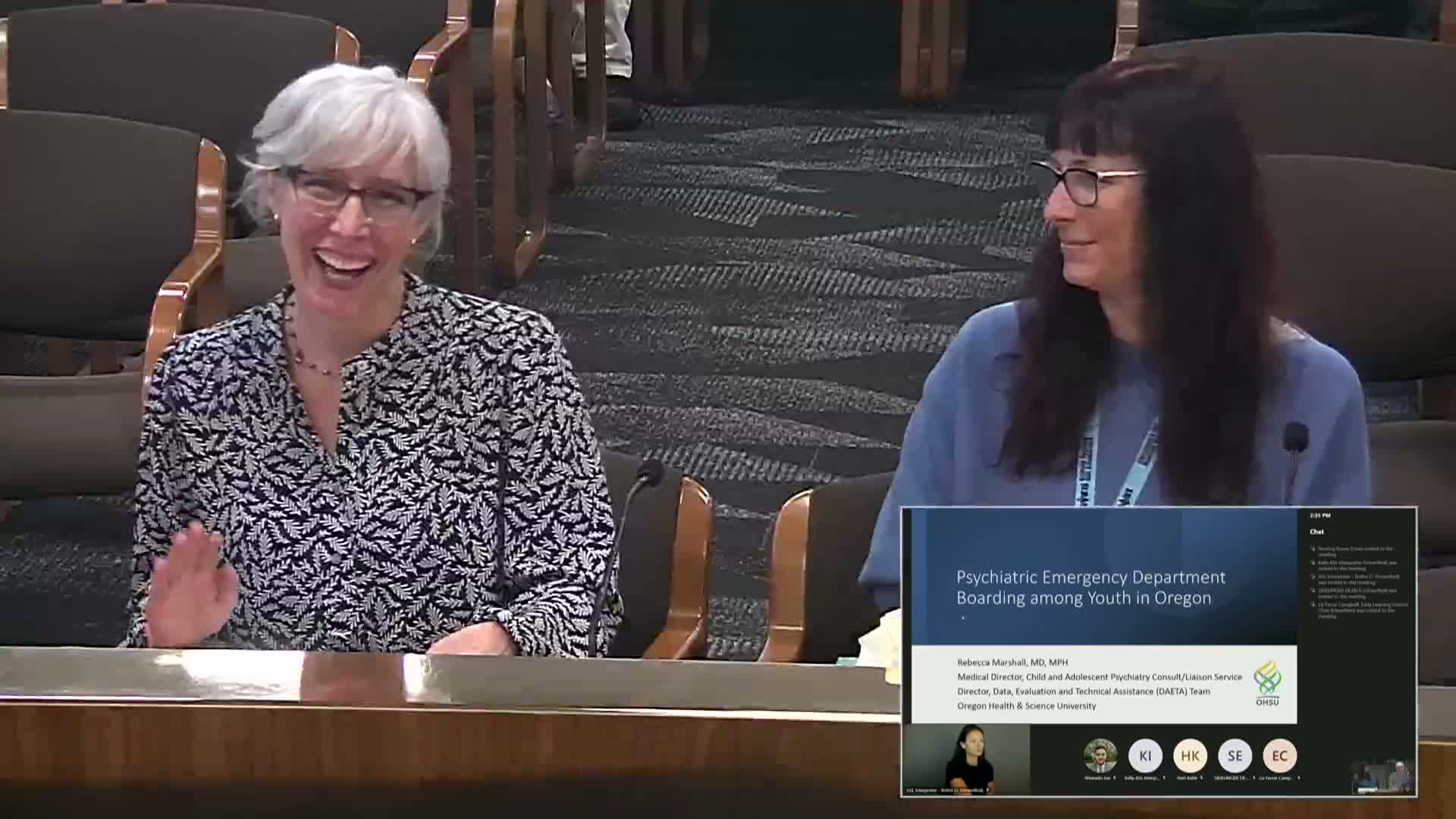
"One in eight visits results in a boarding event nationally," said Dr. Rebecca Marshall, director of OHSU's Child and Adolescent Psychiatry Consult Service, citing a conservative national analysis that defined boarding as multi-day stays in the ED. Marshall said the ED is a chaotic, non-therapeutic setting for children and described cases in which youth remained in ED rooms for multiple days.
Chelsea Holcomb, director of Child, Family, Lifespan Services at the Oregon Health Authority, told the committee OHA uses a 24-hour definition of boarding for ages 0–25 and that in Oregon the share of mental-health ED visits experiencing boarding has remained roughly steady in recent years (about 11 percent by OHA's measure). Holcomb said Medicaid covers the majority of mental-health ED visits and that some service-counting differences explain why OHA and OHSU data are not directly comparable: OHA's data do not capture children whom hospitals admit to pediatric floors to clear ED beds.
Both presenters emphasized that boarding results primarily from downstream shortages—limited inpatient and residential beds, staffing shortages that leave licensed beds unstaffed, and gaps in community crisis and step-down services—and not from failures of ED clinicians. Marshall said Oregon has "42 acute inpatient psychiatric beds" for youth statewide and described how scarcity forces families to demonstrate extreme need before a bed is provided. Holcomb outlined licensed versus program (operational) bed counts for psychiatric residential-treatment facilities (PRTFs) and said many licensed beds are not operable because of staffing or acuity constraints.
Presenters recommended a multi-pronged approach: invest in community crisis stabilization and mobile-response capacity; expand inpatient and specialized residential beds in appropriately sized regional settings; establish short-term therapeutic crisis units and bridge clinics; and align workforce investments so new beds and programs can be staffed. Holcomb also highlighted racial disparities in boarding: preliminary OHA data show Black/African American youth are overrepresented among those boarded for more than 24 hours.
Committee members pressed presenters on data definitions, regional placement options for rural families, and the kinds of beds needed for youth with developmental disabilities or severe aggression. Marshall and Holcomb said some populations require specialized programs with psychiatric management and that smaller, high-support residential settings are expensive and difficult to stand up but may better serve some children than larger campus models.
The presenters described incremental bed expansions funded in recent legislative cycles and projected new program beds coming online in late 2025 and 2026, while underscoring that building beds alone will not eliminate boarding without parallel investments in workforce and community-based services.