Get Full Government Meeting Transcripts, Videos, & Alerts Forever!
Get email alerts on the Unaccepted Ways topic
No spam. Unsubscribe anytime.
Methuen residents press committee to accept unaccepted streets; task force to pursue surveys, title work
Summary
Residents of Crestrail Lane and other neighborhoods urged Methuen’s Unaccepted Ways Committee to resolve decades of unaccepted street segments. Staff said they will pursue targeted surveys, title searches and a petition process while exploring betterment agreements and letters to MassDOT to clear records.
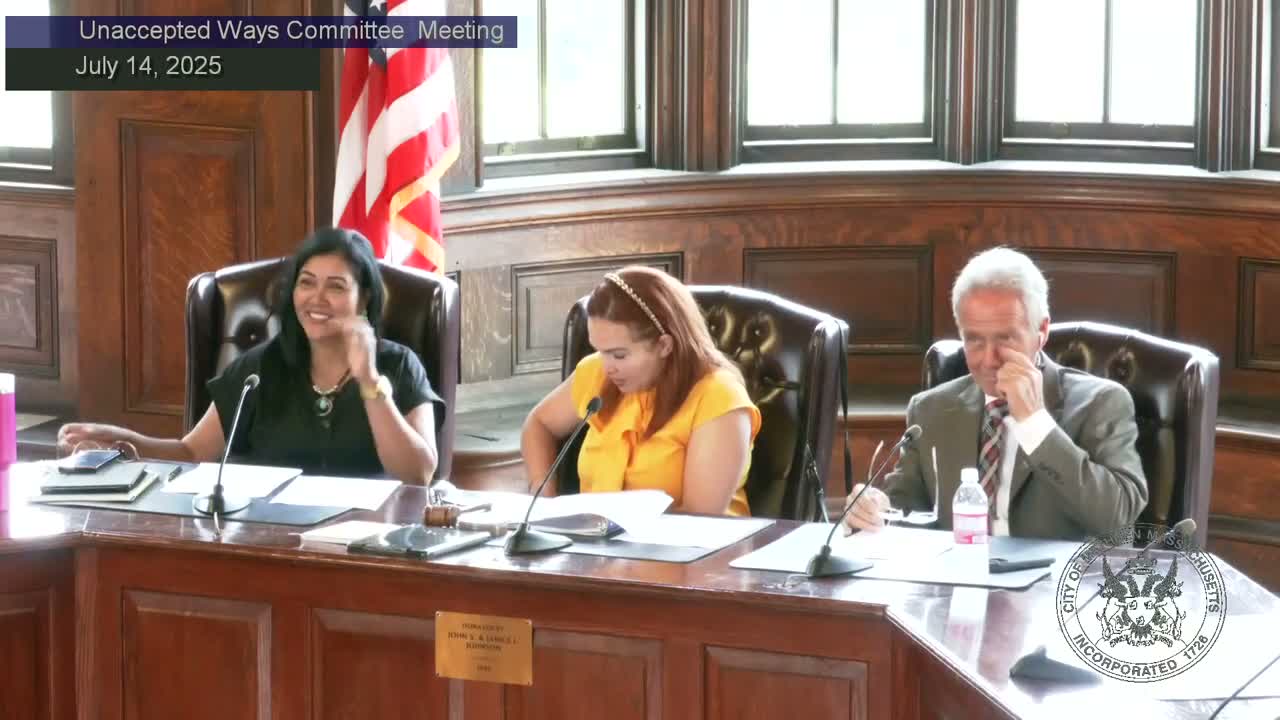
Methuen City’s Unaccepted Ways Committee heard multiple residents on July 14 asking the city to resolve “unaccepted” street segments, with a focus on Crestrail Lane, and directed staff to pursue engineering and title work and to prepare a neighborhood petition to move the matter toward a formal vote.
Mister Longo, a resident of Crestrail Lane, told the committee the cul‑de‑sac at the end of his street is owned by him and a neighbor and that municipal snow plowing repeatedly dumps snow into their circle. He said prior promises of follow‑up did not occur and that bringing the segment into an accepted status could cost “$12,000 to get it approved,” a sum he called unfair after five decades on the street.
The committee heard a second resident, David Wilson, who said the street’s deterioration and frost heaves are beginning to impede driveways and stressed the fairness argument: “Our excise taxes, our property taxes are supposed to … be used to maintain our streets in our neighborhoods,” Wilson said. Both residents urged the city to act without placing the full financial burden on long‑time homeowners.
Michael Welch, who presented a roadway task force update, said he has been following up with MassDOT about rejected acceptance submittals since late March and shared a draft city letter asking the state to accept several streets or clarify historical records. He noted that some streets show historical evidence of acceptance (Adele Place was listed as accepted in 1948; Ferry Road appears on a 1928 map) but that formal acceptance documents are missing for specific segments. Welch said he will meet with DPW Director Pat Bowers to refine a list the task force will press to MassDOT.
The committee discussed two principal approaches: accept targeted unaccepted segments after engineering and surveys define the limits and any remedial work is done, or use a betterment agreement that lets the city pay for upgrades and place the abutters’ share on tax bills over time. DPW Director Pat Bowers and councilors emphasized the legal and technical work required: surveys to establish right‑of‑way lines, title searches to locate old votes or deeds, and solicitor review to ensure the city does not open liability or create inconsistent standards for developers.
Welch reported roughly 200 unaccepted ways in the city database but identified about 41 entries where state records list streets as accepted while city files do not; those 41 may be fast opportunities to reduce the backlog. The committee discussed hiring outside consultants — surveyors and title examiners — to work in tandem with staff to accelerate the research.
As an immediate next step, Councilor Patricia Veil volunteered to work with the Longos on a neighborhood petition and to place it with the solicitor’s office this week. The task force will return with recommended streets, refined documentation and a proposed path—either acceptance resolutions, letters to MassDOT, or betterment proposals—so the council can vote in a future session. No formal acceptance votes occurred at the July 14 meeting.
The committee also briefly reviewed an unrelated parcel that may produce tax revenue and then adjourned at 5:58 p.m.
What’s next: staff will pursue targeted engineering, title searches and a petition for Crestrail Lane; Welch and DPW will refine a packets of streets to send to MassDOT and the solicitor for legal review.