Get Full Government Meeting Transcripts, Videos, & Alerts Forever!
Get email alerts on the Natural Hydrogen Permit topic
No spam. Unsubscribe anytime.
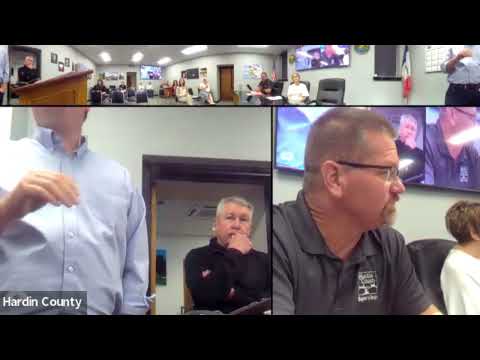
Twin Rivers Exploration asks Hardin County to shrink drain-tile buffer for seismic tests
Summary
Twin Rivers Exploration asked the Hardin County board to amend a county permit to add roads and reduce the buffer from drainage tile and culvert infrastructure from 250 feet to 25 feet for a planned geophysical survey to explore for natural hydrogen; company representatives described surveying methods, insurance and landowner agreements and asked the board to consider a permit-fee equivalent to nearby counties.
Kyle Gandy, a project representative for Twin Rivers Exploration, told the Hardin County board that his company is seeking an amendment to a county permit to add mileage and to reduce the permit’s setback from drainage tile and culvert infrastructure from 250 feet to 25 feet for a geophysical survey. “We’re a subsidiary of Coloma,” Gandy said. “Natural hydrogen has not been discovered in commercial quantities in North America, and so we're one of the few companies exploring for it in the U.S.”
Chris Dammit, identified in the transcript as Twin Rivers’ director of geophysics, described the planned work as noninvasive seismic surveying that uses sound waves to image the subsurface. “It’s like ultrasound technology, noninvasive sound in the ground,” Dammit said, explaining that the survey data would be processed to target any future drill site. He said the company expects to collect about 50 miles of survey lines in Hardin County and that the on‑the‑road phase would take roughly 10–11 days for that portion of the county.
Company representatives told the board they have modified permits in neighboring counties and that Wright County agreed to reduce a 250‑foot buffer to a 25‑foot setback (or 0.5 PPV) for similar operations. They said their survey vehicles put less energy into the ground than typical vibratory road rollers. “We’re putting about 70% of that … which comes out to about 18,000 pounds of force in the ground,” Dammit said in a comparison to standard road‑work equipment.
Twin Rivers said it has liability protections in place: a certificate of insurance naming Hardin County with $5,000,000 in aggregate coverage from its field operator, plus an additional $6,000,000 policy from the parent company, which the presenters described as $11,000,000 in combined coverage. Company representatives also said they indemnify the county for property damage and would accept claims if damage later is associated with their operation. The presenter noted the company has raised substantial capital and argued that the firm would be available to pay claims if necessary.
Presenters proposed an application fee structure modeled on fees the company said Wright County used. Twin Rivers offered an example figure — $21,600 — as an “equivalent permit fee” for Hardin County and said the company would work with county staff to confirm an appropriate administrative fee. They said they have been working with private landowners where crossings are required and that the operation would seek landowner permission before crossing private property.
Board members asked about the duration of insurance coverage and how long landowners could file a claim; Twin Rivers said damage discovered later could be claimed against the policy even if the operator were insolvent. The company confirmed it has not yet filed required drilling permits with the state for any future wells; the current request was limited to the exploration (survey) phase. On next steps, the presenters said they would submit specific road approvals and traffic‑control plans to county staff before conducting surveys.
The county board did not record a motion or vote on the amendment request during the transcripted discussion. The presenters asked the board to amend the local permit to match the reduced buffer used in neighboring counties so they could begin planning operations in Hardin County after completing work in Wright County.