Get Full Government Meeting Transcripts, Videos, & Alerts Forever!
Get email alerts on the Ems Essential Service topic
No spam. Unsubscribe anytime.
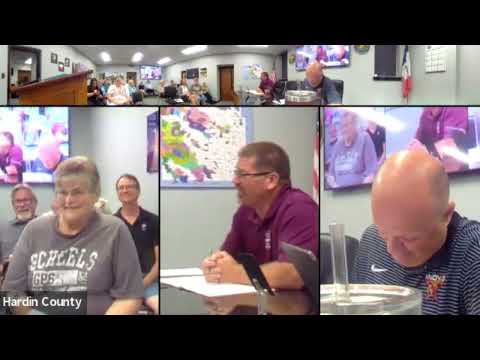
Hardin County holds public hearing on declaring EMS an essential service; advisory council process explained
Summary
Supervisors opened a required three‑hearing series on a proposal to declare EMS an essential service; speakers discussed funding options (levy up to $0.75 per $1,000 and local option income tax up to 1%), advisory council makeup, and next steps ahead of a voter referendum.
Hardin County supervisors opened a public hearing on a proposed resolution to declare emergency medical services (EMS) an essential service, beginning a statutorily mandated process that would put funding and service rules to voters if the board advances the measure.
A county supervisor, who introduced the hearing, summarized the statutory steps and the stakes for local communities. "This process is about ensuring that EMS funding is treated with the same importance as fire and law enforcement," the supervisor said, and noted the law requires three public hearings before the board may approve the resolution and refer the question to voters.
Why it matters: If supervisors ultimately adopt the resolution, the county would ask voters whether to authorize funding the service. Under the statute discussed at the hearing, counties may rely on up to a $0.75 property tax levy per $1,000 of assessed value, a local option income tax of up to 1%, or a combination of both; the advisory council would recommend the funding mix to place before voters.
Speakers at the hearing pressed for practical details. Scott Schwartz, a city council member, urged supervisors to "take us through the process" and let voters decide. Residents asked how municipalities and unincorporated townships would be represented on the advisory council; supervisors said representation options discussed included township and municipal delegates plus EMS provider representation but stressed official appointments cannot be finalized until after the third hearing and board affirmation.
Public commenters also flagged operational gaps and resource disparities. John Schmitz, a retired Army engineer and veteran, described the difference between basic life support (BLS) and advanced life support (ALS) crews and said funding is necessary so "I expect an ambulance to show up" in rural medical emergencies. Residents asked for an early, clear inventory of current fleet capacity and service standards; one participant recommended the advisory council or staff present a factual summary of existing EMS financing and equipment at the next hearing.
On governance and ballot language, county staff and counsel emphasized that referendum language should be specific. A procedural speaker noted the code requires specific ballot language so voters know exactly what they are approving and that any change in levy amount beyond what the ballot authorizes would require a new vote. The hearing record also noted an existing code mechanism allowing a petition to discontinue a tax if 25% of prior-election voters sign such a petition.
Next steps: Supervisors closed the public hearing at 9:41 a.m. The board will hold at least two more public hearings as required by statute; one participant requested that the advisory council report back more frequently than annually and that staff provide a presentation of current EMS finances at the next hearing (the board discussed a Sept. 8 meeting date). If the board ultimately approves the resolution the required number of times, the advisory council will be formed and will recommend specific ballot language and funding distributions for voter consideration.
The hearing record shows extensive public interest in representation, service standards, equipment costs and how any authorized funds would be distributed among towns, townships and EMS providers. Supervisors repeatedly emphasized that many details — distribution rules, precise levy levels, and oversight arrangements — will be determined by the advisory council and by the specific ballot language the council recommends.