Get Full Government Meeting Transcripts, Videos, & Alerts Forever!
Get email alerts on the Ems Rfp topic
No spam. Unsubscribe anytime.
Board approves FALC as countywide 9-1-1 basic life‑support provider after contentious hearing
Summary
After hours of testimony from fire chiefs, labor groups, and business representatives, the Orange County Board of Supervisors voted to accept staff’s recommendation awarding 9‑1‑1 basic life‑support ambulance contracts to FALC Mobile Health Corp. The decision prompted debate over a public‑private alternative and potential federal matching funds.
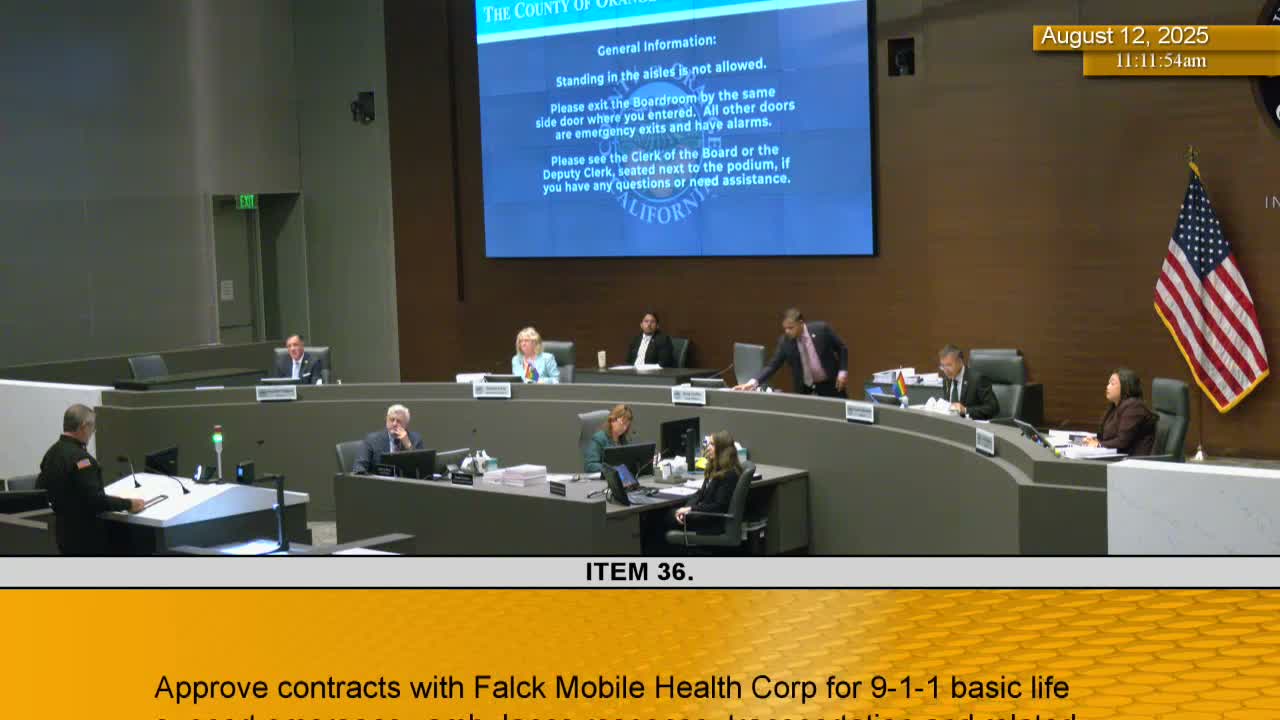
Orange County supervisors on Aug. 12 voted to accept staff’s recommendation to award five exclusive operating-area ambulance contracts for 9‑1‑1 basic life‑support service to FALC Mobile Health Corp., a decision that followed more than three hours of public comment and board deliberation.
The board’s action concluded a contentious hearing in which local fire leaders and other speakers urged supervisors to consider a public‑private ‘‘alliance’’ model led by the Orange County Fire Authority (OCFA) that supporters say could bring tens of millions of federal matching dollars into county emergency medical services. ‘‘OCFA emergency is the better option,’’ a speaker representing the fire authority said during public comment, arguing the partnership would return federal funds to local EMS innovations.
Falcon (FALC) representatives and organized‑labor advocates defended the county’s procurement process and the staff evaluation, and said FALC scored highest in every exclusive operating area. ‘‘Our proposal distinguished itself through comprehensive approach, innovative solutions, and a proven track record of excellence,’’ a FALC executive told the board.
The debate centered on two questions: whether the county could — or should — favor the OCFA alliance on the basis of anticipated federal ground emergency medical transportation (GEMT) match funds, and whether doing so would expose the county to state review or legal challenge from the Emergency Medical Services Authority (EMSA). OCFA supporters cited estimates ranging from roughly $35 million to as much as $80 million over five years if a public‑provider model were adopted for some or all zones; Whitman Enterprises, a billing consultant, presented modeled estimates and described how GEMT retroactive payments can flow once state processes are approved. HCA staff and county counsel told the board those potential sums were uncertain and that the RFP as approved by EMSA constrained the county’s discretion.
Supervisor Katrina Foley said she favored considering a public‑private model that could channel additional revenue into EMS, but she acknowledged the board faced legal and procedural limits given how the RFP had been written and approved by the state. County counsel advised that deviating from the highest‑scoring proposer would invite litigation unless the board could document a clear, defensible flaw in the procurement record.
After public testimony from labor leaders, OCFA officials, other ambulance providers and residents and a lengthy staff Q&A about EMSA rules and GEMT mechanics, Chair Chaffee moved to approve the staff recommendation. The motion carried with four votes in favor and one abstention; the board recorded the outcome and directed staff to continue communications with EMSA and to return to the board with options for future solicitations.
Next steps: HCA will finalize contract documentation under the board’s direction and remain in contact with state regulators about any changes needed for implementation. Supervisors asked staff to explore whether a shorter-term contract or an earlier re-solicitation could be feasible in future cycles to preserve flexibility for models that might produce additional federal revenue.
Vote at a glance: board approved staff recommendation to award contracts to FALC Mobile Health Corp.; roll call recorded four yes votes and one abstention. The board also directed staff to seek additional guidance from EMSA on timing and options for future RFPs.
Context: The hearing drew competing claims about potential federal funds and system resilience. Supporters of the OCFA alliance described co‑located dispatch, shared station resources, and possible GEMT uplifts that could be reinvested in paramedicine; opponents warned that the state’s EMSA must approve deviations from a highest‑scoring award and that the promised federal sums were not guaranteed or immediately available.