Get Full Government Meeting Transcripts, Videos, & Alerts Forever!
Get email alerts on the Education topic
No spam. Unsubscribe anytime.
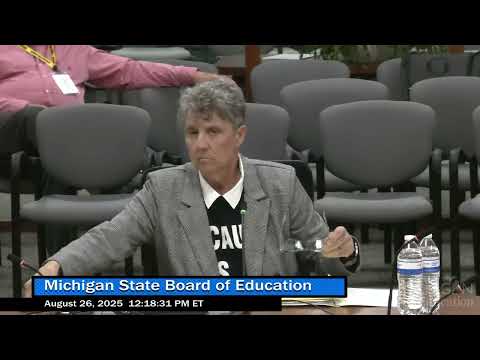
Dr. Judy Walton pitches relationship-first leadership, a literacy 'menu' and tighter school-safety oversight in Michigan superintendent interview
Summary
At a midday State Board of Education interview, Dr. Judy Walton emphasized relationship-building, a 'trust first' leadership style, proposing a menu of science-of-reading resources, expanded reading specialists for older students, supports for special-education and foster youth, and a review of emergency operating plans and liability standards.
Dr. Judy Walton, a finalist for Michigan superintendent of public instruction, told the State Board of Education at a midday interview that she would lead by building relationships and listening first, then quickly address written and operational priorities in the Michigan Department of Education (MDE).
"Because kids" is the motivating line Walton offered about her candidacy, describing classroom- and community-level engagement as central to how she would gather information and set priorities. She said she grants trust from the outset: "You don't have to earn my trust. I grant trust from the beginning," Walton said, framing that philosophy as a way to surface varied staff experiences and build collaboration across MDE.
Why it matters: Walton presented a practical, staff-focused approach to a department that oversees roughly 1.4 million students. Her pitch combined teacher-and-student-facing proposals (classroom shadowing, a literacy resource menu) with system-facing priorities (clear metrics, interagency coordination and attention to school safety and liability).
Key policy proposals and specifics
- Literacy: Walton said the state should offer "a menu of choices" of approved, research-based "science of reading" resources for districts to adopt rather than a single mandated program. She urged funded professional learning so teachers acquire reading-specific credentials and recommended monitoring the state's dyslexia screening and adding reading specialists above the elementary grades to help older students who cannot read.
- Special education and foster youth: Drawing on personal family experience, Walton described the practical dilemma some families face when diploma rules interact with age‑26 service eligibility. She advocated expanding awareness and use of existing options (personal curricula and credit recovery), increasing work‑based learning opportunities for students with IEPs and focusing on chronic absenteeism and student engagement as major drivers of lower graduation rates.
- School safety and emergency plans: Asked about Oxford High School and the adequacy of Emergency Operating Plans (EOPs), Walton said ensuring each district has a clear, regularly updated EOP is essential. "A good EOP is important," she said, adding she believes many districts use state or state‑police templates and that plans should be updated and exercised; she also said she would consult legal and insurance experts before endorsing changes to governmental-immunity standards.
- Workforce: Walton prioritized 'grow-your-own' programs, local partnerships and targeted incentives (including loan-repayment models) to recruit teachers, paraprofessionals and related professionals such as school psychologists. She noted the state has made licensing out‑of‑state teachers easier in recent years and proposed extending incentives and certification support to other high‑need roles.
- Equity, funding and interagency work: Walton repeatedly tied school challenges to broader community conditions — housing, transportation and health care — and advocated using targeted private partnerships, clearer strategic metrics, and cross-sector 'bundling' of services rather than siloed programs.
Quotes and exchanges
- On scaling from a small district to statewide leadership: Walton said her combined career as a trial attorney, teacher and district central-office leader equips her to translate local lessons to statewide strategy: "My skills are portable as well."
- On accountability and law: When pressed about modifying immunity standards so families could seek redress after catastrophic events, she said she would study standards such as gross negligence versus negligence and consult the law and insurers before taking a position.
Authorities and statutory context cited in the interview included PA 146 and PA 147 (literacy-related public acts), references to the Michigan Merit Curriculum and statewide assessments used for interstate comparisons such as NAEP; Walton cautioned against relying on single-data‑point comparisons between states.
What Walton proposed next if selected: be visible across regions, institute regular two-way communication with the legislature and governor's office, and deploy both qualitative listening (one-on-one meetings and anonymous staff surveys) and clear public metrics tied to the strategic plan.
Process note: The interview included questions from multiple State Board members about scaling leadership, literacy policy, school safety, special education, workforce recruitment and early-childhood coordination. No board decision or vote took place during the session; the board recessed briefly and continued the interview schedule.
Ending: Walton closed by identifying herself as a native Michigander and reiterating the goal of choosing leadership that produces different results: "If we want different results, we need to do different things." She thanked board members for the opportunity.