Get Full Government Meeting Transcripts, Videos, & Alerts Forever!
Get email alerts on the Education topic
No spam. Unsubscribe anytime.
State board advances three finalists for Michigan superintendent search
Summary
The Michigan State Board voted to advance a three-person slate of finalists for second-round interviews in the state superintendent search after board members ranked candidates and debated whether to bring back three or four candidates; special education leaders urged the board to prioritize students with disabilities during selection.
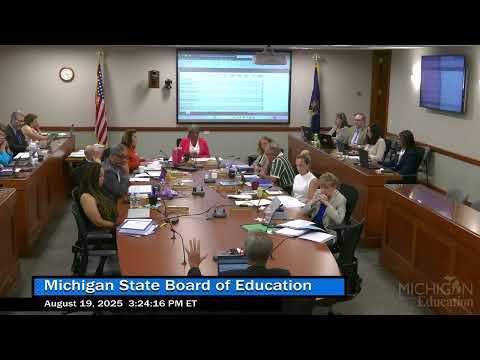
The Michigan State Board of Education voted to advance a three-person slate of finalists for second-round interviews in its search for the next state superintendent, the board announced after a roll-call vote Monday.
The motion to present a slate of finalists — Glenn Malayko, Judy Walton and Lisa Coombs — was moved from the floor and carried after members recorded their votes. Pollock, Lipton, Pritchett, Pugh, Robinson and Tilly voted yes; McMillan voted no; Snyder passed. The board directed its search consultant, HYA, to notify the candidates who will advance and to help schedule the second-round interviews.
The vote capped an extended discussion about how many finalists to invite back for deeper interviews. A representative from HYA outlined a transparent ranking system for the board: members may select up to three candidates (or fewer), with optional rank-order scoring (first choice 5 points, second 3, third 1) used to narrow the field. Some board members urged inviting a fourth finalist to preserve representation and broaden comparison; others said three finalists is the customary minimum to reduce the risk of late dropouts.
Public comment earlier in the meeting emphasized special education priorities. Abby Seifer, executive director of the Michigan Association of Administrators of Special Education, told the board the association ‘‘believes all students are general education students and that students with disabilities deserve high quality instruction and equitable access to the opportunities Michigan’s educational system provides.’’ She urged the board to make inclusive excellence and protections under the Individuals with Disabilities Education Act a central part of the superintendent search and offered suggested questions for follow-up interviews.
Board members described the second round as less scripted and more conversational, with time for candidate presentations and on-the-spot questioning. The board asked staff and HYA to propose interview logistics and possible presentation topics; members discussed whether the second round should be one or two days.
The board will notify finalists of next steps and availability; no final appointment was made at the meeting. The slate advanced by the vote will return for deeper interviews before any final selection.
The board adjourned at 3:59 p.m.