Get Full Government Meeting Transcripts, Videos, & Alerts Forever!
Get email alerts on the Literacy LETRS topic
No spam. Unsubscribe anytime.
Board hears literacy-implementation update and contentious debate over mandatory LETRS training and vendor influence
Summary
MDE told the board it had awarded Section 35m grants to 561 districts and advanced 39 Section 35n applicants; staff urged a mandatory LETRS training requirement and increased literacy funding while board members debated vendor influence, local control and program trade-offs.
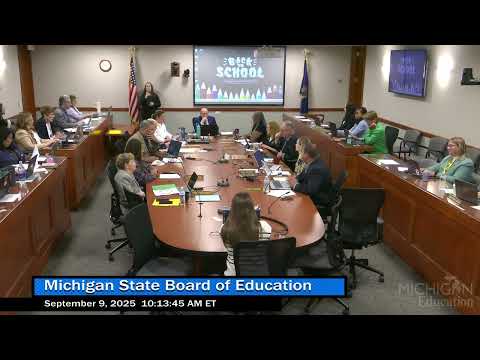
The Michigan Department of Education briefed the State Board on implementation of Public Act 146 (K–12 literacy/dyslexia law) and related grants on Sept. 9, reporting award and timeline details and advancing legislative recommendations, including a proposal to make LETRS professional development mandatory for early-literacy educators.
Denisha Rawls Smith and literacy unit staff said MDE received 561 Section 35m applications and that every applying district was awarded funds: 370 awards for Tier 1 curriculum, 63 for intervention materials and 129 for professional development. Districts were notified of award amounts on Aug. 8, 2025; budgets are due Sept. 19 and payments are expected in October state-aid disbursements. For Section 35n (competitive grants), the department received 115 applications and advanced 39 applicants to the next phase; winners will be named in the coming weeks.
Under Public Act 146, the department sent certified letters to parents/guardians of third-grade students who scored not proficient on the M-STEP to inform families of rights, next steps and options for interventions.
MDE presented four legislative priorities tied to literacy implementation: mandatory LETRS training for K–5 early literacy educators, class-size reduction in high-poverty K–3 classrooms, doubling the FY2025 $87 million one-time allocation for early-literacy materials, and reducing policies that diminish in-person instructional time (professional-development days and permitted virtual days).
The board’s discussion grew heated over LETRS and its primary vendor relationships. Board member Tom McMillan raised concerns that Lexia (a vendor associated with LETRS implementation and materials) is connected to large private-equity ownership and suggested that mandating LETRS could advantage corporate providers; he also cited studies questioning whether training alone produces statistically significant student-score gains and argued for preserving local control and options.
Denisha Rawls Smith responded that LETRS training is curriculum-agnostic: the training teaches the science of reading and can be applied to whatever curriculum a district already uses. Other board members pushed back on McMillan’s characterization and pointed to multiple curricula and vendors on the committee’s review list; some members stressed urgency to scale proven training given the state’s literacy needs, while others warned against funneling public dollars to a single provider.
Presenters reiterated implementation supports (technical assistance through the MyMTSS TA Center), coaching and that some districts have expedited LETRS completion timelines using local funds. The board recessed for lunch at noon; public comment on the standards and literacy items will be taken at the public-participation period.