Get email alerts on the Class Size Policy topic
No spam. Unsubscribe anytime.
State Board Backs Class-Size Limits, Rejects Amendment to Shift Burden to District Administration
Summary
The State Board adopted a resolution calling for statutory class-size caps (K–3: no more than 20 students; grades 4–8: no more than 23; grades 9–12: no more than 25) and urged prioritizing FY 2026 funding to help high-poverty schools hire teachers; an amendment to direct districts to reduce administrative costs failed in committee vote.
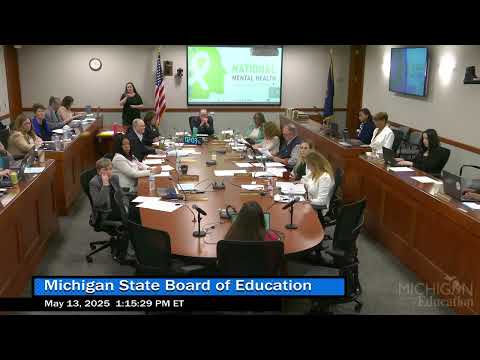
The Michigan State Board of Education adopted a resolution urging the legislature and the department to prioritize funding so high-poverty schools can lower class sizes, and it recommended specific caps for core classes by 2030–31.
Doctor Robinson read the resolution into the record, citing research showing smaller class sizes lead to better outcomes and noting that large classes are disproportionately concentrated in higher-poverty and urban districts. The resolution calls on the legislature to provide the funding necessary for schools to reach the proposed caps: no more than 20 students per class in grades K–3, no more than 23 in grades 4–8, and no more than 25 in grades 9–12, with reasonable exceptions for physical education, performing arts, CTE and other specialist settings.
Board member Tom McMillan proposed an amendment that would replace a board call for legislative funding with a requirement that "school districts reduce administrative costs to ensure schools are able to lower class sizes." Supporters of the amendment cited national data alleging non‑instructional staffing grew faster than classroom staffing in recent decades; opponents said the proposal oversimplified complex local constraints, including building capacity and principal workload.
The board held a roll-call vote on the amendment; it failed (Yes votes: McMillan, Snyder; No votes: Lipton, Pritchett, Pugh, Robinson, Tilly). The full resolution then passed on a roll-call vote: Lipton Yes; McMillan No; Pritchett Yes; Pugh Yes; Robinson Yes; Snyder Yes; Tilly Yes.
Board members debating the omnibus text emphasized the practical challenges of reducing class sizes — including the need for facilities and teacher hires in places already at capacity — while noting the equity rationale for prioritizing high-poverty schools. One board member noted that some districts are physically unable to add classrooms without additional infrastructure investment.
What’s next: The resolution is a policy statement urging legislative action and departmental guidance; it does not itself create statutory limits. Implementation would require funding, local facility capacity, and district-level planning.
The resolution passed during the same meeting that included presentations on literacy funding and other budget proposals.
AI generated
The text on this page is AI generated. Summaries, highlights, analysis, and video transcripts are all produced from the original source material.
AI can make mistakes, so if you spot one, and we will fix it for everyone.
Note: the source content is unaltered by us. Any content source we link to, be it a video, an audio recording, or a document, is presented exactly as its publisher released it. That publisher is usually a government body, sometimes an individual official or another organisation.