Get Full Government Meeting Transcripts, Videos, & Alerts Forever!
Get email alerts on the Health Education Standards topic
No spam. Unsubscribe anytime.
Michigan board reviews major overhaul of K–12 health education standards
Summary
State Board of Education staff presented a proposed rewrite of Michigan’s K–12 health education standards that shifts from grade-level standards to six practice-based competencies, adds topics such as healthy relationships and community health, and reiterates statutory parental safeguards for optional sexual-health instruction. Public comment period to follow.
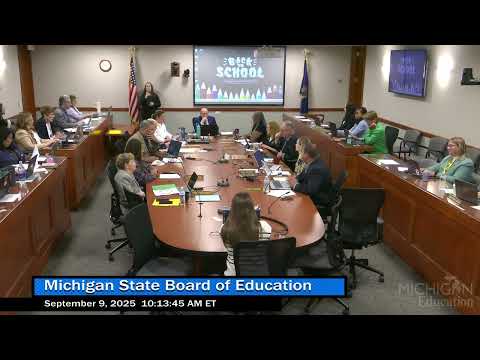
State education officials on Sept. 9 outlined a proposed revision to Michigan’s K–12 health education standards that shifts the framework from grade-specific standards to six practice-based competencies and updates topic names and organization.
The Michigan Department of Education told the State Board that the draft uses grade spans (K–2, 3–5, 6–8, 9–12) rather than single-grade standards, reframes 'standards' as practices emphasizing skills and processes, and embeds core content within those practices. The six practices are listed as self-awareness and analyzing influences; social awareness, relationships and communication; information and resource seeking; decision-making and problem solving; self-management and goal setting; and advocacy and health promotion.
Presenters said the department used the 2024 national health education standards and a Massachusetts template as a baseline, reviewed the draft in two rounds with content experts and larger stakeholder groups, and made edits to reflect Michigan’s context. Topic-name changes include "balanced eating and physical activity" (previously "nutrition and physical activity") and a re-labeling of social-emotional health to "mental and emotional health." The draft also adds healthy relationships and community and environmental health as discrete topics.
MDE staff emphasized this is an informational presentation; public comment will be taken during a coming comment period and the department plans to return with a final draft and request for approval at a later meeting.
Board members pressed presenters on implementation details. One member asked for a crosswalk showing exact changes from the 2007 standards; presenters said there is no granular crosswalk because the revision draws primarily from the national and Massachusetts standards rather than the 2007 text. Members raised questions about how students would learn to identify trusted adults and how the standards address social media and misinformation; presenters said the practices emphasize critical thinking and resource evaluation so the language will remain relevant as technology changes.
The board also discussed statutory constraints tied to optional comprehensive sexual-health instruction. Presenters reminded the board that Michigan law requires communicable-disease instruction (including HIV) beginning in elementary grades, allows districts to offer optional sex education with protections for parent review and opt-outs, requires a local advisory board (SEIB) with majority parent membership to review curricula, and prohibits inclusion of abortion in family‑planning lessons if districts choose to teach sex education.
The department will accept public comment on the draft beginning this week, incorporate feedback as appropriate, and return to the board with a final version at a future meeting.