Get Full Government Meeting Transcripts, Videos, & Alerts Forever!
Get email alerts on the State Superintendent Interview topic
No spam. Unsubscribe anytime.
Dearborn Superintendent Glenn Malayko outlines literacy, equity and school‑safety priorities in State Board interview
Summary
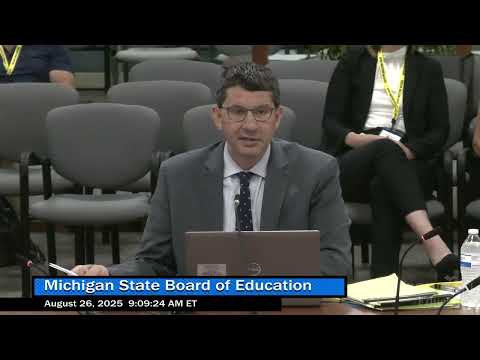
In a Aug. 26 special meeting, the Michigan State Board of Education interviewed Dearborn Public Schools Superintendent Dr. Glenn Malayko as one of three finalists for state superintendent. Malayko emphasized an entry plan of listening and relationship building, literacy initiatives, equity‑focused funding advocacy, ISD collaboration, school safety protocols and expanded mental‑health supports.
Lansing — Dearborn Public Schools Superintendent Dr. Glenn Malayko told the Michigan State Board of Education on Aug. 26 that his entry plan as state superintendent would center on "listening, learning, relationship building" and an aggressive push on literacy, equity in school funding and student safety.
Malayko, one of three finalists for state superintendent, opened his 10‑minute presentation by saying he would meet MDE staff, local superintendents and community stakeholders to refine the department's top priorities. "I'm gonna start with listening, learning, relationship building as a theme in the beginning," he said, adding that he makes "well over 400 school visits a year." He later summarized his professional priorities as "humility, urgency, partnership, listening ... grounded in decisions and data."
Why it matters: Board members framed the interview around statewide problems — Michigan's low NAEP reading scores, an ongoing debate over adequacy versus equity in school funding, school‑safety concerns and uneven special‑education capacity across districts. The board repeatedly pressed Malayko on how his Dearborn experience would translate to oversight of more than 1.4 million students across 800‑plus local systems.
On literacy, Malayko said Dearborn long has implemented many elements of Michigan's dyslexia and literacy laws and would promote statewide adoption of evidence‑based instruction and teacher training. "We were doing [this] prior in Dearborn," he said, pointing to a local Teacher Reading Academy and LETRS training. Asked how he would be independent from associations, he said, "I am my own person and my beliefs... I'm all about students." He also supported universal screeners and literacy coaching.
Funding and equity: Board members pressed Malayko about the School Finance Research Collaborative (SFRC) and whether he would advocate for the equity‑focused funding it recommends. Malayko said he had promoted the SFRC report in Dearborn and supports moving toward more equitable, adequacy‑oriented funding, while acknowledging the ultimate authority for budget changes rests with the Legislature and governor. He described using multiple contingency budget plans to prepare for possible federal funding reductions.
School safety and a Dearborn incident: When board members raised a specific incident that drew media attention in Dearborn, Malayko said he had publicly stated the matter "was not" the sexual‑assault reporting initially circulating on social media, and he emphasized collaboration with law enforcement and internal investigations. He said the district created an "incident report system" to inform the board more quickly when social media generates misinformation. Malayko affirmed he supports a zero‑tolerance stance on sexual assault and said victims were given supports.
On governmental immunity and emergency plans: In response to questions about the Oxford school shooting and whether districts should face narrower immunity in cases of death or serious injury, Malayko backed regular Emergency Operating Plan (EOP) reviews and said he would "study the issue" with legal counsel before advocating statutory changes on immunity. "If there's negligence, districts should be held accountable," he said, while stopping short of committing to specific legislative proposals without legal study.
Special education and discipline: Malayko described using restorative practices and leveraging ISD partnerships to reduce suspensions and improve special‑education supports. He said Dearborn uses co‑teaching models and works with ISDs to provide specialized services and professional development when districts lack capacity.
ISD collaboration and school choice: Asked how MDE could "leverage" Intermediate School Districts (ISDs) statewide, Malayko said ISDs can share services (literacy coaches, training) and that he would examine statutory constraints and stakeholder input. He said parental choice is important but emphasized that MDE must support all students regardless of the governance model.
Rural CTE and mental health: On access to career and technical education in rural areas, Malayko favored partnerships with colleges, ISDs and private providers and shared‑service models. On behavioral health, he highlighted Dearborn's expansion of social workers and contracts with referral services to connect students to therapists and wraparound supports.
Closing: Malayko closed by stressing his career of working in a large, diverse district and citing Dearborn outcomes: a stated 95 percent graduation rate and a 72 percent college‑going rate. "If you hire me, you're gonna see me always bringing it back to what is the impact on students," he said. The board recessed for lunch and planned to reconvene for subsequent interviews and deliberations.
What’s next: The board is scheduled to hear the remaining finalists and then deliberate on a selection. The meeting included an explanation of how members of the public could register for comments later in the day.