Get Full Government Meeting Transcripts, Videos, & Alerts Forever!
Get email alerts on the Special Education Standards topic
No spam. Unsubscribe anytime.
State Board Approves New Special-Education Teacher Preparation Standards Over One Dissent
Summary
The Michigan State Board of Education voted 6–1 to adopt new statewide preparation standards creating a stand‑alone special-education teacher endorsement intended to broaden the pipeline, increase reciprocity with other states and emphasize cross‑cutting instructional skills; implementation steps and timelines were presented by MDE staff.
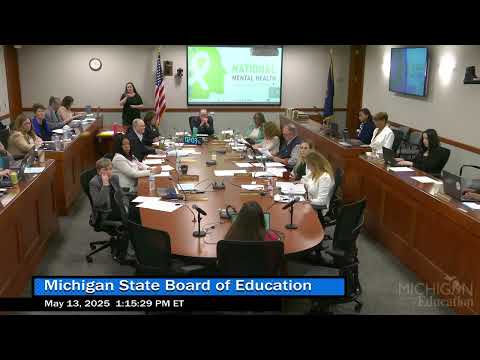
The Michigan State Board of Education voted to approve a new set of special-education teacher preparation standards after a day of public comments and extended discussion.
Supporters, including higher-education faculty and local superintendents, told the board the standards are designed to increase the number and readiness of special-education teachers statewide. "These standards will help us to assure that our Michigan children will receive the best education informed by local, state, and national best practices," said Heather Eckner, statewide director of education for the Autism Alliance of Michigan, during public comment.
The board heard that the standards were developed by a stakeholder committee that aligned Michigan’s proposal with the Council for Exceptional Children’s practice-based professional preparation standards. MDE staff told the board 128 individuals completed the public-comment survey representing 31 counties and 43 districts, and that 80 percent of respondents expressed support for the proposed standards. Presenters said the new endorsement is intended as an additional, stand‑alone option that would not remove existing specialty endorsements.
Opponents on the board raised concerns about reducing deep specializations. "I’m just gonna be open and honest about not supporting these standards," said board member Snyder, who argued that moving away from specialized endorsements risks losing expertise needed for complex placements.
MDE presenters responded that the standards retain current endorsement areas and aim to teach high‑leverage, cross‑categorical practices so teachers can support students across multiple eligibility areas. They also outlined next steps and timing, saying any rule changes to implement the endorsement could take roughly 18 to 24 months, that a Michigan teacher certification test aligned to the new standards could take about three years to develop, and that preparation programs could begin admitting cohorts after the board’s approval (presenters estimated program approvals could begin in April 2026 and first newly endorsed teachers might enter classrooms by spring 2028).
Doctor Pritchett moved approval, Miss Tilly seconded, and the board approved the proposal on a roll-call vote: Lipton Yes; McMillan Yes; Pritchett Yes; Pugh Yes; Robinson Yes; Snyder No; Tilly Yes.
What’s next: MDE will determine whether administrative-rule development is needed, begin technical assistance for higher-education providers that wish to offer the endorsement, and move to create aligned certification assessments and implementation guidance for districts.
The vote followed extensive public comment from parents, educators and higher-education faculty and closed a multi‑step process of committee drafting, targeted feedback and public comment that MDE presented to the board during the meeting.