Get Full Government Meeting Transcripts, Videos, & Alerts Forever!
Get email alerts on the Education Policy topic
No spam. Unsubscribe anytime.
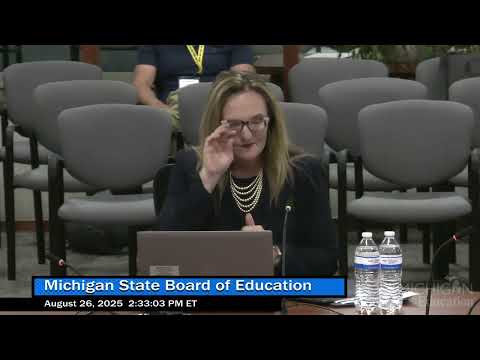
Finalist Lisa Koons tells Michigan board she would prioritize literacy, attendance and teacher pipelines
Summary
In her interview with the Michigan State Board of Education, Dr. Lisa Koons laid out an entry plan focused on a statewide 'listen and learn' process, implementation of evidence‑based literacy policies, an attendance task force and grow‑your‑own teacher pipelines; she cited prior results in Virginia including a 3.1% drop in chronic absenteeism.
Dr. Lisa Koons, a finalist for Michigan state superintendent, presented an entry plan that centers on three overlapping phases — "listen and learn," "analyze and share," and "plan and implement" — and three critical focus areas: early literacy, student attendance and the educator pipeline.
Koons said the listening phase would begin in October 2025 if she is selected and include one‑on‑one conversations with board members, the governor’s office, state budget staff, ISD leaders and other stakeholders. She proposed school learning tours led by regional teachers of the year, stakeholder roundtables, an online feedback survey and an internal staff questionnaire to surface regional differences and promising local practices.
"Every child every day as a center," Koons said, summarizing her approach to listening and tailoring implementation to local contexts. She called for an implementation playbook to scale classroom practices and for a weekly newsletter to build relationships across districts.
On literacy, Koons described PA 146 as a "complex, comprehensive law" that addresses materials, assessment and coaching and said PA 147 presents an opportunity to strengthen higher‑education preparation of new teachers. She emphasized the "science of reading," coaching and the need to close the gap between statutory frameworks and classroom implementation so both new and veteran teachers can teach literacy effectively.
On attendance, Koons proposed an attendance task force composed of local stakeholders and communication toolkits for districts. Citing her prior work in Virginia, she said 86% of participating schools improved attendance locally, the state saw a statewide 3.1% reduction in chronic absenteeism in one year and her office reported the equivalent of 9,000,000 additional student hours of attendance. "Attendance is access and opportunity," she said, calling it a leading indicator of students’ ability to learn.
To address teacher shortages, Koons advocated paid grow‑your‑own apprenticeships, high‑school CTE pathways into teaching, paraprofessional pipelines and principal mentoring programs to improve retention. "Paying teachers while they’re going" through preparation, she said, reduces economic barriers and helps retain educators five years into the profession.
Koons repeatedly emphasized tailoring strategies to Michigan’s diversity — urban, suburban, rural and Upper Peninsula contexts — and committing to evidence‑based pilot programs and transparent monitoring of costs and outcomes. She closed by asking the board to prioritize implementation coherence across districts and support sustained investments tied to measurable targets.
The board will continue its selection process; public comment was scheduled to follow the interview session.