Get Full Government Meeting Transcripts, Videos, & Alerts Forever!
Get email alerts on the School Funding topic
No spam. Unsubscribe anytime.
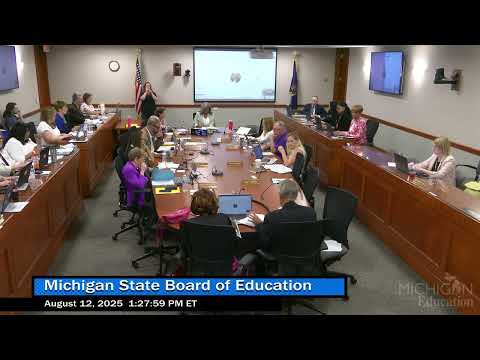
Board hears fiscal-year 2026 budget comparisons, flags risks of rolling categoricals into block grant
Summary
MDE presented FY26 comparisons of the governor, Senate and House proposals, warning the House's section 22f block grant would roll many targeted categoricals into per-pupil funding and could dilute supports for English learners, special education and rural transportation; board members pressed on equity, school meals and literacy priorities.
Department officials presented a comparative review of three FY26 budget proposals — the governor’s executive recommendation, the Senate version and the House proposal — and framed the discussion around Michigan’s Strategic Education Plan Goal 8: adequate and equitable school funding.
Diane Golczynski, deputy superintendent for business, health and library services, and Olivia Ponte, legislative liaison, told the board the House plan leans toward a section 22f block grant that rolls dozens of categorical line items into a per-pupil payment. The department warned that consolidating funding for programs such as English learners, special education equalization and bilingual education into a single per-pupil payment could “water down” supports that serve students with different needs and that some programs are administratively best managed at the state level. The presenters cited examples and line-item differences: the House’s inclusion of 22f raised per-pupil amounts for some sectors (the House’s per-pupil figure for cyber charters was discussed at roughly $10,000 versus about $8,000 in other proposals); the governor proposed $150 million for consolidation and demolition; the House proposed about $286.5 million for consolidation and infrastructure with expanded allowable uses; and the FY25 appropriation included $87 million for early literacy materials that the department recommended doubling for FY26 to support full implementation of recently passed literacy laws (PA 146 and 147).
Board members pushed on how 22f would work in practice. A board member asked whether districts would still be able to meet federal or state requirements if funding were rolled into a per-pupil amount; presenters said federally required programs (for example, state assessments) cannot be waived by districts and cautioned against rolling federally mandated line items into discretionary local spending. Questions also addressed transportation funding for rural districts, special-education equalization, and whether districts and local associations had weighed in; the department said a coalition of education organizations had sent a letter and that some grants that impose heavy administrative burdens could be candidates for roll-up, while others that serve distinct student populations should remain targeted.
On school meals, presenters reminded the board that the FY25 budget included a Michigan School Meals provision (section 30d) that funds universal meals through Sept. 30; districts, facing budget uncertainty, may be deciding whether to change local practices (Okemos was cited as an example of a district that pulled out of community eligibility), and the department advised against precipitous changes. Presenters also noted MDE’s small administrative footprint — roughly 1% of state FTEs administering about 25% of the state budget — and that the House proposed cutbacks in MDE FTE and funding that the department characterized as disproportionate.
The department summarized four literacy recommendations for the legislature that can be accomplished through budget and policy: mandatory LETRS training for K–5 teachers in relevant specialties, targeted funding to support low class sizes in high-poverty K–3 classrooms (the Senate proposed incentives and a $65 million pool), more funding for high-quality early literacy materials, and increased in-person instructional time (the department and multiple board members said current law allows too many non-instructional days to count as instruction, and both the House and Senate proposed reducing virtual days counted toward instruction from 15 to 7).
Board members and the chair emphasized the policy stakes: several members said rolling categoricals into a block grant would reduce transparency and equity, and they urged the legislature to preserve funding targeted to students with higher costs. The board requested continued briefings as budget negotiations progress.