Get Full Government Meeting Transcripts, Videos, & Alerts Forever!
Get email alerts on the Library Funding topic
No spam. Unsubscribe anytime.
State librarians warn MeL and MeLCat services face risk if federal IMLS funding is cut
Summary
State and local library leaders told the State Board that proposed elimination or reduction of the Institute of Museum and Library Services would jeopardize MeL databases, MeLCat interlibrary loan and delivery services that rely on roughly $4.8 million in federal LSTA funds for Michigan.
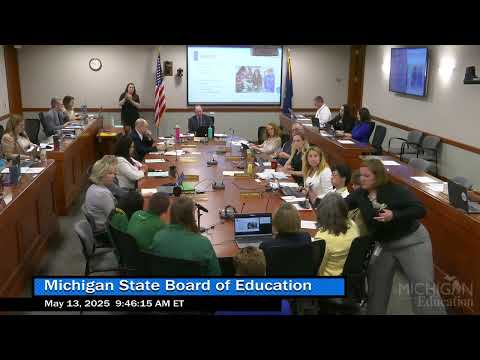
State and local library leaders told the State Board of Education on May 13 that proposed cuts to the Institute of Museum and Library Services (IMLS) and related LSTA funding would threaten statewide electronic resources (MeL) and the MeLCat interlibrary-loan catalog.
Randy Riley, State Librarian, said an executive order calling for elimination or curtailment of IMLS functions has created significant uncertainty. Riley said Michigan’s LSTA (Library Services and Technology Act) allotment is about $4.8 million a year and that those federal dollars support MeL databases, MeLCat operations and subgrants to local libraries. "If you look at IMLS funding nationally...the whole agency gets about $294,000,000," Riley said, and he warned that zeroing out IMLS would make it very hard to sustain current statewide services.
Riley described MeL as the state’s e-content collection (about 80 databases) with roughly $3.5 million in content costs, MeLCat as a catalog of about 440 participating libraries with about $1.3 million in costs, and delivery services that circulate more than a million items a year costing about $1.1 million. He said these services produced large usage—tens of millions of article downloads and millions of circulations—representing a high return on investment for the state.
Glenn Fisher (DeWitt District Library) and Larry Neal (Clinton Macomb Public Library) told the board how small and mid-size libraries depend on MeL databases and MeLCat to serve patrons who cannot otherwise access specialized content or expensive texts. Neal said MeLCat converts his library’s 700,000-item collection into access to more than 34 million items statewide; patrons in his community use MeL for academic journals, test-prep, and vocational resources.
Board members asked whether state funding could replace federal funds; presenters said state substitution would be difficult to scale and that small rural libraries would be most vulnerable. Directors asked the board to advocate for preserved federal support or state funding alternatives to avoid proportional losses to small libraries and communities that rely on shared resources.
The presentation was informational; no board action was taken.