Get Full Government Meeting Transcripts, Videos, & Alerts Forever!
Get email alerts on the School Meals topic
No spam. Unsubscribe anytime.
Board hears expansion and summer-feed plans for Michigan School Meals; budget and farmer partnerships under discussion
Summary
State education officials and Utica Community Schools described Universal Meals and three summer-feeding programs, reporting big participation increases and $200 million in state reimbursements while noting federal funding and farmer partnership questions remain.
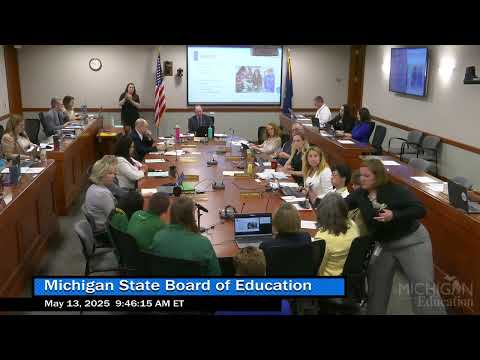
State education officials told the State Board of Education on May 13 that Michigan’s Universal Meals program and summer feeding efforts have significantly increased participation and drawn additional federal support, but officials and board members warned that federal budget uncertainty threatens some related farmer partnerships.
Diane Golczynski and Diane Kelleher of the Michigan Department of Education outlined the Universal Meals (Healthy School Meals for All) program, saying the initiative provides one breakfast and one lunch at no cost to all K–12 public-school students. Presenters said the program is funded primarily with federal reimbursements (approximately 75% of the total) supplemented by state appropriations; MDE noted the 2024–25 state budget included $200,000,000 for state reimbursements to schools.
Kelleher said the expansion has increased daily participation by about 115,000 breakfasts and nearly 180,000 lunches and that increased participation brought roughly $20,000,000 in additional federal funds to purchase U.S.-grown products to serve in school meals. She said the state’s 10¢-a-meal program helps link local farmers to school purchases and described some local successes.
Officials also described three USDA summer programs: Meet Up & Eat Up (on-site congregate meals), Meals to Go (rural take-home packs, launched in 2023) and Sun Bucks (Michigan Summer EBT administered by the Michigan Department of Health and Human Services in partnership with MDHHS and MDE). A presenter said Sun Bucks provides electronic benefits of about $120 per eligible child (as stated in the presentation) and that benefits remain available for roughly 122 days after issuance.
Mandy Sosnowski, director of food and nutrition services at Utica Community Schools, described menu diversification, local-farm sourcing and labor impacts: UCS reported a 63% increase in breakfasts and 69% increase in lunches served and said the program allowed hiring more food-service staff and offering higher wages. Sosnowski highlighted mobile summer distribution sites that deliver meals directly to apartments and trailer communities.
Board members praised the program’s elimination of stigma and its nutrition and attendance benefits but pressed officials about long-term funding and the mechanics of farm partnerships. The presenters said the 10¢ program is state-funded and continues, but noted ongoing federal budget uncertainty; they urged board advocacy if federal support is reduced.
This presentation was informational; there was no board vote on program funding at the meeting.