Get Full Government Meeting Transcripts, Videos, & Alerts Forever!
Get email alerts on the Teacher Workforce topic
No spam. Unsubscribe anytime.
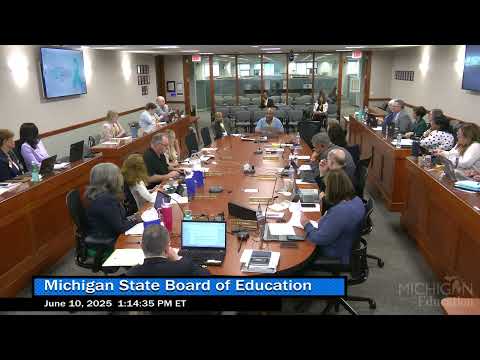
State Board hears large portfolio of teacher recruitment, retention investments as part of Goal 7
Summary
Michigan Department of Education officials briefed the State Board on Goal 7 of the Top 10 strategic plan, detailing scholarships, grow‑your‑own grants, apprenticeship funding, mentoring investments, loan repayment, and targeted rural credentialing to increase the number, quality and diversity of certified teachers.
The State Board of Education received an informational briefing on Goal 7 — increasing certified teachers in shortage fields — that outlined a package of state investments and program changes intended to boost recruitment, preparation and retention.
Presenters described a multi‑year pattern in teacher preparation enrollment: a large decline in the early 2010s followed by a rebound; initial certificate issuance is rising, driven primarily by completers of Michigan‑approved programs. Officials said the data presented were current through April 21, 2025, and do not yet include spring graduates.
The department highlighted several programs: the My Future Educator Fellowship (My LEAP), which provides scholarships up to $10,000 annually to candidates who commit to teach in Michigan public schools; a $9,600 per‑semester student‑teacher stipend; Grow Your Own (Section 27b), a $175 million multiyear grant to help school staff earn certification; Talent Together, a $66.4 million apprenticeship‑style pathway for working staff; and a mentoring and induction investment that totals $50 million under Section 27h. Officials said the mentoring portfolio includes a $500,000 materials grant awarded to Western Michigan University and a $500,000 evaluation grant to the American Institutes for Research, with baseline data collection beginning October 2025 and a final report due September 2027.
The department also described a $225 million student loan repayment allocation (Section 27k) first funded in fiscal year 2024; as of fiscal year 2024 the department had distributed more than $21 million to over 9,000 school staff across 553 districts. Presenters said the Grow Your Own grants reached more than 1,600 staff in locally designed programs with 28 preparation partners, and Explore grants (a $1 million program) have reached dozens of districts and hundreds of schools.
Board members asked detailed questions about grant demand and program timelines. One member noted 370 applications requesting roughly $43 million against an initial mentoring allocation spread across multiple years; presenters confirmed the mentoring fund is structured as multiyear intent language and that additional funding would be required to meet full applicant demand. On MTTC test fee reimbursements, presenters said the program refunds the registrant's original payment after test completion and that a vendor‑provided free practice test is available at registration.
Board members also urged attention to working conditions and class size as retention factors. "A 30‑year veteran has skills and backgrounds that we can't afford to miss," a board member said during the discussion, underscoring that recruitment and induction are only one side of addressing shortages.
The board took no formal action; presenters said they will continue to update the board as program evaluations and application rounds progress.