Get Full Government Meeting Transcripts, Videos, & Alerts Forever!
Get email alerts on the Instructional Time Model topic
No spam. Unsubscribe anytime.
Fountain Hills board hears public hearing on instructional-time model; superintendent proposes ASU Accelerate, EVIT and project-based learning changes
Summary
Superintendent Jay presented three proposed updates to the district instructional-time model — formalizing in-person ASU Accelerate co-teaching, counting an EVIT post-travel study hall as instructional time, and adding 1.5–2 hour project-based learning blocks on early‑release days — and said the board will vote on the changes in two weeks.
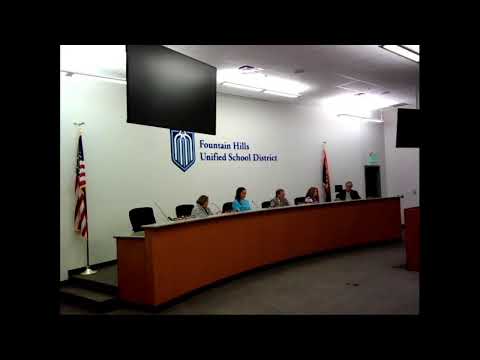
President Rakowski and the Fountain Hills Unified School District Board held a public hearing on proposed changes to the district’s instructional-time model, hearing a presentation from Superintendent Doctor Jay. Jay said the revisions are intended to clarify how current programs are scheduled and to make room for recent program growth.
"The instructional time model allows the school district to be creative in their scheduling, and it allows us to do some things that are more a little outside the box," Superintendent Jay told the board during the public hearing. He outlined three specific updates: formalizing ASU Accelerate co-taught sections so students take the dual-enrollment courses under teacher supervision; counting a 30-minute study hall period after students return from East Valley Institute of Technology (EVIT) travel as part of the academic day; and scheduling longer blocks for project-based learning on early-release days, initially at K–5.
Jay said ASU Accelerate has become one of the high school’s most popular programs and that district staff want to keep local teachers in the classroom to monitor student progress rather than shifting courses entirely online. On EVIT, he described a recurring 30-minute window when students return from morning EVIT sessions and said the district will place a study‑hall block in the schedule so that travel and transition time count toward the instructional day. For elementary early‑release days, the district proposes 90– to 120‑minute project blocks for cross‑curricular work using a low‑cost software library of prebuilt projects.
Board members who spoke during the hearing praised the project‑based idea as a hands‑on approach that can strengthen the district’s "portrait of a graduate" skills. Staff said the software subscription would be a capital/operational purchase and estimated the annual subscription at under $10,000. No members of the public spoke against the revisions during the hearing.
Superintendent Jay said staff will return a refined time model for board action in two weeks. The district posted the draft language in the meeting packet for review and asked members to check implementation details before the vote.