Get Full Government Meeting Transcripts, Videos, & Alerts Forever!
Get email alerts on the Procurement Fy26 Strategy topic
No spam. Unsubscribe anytime.
Purchasing division lays out FY26 'Metro procurement way' with focus on training, supplier management
Summary
Purchasing Agent Dennis Rowland presented a FY26 strategy that builds on FY25 gains in buyer standardization, cycle‑time reduction and new COI software, and outlined a 'Metro procurement way' roadmap that emphasizes training, supplier relationship management, a 180‑day solicitation target and a 2030 vision for national leadership.
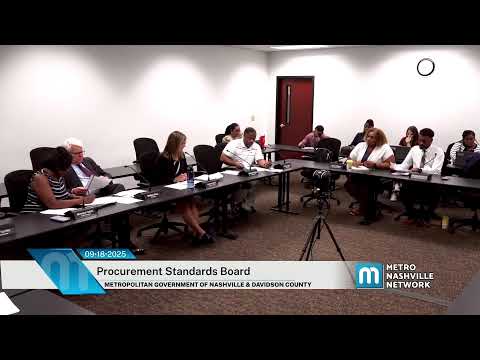
Dennis Rowland, purchasing agent, presented the department’s FY26 strategy and said the effort builds on “significant wins” from FY25, including reduced cycle time, buyer standardization and a new certificate-of-insurance tracking system. He told the Procurement Standards Board the team developed a stringent cost‑savings methodology and targeted, department-specific training, which the division calls "procurement personal training (PPT)."
Rowland flagged staffing constraints as a major limit on implementation last year, citing personal and military leaves and health‑related absences that reduced bandwidth and, at times, led to solicitation errors, protests and cancellations. He said four new procurement resources were onboarded the prior Monday and that the division has organized a new structure to optimize talent.
"The 2030 vision is to be the number 1 government procurement organization in The United States," Rowland said, describing the "Metro procurement way" as a roadmap rooted in five mindsets — openness, transparency, learner, frugal and competitive — and five corresponding actions focused on integrity, accountability, performance, measurement and continuous improvement.
On efficiency, Rowland outlined a 180‑day solicitation target developed by a Kaizen team and said the department will implement buyer standards, site visits and an AI tool called ART to automate reporting and improve solicitation quality. He also described a strategic sourcing initiative that screens requisitions before buyer assignment to design sourcing strategies up front.
Rowland discussed supplier relationship management as a multi‑year goal: staff will study a supplier relationship management system, implement supplier performance monitoring and add measurable KPIs to contracts. He cited recent supplier issues in the water department as an example prompting earlier engagement with suppliers.
Rowland described improved internal communications — one‑on‑ones, town halls and weekly automated project updates — and a procurement roadshow planned for September 30 to brief departments on the new templates and processes. He said culture building will be supported by a permanent office move (planned for Sept. 9), cross‑functional committees, job shadowing and mentor coaching.
Rowland also noted the department’s external recognition: staff presented at the ACCA conference, pursued NIGP and CCFO certifications, and the team was selected for a Harvard Bloomberg cohort to study how to increase supplier competition; he said a four‑person team will travel to Boston in October for the cohort’s onsite work.
The presentation concluded with board members thanking Rowland and staff for the work and the improvements in department relationships and data reporting. The board took no separate vote on the FY26 strategy itself; it moved next to the reporting templates on the agenda.