Get Full Government Meeting Transcripts, Videos, & Alerts Forever!
Get email alerts on the Procurement Inmate Health Services topic
No spam. Unsubscribe anytime.
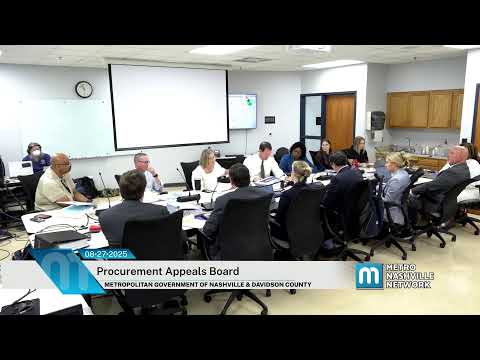
Procurement Appeals Board upholds Metro award of $150M jail health contract after CHS appeal
Summary
The Procurement Appeals Board voted 4-0 to uphold the purchasing agent’s intent to award RFQ 379372 — a roughly $150 million contract for inmate medical, dental and behavioral health services — rejecting CHS Tennessee LLC’s appeal that the process was arbitrary and unfair.
The Procurement Appeals Board of Metro Nashville and Davidson County on a unanimous vote upheld the purchasing agent’s March 14 intent to award RFQ 379372, a roughly $150,000,000 contract for medical, dental and behavioral-health services for the county jail.
The board voted to uphold the purchasing agent’s decision after hearing a morning of presentations from Metro procurement, the appellant CHS Tennessee LLC and its counsel, representatives of the apparent awardee, and an operator who would provide the services. Chair Scott Potter recorded the motion to uphold; the recorded vote was Scott Potter, Gerald Smith, Brady Rich and Diane Lance — all voting yes. Attorney Nikki Eke, counsel to the board, said a written order memorializing the decision will be circulated within about a week.
Why it mattered: the contract covers clinical services for about 2,000 incarcerated people in Davidson County and, counsel for CHS and a YesCare executive said, carries significant operational and public-safety risk if a vendor is not fully vetted. CHS argued the procurement process was arbitrary because the solicitation limited written project descriptions to 15 pages, no oral interviews were held, and Metro asked clarifying questions and accepted supplemental pages from only the apparent awardee — advantages CHS said were outcome-determinative.
What the parties said: Dennis Rowland, Metro’s chief procurement officer and purchasing agent, outlined the solicitation timeline and defended Metro’s process. He said the solicitation was posted Sept. 25, 2024, received six proposals by the Dec. 17 closing, underwent seven evaluation meetings, and produced an intent to award on March 14, 2025. Rowland said amendments (notably Amendments 4 and 8) clarified that staffing plans could be submitted without counting against the project-approach page limit and that Metro’s consensus scoring by subject-matter evaluators followed procurement rules and produced published evaluator comments.
CHS’s counsel, including John Cooper and Michael Catone of Holland & Knight, said CHS filed a timely appeal and contended evaluators repeatedly marked the CHS proposal as ‘‘vague’’ or lacking detail. They argued that for a complex $150 million contract, a 15-page written response without interviews or a comparable post-submission opportunity for all bidders made the award arbitrary. CHS further said it included the Mental Health Cooperative (MHC) in its price — adding about $8,000,000 to its bid — based on pre-solicitation conversations, and that RFQ language and department contacts created ambiguity about whether MHC participation was effectively required.
Representatives for the apparent awardee (identified in the record variously as Bridal Core Health Strategies LLC and Vital Core/Vital Corps) and counsel Rocky King said Metro plainly reserved the right to ask clarifying questions, consensus scoring is permitted, and interviews were not mandated by the RFQ or law. The record shows the apparent awardee scored 92.03 overall while CHS scored 83.66.
YesCare’s COO Bill Carr, invited by CHS to speak for its operator partner, urged the board to ensure the winning provider is thoroughly vetted because of clinical, transition and electronic-health-record risks involved in delivering care to a jail population that, he said, has higher rates of mental-health needs and infectious disease.
Board discussion focused on whether it can be fair to ask clarifying questions of a single finalist when proposals differ, how Metro’s Q&A and amendment process was administered, and whether the RFQ’s MOU language required a specific subcontractor or only required a plan to manage transitions. Metro procurement staff testified that pre-offer meetings and a large Q&A record (hundreds of Q&A entries) were available to vendors, that MOU requirements were not scored and were intended to govern contractual transition if there were a change in providers.
Outcome and next steps: the board concluded the purchasing agent’s decision complied with the applicable procurement regulations and the solicitation’s terms and upheld the award. The board directed counsel to prepare a written order; Attorney Eke indicated the order should be circulated within about a week. The meeting was then adjourned.
The board’s written order will provide the formal grounds and any remedial directions; parties retained statutory rights to seek review in chancery court under the Metro code’s appeal provisions.