Get Full Government Meeting Transcripts, Videos, & Alerts Forever!
Get email alerts on the Construction Safety topic
No spam. Unsubscribe anytime.
New executive director outlines safety benchmarks, complaint process and KPI rollout for Contract and Compliance Board
Summary
Trey Atkinson, the new executive director of the Contract and Compliance Board, told members he will prioritize site safety, a secure worker complaint process, and a KPI dashboard to monitor contractor performance; staff will form subcommittees and follow council deadlines for any policy recommendations.
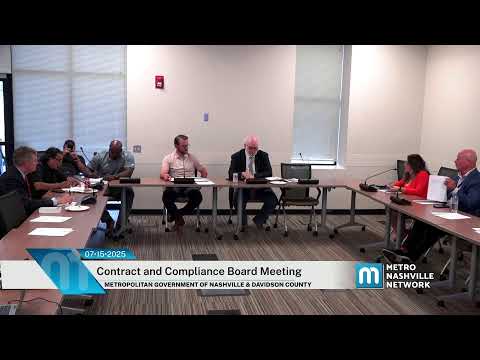
Trey Atkinson, the newly introduced executive director of the Contract and Compliance Board, told members at the meeting that his priorities include raising worksite safety standards, standing up a secure complaint process for workers and developing key performance indicators to track contractor compliance and payment equity.
Atkinson said the board—created by ordinance in July 2024 to provide independent oversight of public construction—will focus on monitoring contract compliance, reviewing safety plans and incidents, and making policy recommendations to Metro Council. "Safety is ... number 1 priority of all the GCs that work for Metro," Atkinson said, adding he has met with general contractors, safety directors and Metro legal and finance staff during his 60-day onboarding.
Why it matters: the board’s recommendations would inform Metro Council action and could lead to policy or ordinance-level changes. Atkinson identified several near-term items for board work: a secure, potentially anonymous worker-reporting channel; standardized safety benchmarks and KPIs across departments; and payment oversight to surface subcontractor-level payment problems.
Atkinson and consultant Daniel Villal of Intellisia Partnerships outlined how compliance technology and benchmarked KPIs could shift oversight from complaint-driven responses to real-time monitoring. Villal said his firm helps "translate policy ... into activated procurement strategies and practices, and then coming behind that effort with the data capture that empowers the agency to make real time decisions." Villal offered to return with models tailored to Metro priorities.
Procurement and subcontractor issues drew particular attention. Dennis Rowland, Metro’s chief procurement officer, asked for KPIs that fit Nashville’s procurement scale rather than benchmarks pulled from much larger cities. Council member Zapolya urged routine site audits and a complaint procedure that protects workers from retaliation.
Mr. Pena, who identified himself as a federal OSHA trainer, raised specific wage concerns: he said he recently received a complaint from the wife of a JW Marriott worker about unpaid overtime and reported workers on the Tennessee Titans stadium project alleging unpaid overtime as well. Atkinson acknowledged the concerns and pointed to the business assistance office’s payment-verification role while saying the board would examine payment oversight and complaint-handling options.
Board process and next steps: members discussed forming a bylaws subcommittee (participants named tentatively) and agreed the executive director should follow up to schedule that subcommittee while complying with Tennessee open meetings requirements. Staff and Atkinson noted a tight timeline for drafting any resolution to Council, identifying August 22 as a deadline to get materials to legal and warning that resolution drafting requires a roughly two-to-three-week lead time. The Chair asked Atkinson to follow up with members to schedule subcommittee meetings and return with more concrete KPI proposals and any draft policies.
The meeting adjourned after a brief voice vote following a motion and second.
Provenance: reporting in this article is drawn from the board meeting transcript, including Atkinson’s presentation of board functions and priorities and members’ questions and comments.