Get Full Government Meeting Transcripts, Videos, & Alerts Forever!
Get email alerts on the Capital Plan topic
No spam. Unsubscribe anytime.
Spring Hill leaders begin prioritizing a $480 million, 10‑year capital plan; staff to send ranked surveys
Summary
City staff presented a proposed 10‑year capital improvement plan with roughly $480 million in requests, asked the Board of Mayor and Aldermen to prioritize projects via two SurveyMonkey ballots, and flagged funding constraints that will shape which projects move forward.
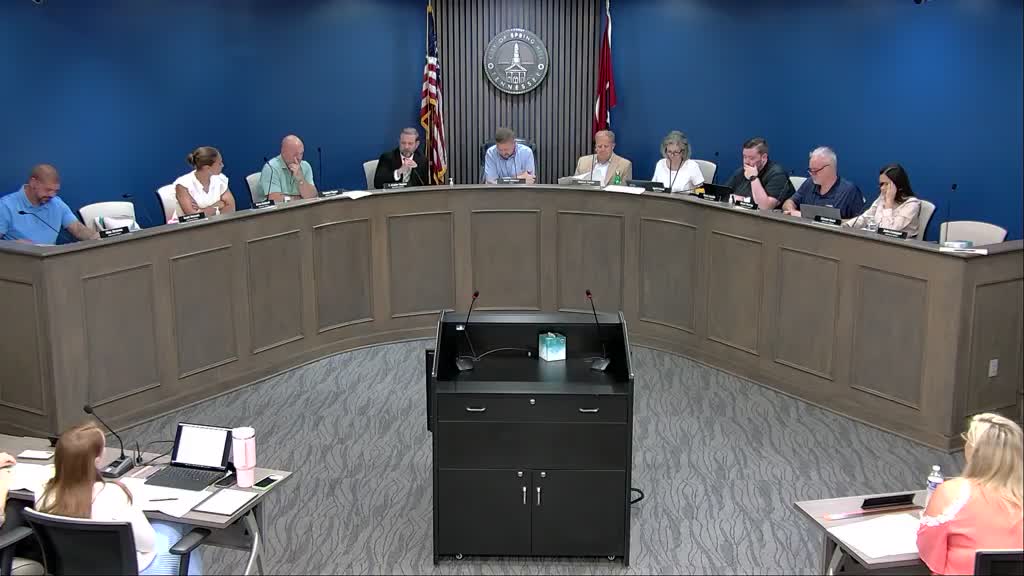
City staff outlined a proposed 10‑year capital improvement program for Spring Hill on Sept. 29, asking the Board of Mayor and Aldermen for direction on which projects to prioritize and how to pay for them.
"There's essentially a $480,000,000 request that of course will be spread over 10 years," City Administrator Mr. Napier told the board as he described the spreadsheet staff prepared to collect priorities and develop a funding plan. Staff said they will send two ranked surveys to aldermen — one focused on 1875‑resolution projects and a second covering projects that are not yet committed — and will return consolidated rankings and funding options at a December 1 work session with a view toward adopting a plan by early January.
Project manager Miss Stahl walked the board through the packet, explaining color codes on the spreadsheet: green entries denote active projects with "shovels in the ground," yellow entries are projects in process or tied to grants, a separate block lists projects committed under the 1875 resolution, and the final block lists not‑committed/not‑allocated requests. She confirmed staff will update the packet with the board's suggestions and said the surveys will be issued after that update; aldermen were asked to complete rankings by Oct. 20.
Finance lead Miss Holden cautioned that the aggregate request is far larger than the city can deliver at once. "This is a large number. This is not possible," she told the board, adding she will present more detailed funding scenarios and debt‑capacity calculations in November and December. Holden said some revenue assumptions in the draft rely on reappraisal years and that volatile revenue streams (for example, adequate‑facilities receipts and impact fees) are not ideal sources for long‑term borrowing.
The board discussed several high‑cost and time‑sensitive items during the meeting, including intersection and corridor widenings, upgrades to parks and ball‑field lighting, a new city services campus (CSA) in phased development, and multiple fire‑station projects. Chief Temple described plans to reuse the recently completed Station 4 design as a model to reduce design cost for other stations, and said work to replace Station 1 would be a major rebuild that consolidates administrative and training functions. Staff reported a parcel needed for Station 1 is contractually unavailable for site access until December 2028, which affects sequencing and whether the board should prioritize land acquisition separately.
Aldermen pressed staff on several issues they said should inform prioritization, including grant expiration dates, which projects already have design and right‑of‑way secured, and which items are likely to attract developer contributions or state/federal matches (for example, projects tied to the GNRC regional transportation process or TDOT opportunities). Napier and Holden said staff would annotate the packet where possible and flag grant deadlines and developer commitments for the board's review.
Next steps: staff will update the CIP packet per the evening's discussion, issue the SurveyMonkey rankings, and return a prioritized funding plan at the December 1 work session. The board signaled consensus to include green and yellow projects in the prioritization exercise while asking staff to verify grant timelines and funding offsets.
Sources: City Administrator Mr. Napier; project manager Miss Stahl; finance director Miss Holden; Chief Temple.