Get Full Government Meeting Transcripts, Videos, & Alerts Forever!
Get email alerts on the Planning Votes topic
No spam. Unsubscribe anytime.
Planning Commission approves rezoning, EV bus canopy, two-unit SUP and advances two zoning text amendments
Summary
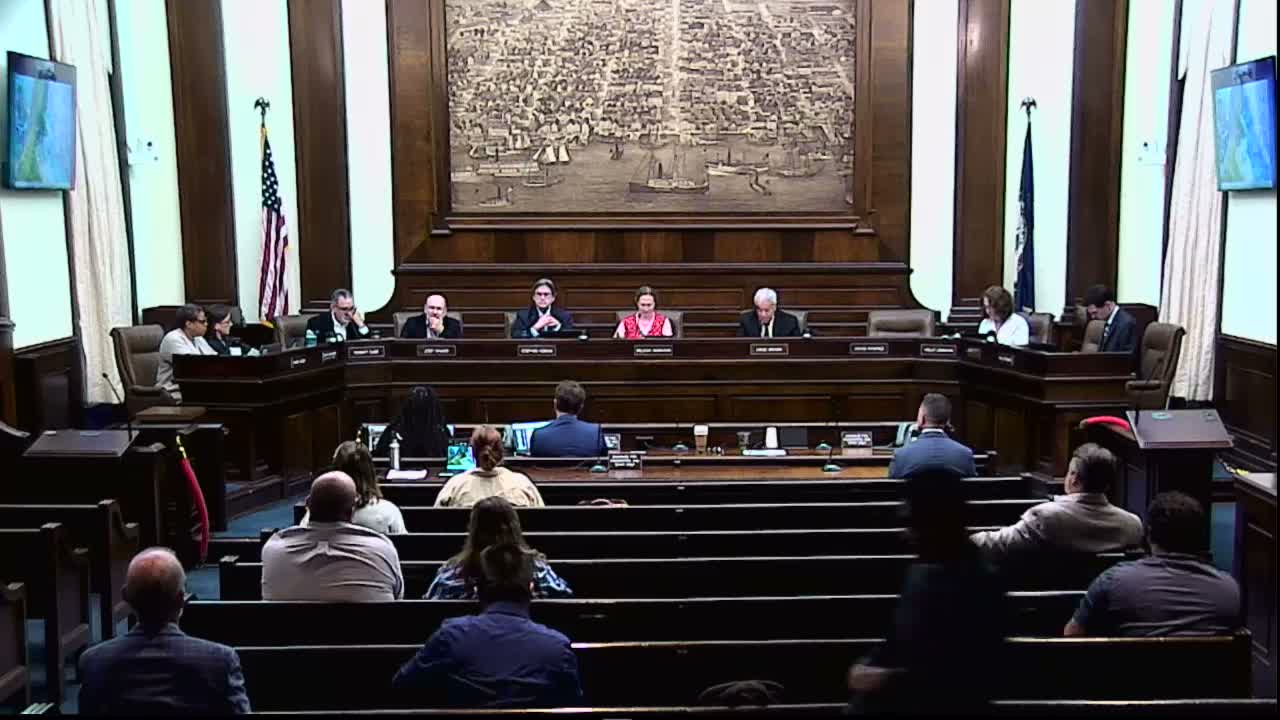
At its September meeting the Alexandria Planning Commission approved a rezoning on Helen Street, a development special-use permit for an Alexandria Transit Company bus canopy with EV charging, and a special-use permit for a two-unit home. The commission also initiated and recommended council approval of zoning text amendments on coastal resilience and a murals program.
The Alexandria Planning Commission on Sept. 24 approved a series of routine and substantive land-use items and moved two ordinance changes forward to City Council. Resolutions and votes were unanimous where recorded.
The commission approved a rezoning request for a property on Helen Street that would change zoning from R-25 (residential family) to RB (townhouse). Commissioner Brown moved to approve after staff identified a 1988 building permit and prior zoning approval that established rights for a structure previously deemed nonconforming; the motion carried 6-0.
The commission also approved a development special-use permit for the Alexandria Transit Company at 3000 Business Center Drive to expand maintenance, storage and parking and to construct a canopy with electrical vehicle charging stations. Commissioner Dube, while supporting the project as advancing sustainable transportation, urged staff and the applicant to monitor evolving fire-code and charging-safety standards. The motion to approve passed 6-0.
On a separate housing item, the commission approved Special Use Permit 202500032 for a two-unit semi-detached dwelling at 51 East Windsor Avenue. Staff planner Katie McDonald summarized that the applicant proposes to demolish the existing dwelling on one lot and construct two units, with the left unit on a substandard lot; the application met bulk and height expectations and staff recommended approval subject to conditions. Owner-applicant Diawadala told the commission the intent is to complete both lots as a single project, that engineers will address grading/fill, and that the arborist will review potential tree preservation. Commissioner Brown moved approval inclusive of the Sept. 4 staff memo; the motion passed 6-0.
The commission initiated and recommended City Council approval for two zoning text amendments. Stormwater planner Gavin Beliteri presented changes to Article 13 of the Environmental Management Ordinance to bring local rules into alignment with state changes to the Chesapeake Bay Preservation Act. The amendments add definitions, require resiliency assessments using state-approved models (a 30-year sea-level-rise and storm-surge horizon), and clarify when adaptation measures such as living shorelines or bioretention are required in Resource Protection Areas. Commissioners praised the targeted focus on RPAs and emphasized outreach and implementation details. The commission voted to initiate the amendment and to recommend approval to council, unanimous 6-0.
Planning staff also presented a text amendment to distinguish murals from signs and to create a murals program in Article 9 of the zoning ordinance. The proposal would allow limited murals by-right, require an administrative SUP for larger-text murals, and reserve the largest murals for council SUP review while grandfathering existing murals. Rachel Drescher of planning and zoning said staff recommended approval; the commission voted to initiate and to recommend approval 6-0.
Other procedural matters handled at the meeting included approval of the June 4 meeting minutes (with deferral of the June 23 minutes), and approval of the commission’s annual report with minor text changes. The meeting adjourned at 9:24 p.m.
Actions recorded here reflect motions and outcomes taken on the record during the Sept. 24 meeting. Any implementation steps (e.g., council review, building permits, grading review, arborist review, or safety-code updates) were discussed as next steps by staff and commissioners.