Get Full Government Meeting Transcripts, Videos, & Alerts Forever!
Get email alerts on the Zoning Conditional Use Permits topic
No spam. Unsubscribe anytime.
Poquoson planning commission backs tighter submittal rules, eyes limiting major CUPs to commercial districts
Summary
City staff proposed classifying conditional-use permits as 'major' or 'minor,' requiring concept-plan submittals and enforcing a 30''35-day 'officially submitted' deadline; commissioners signaled support for Option 2 and asked staff to present the language at next month''s public hearing.
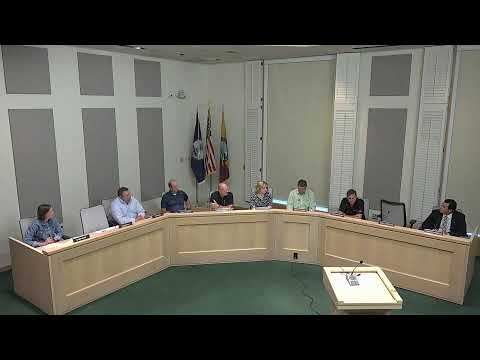
The Poquoson Planning Commission signaled consensus June 16 to advance proposed amendments that would classify conditional-use permits (CUPs) as either "major" or "minor," tighten submittal deadlines and require a basic concept plan for larger projects. Staff said the changes are meant to reduce last-minute materials, speed review and ensure the planning commission and council see complete information before public hearings.
Wally, a city planner leading the presentation, cited state authority for CUPs ("Virginia Code 15.2 dash 22 86 a 3," as spoken) and said the changes draw on model language including the Albemarle Land Use Handbook. Under the proposed text, major CUPs would generally be limited to commercial zoning districts; examples that could trigger major review include new principal commercial buildings, required traffic studies, ARB approvals for new buildings or exterior refurbishments, and professional assessments for unique noise, dust or odor impacts. The required concept-plan elements listed by staff include ingress and egress, property lines, building orientation, dimensions (including phases), parking, landscaping and a general location for stormwater best-management practices.
Staff also proposed requiring that applications be "officially submitted" to the zoning administrator a set number of days before a scheduled planning-commission hearing (generally 30''35 days). Wally said materials submitted after that deadline would not be allowed at the commission stage; if city council received new or revised materials after the commission''s recommendation, the application would be remanded back to the planning commission for reconsideration. Those changes, staff said, are intended to protect due process for applicants, the public and reviewers by ensuring adequate review time before formal recommendations or council decisions.
Commissioners asked how gray cases would be handled. Wally said the zoning administrator would exercise discretion under the proposed criteria; commissioners requested clearer language to define the boundaries between "major" and "minor" to reduce ambiguity. Several commissioners also noted the potential cost burden for applicants assembling more complete materials and said staff should continue to work with applicants to avoid making projects cost-prohibitive.
The commission discussed application fees and advertising costs. Staff said state law requires legal advertising in a newspaper of general circulation and that a one-paragraph advertisement typically costs about $500; staff noted the application fee (quoted at $711 during the meeting) is intended primarily to help cover advertising and that fees rise annually with CPI adjustments.
Commissioners revisited the recently controversial pickleball CUP and asked whether noise concerns would automatically convert it to a major CUP. Wally said the pickleball proposal would remain a minor CUP under the proposed criteria, noting the record has contained contradictory information from both sides on noise impacts. Commissioners raised traffic and parking as distinguishing factors for more intensive commercial uses.
By the end of the discussion, commissioners generally favored Option 2''the middle ground that limits major CUPs to commercial districts while still allowing minor CUPs more widely''and asked staff to refine the definitions for clarity. Wally said he would present the language as discussed at the public hearing next month; no formal vote was recorded during the work session.
Next steps: staff will refine the draft language to tighten the "major"/"minor" definitions and present the revised ordinance at the planning commission''s public hearing next month. The commission also noted applicants retain the option of pursuing conditional rezoning if a project falls into a gray area.