Get Full Government Meeting Transcripts, Videos, & Alerts Forever!
Get email alerts on the Energy Efficiency topic
No spam. Unsubscribe anytime.
Ramsey County plans $8.4 million internal loan to finance energy upgrades, citing IRA deadlines
Summary
Ramsey County staff outlined a multi‑phase Guaranteed Energy Savings Project that would use an $8,445,000 zero‑interest internal loan to fund LED retrofits, solar PV and HVAC improvements; staff say federal Inflation Reduction Act incentives and a statutory Minnesota guaranteed‑savings program shape timing and payback windows.
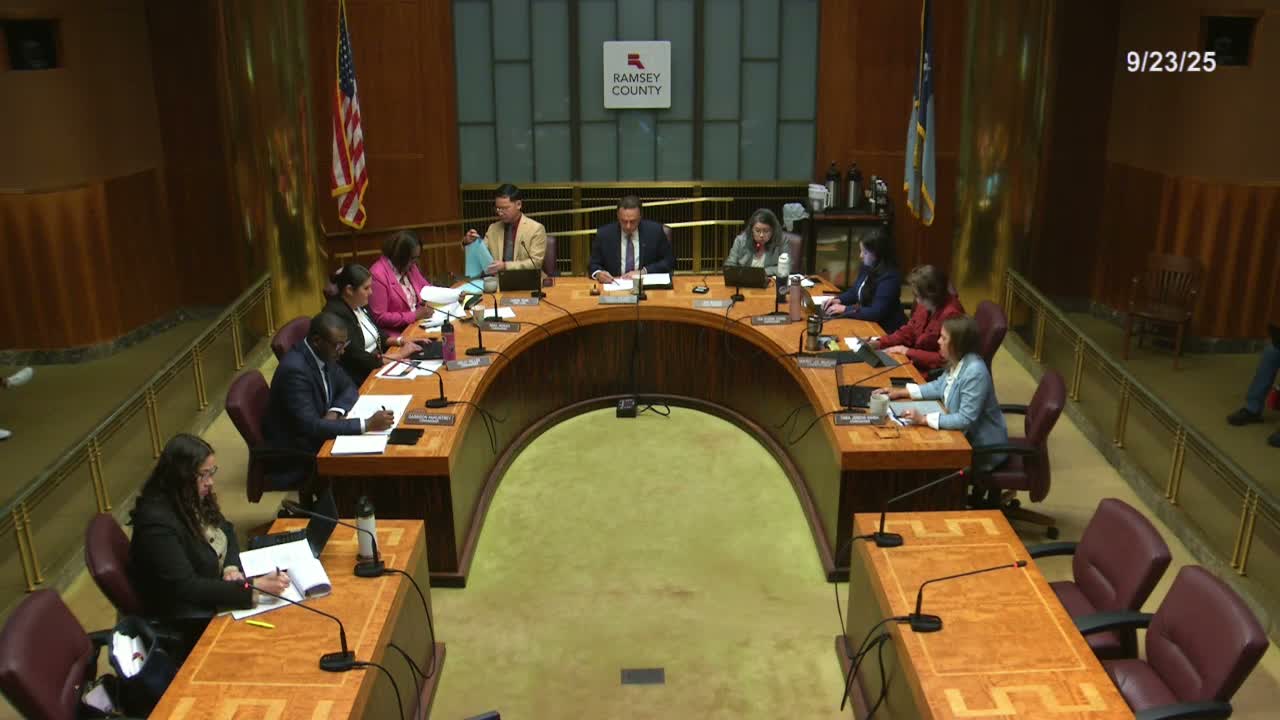
Ramsey County officials on Sept. 23 described a multi‑phase energy retrofit program they say will accelerate countywide reductions in energy use and greenhouse‑gas emissions.
Jean Krueger of Ramsey County property management introduced the Guaranteed Energy Savings Project and said countywide energy consumption is “down 25% from what it was in 2019,” with property‑management facilities reduced about 43.8% through 2024. County staff presented a phasing plan that prioritizes high‑return projects including LED lighting, building envelope work, solar photovoltaic installations, roofing and HVAC controls.
The project is being structured under the Minnesota Guaranteed Energy Savings Program, a statutorily authorized financing mechanism staff said allows governmental entities to take multi‑year loans to pay back energy investments over terms of up to 20 years. A county finance representative described the funding plan as an internal, zero‑interest loan from the general fund: “This would be $8,445,000 that would be paid back,” the finance representative said, and noted the county’s estimated unrestricted 2024 general fund balance was $54,000,000 (unaudited).
Presenters said they surveyed roughly 2,300,000 square feet across 21 county buildings and identified about 60–72 feasible projects. Staff forecast that the first phase would produce an immediate energy reduction boost — about an 11% jump toward annual reduction goals — and a roughly 15% reduction in carbon‑emissions output relative to last year’s production. The presenters highlighted one site, the Ramsey County Correctional Facility, as the location of an approximately 1‑megawatt rooftop solar installation.
Commissioners asked whether geothermal had been ruled out; staff responded geothermal was prohibitively expensive in this phase and would have consumed an estimated three‑quarters of available project funding, producing paybacks beyond the county’s planning horizon. On timing, staff noted several federal incentives under the Inflation Reduction Act have deadlines and said projects that rely on those incentives generally must be started this year and completed by mid‑2027 to retain eligibility.
County staff said they are finalizing contract terms with the consultant (INBUILT) and expect to return to the board at the first meeting in October with a recommended RBA and a request to set up the internal loan and contract approval. No formal financing authorization occurred at the Sept. 23 meeting.
Why it matters: County officials framed the project as a strategic way to sustain multi‑year energy reductions while leveraging federal incentives that have time‑limited qualification windows. The financing approach spreads upfront costs while attempting to preserve general fund flexibility for other needs. Next steps: staff expect to bring an RBA and loan setup to the board for action in roughly two weeks.