Get Full Government Meeting Transcripts, Videos, & Alerts Forever!
Get email alerts on the Infrastructure.drainage topic
No spam. Unsubscribe anytime.
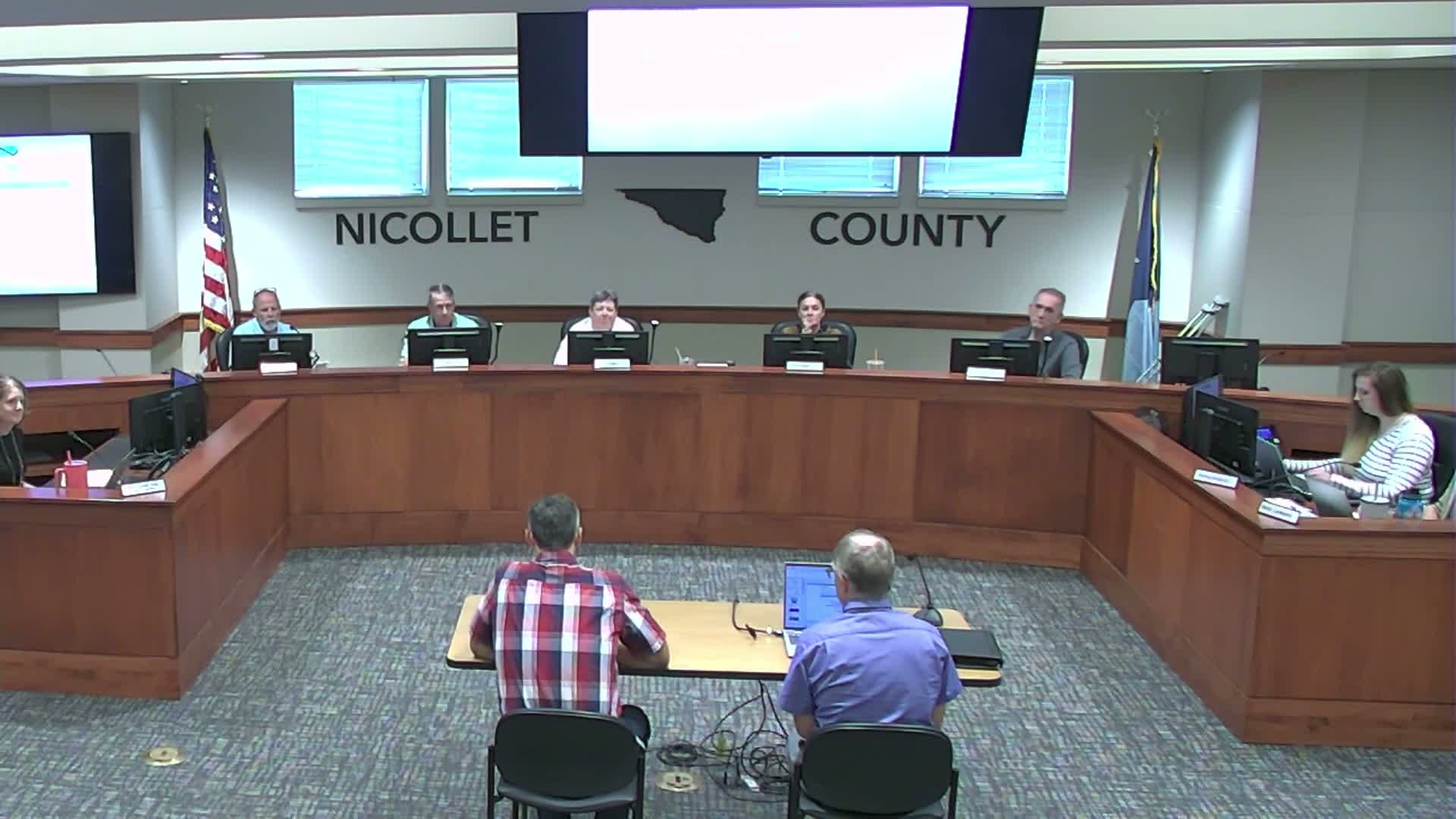
Nicollet County drainage board allows MnDOT culvert replacement to proceed after landowners object
Summary
After testimony from farmers and a Houston Engineering review, the Nicollet County Drainage Authority voted Sept. 3 to take no action and allow MnDOT to install a replacement culvert on County Ditch 75. Board members were told a formal reestablishment‑of‑records would cost about $30,000 and could delay MnDOT’s project.
Nicollet County’s Drainage Authority voted Sept. 3 to take no action and allow the Minnesota Department of Transportation to proceed with a planned replacement of a culvert on County Ditch 75, after landowners urged the board to require the pipe be set lower.
Landowners and contractors told the board the culvert is impeding drainage and costing farms. Tom Eckberg of Tom Eckberg Tiling LLC said many customers ‘‘have a problem with the ditch being the level it is’’ and that his crew ‘‘could do it in 1 day.’’ Several farmers said heavy rains last year drowned dozens of acres; Matt Herberg said 30 of 80 acres were ‘‘completely zeroed’’ last year and Greg Anxton estimated about 55 acres were lost.
County Attorney Michelle and Chris Otterness of Houston Engineering outlined the board’s legal and technical options. Otterness explained that a statutory reestablishment‑of‑records (a system‑wide process that can take months) reconstructs historic alignment and elevations; he estimated such a process for the system would cost roughly $30,000 and said, based on plans he reviewed, ‘‘I don’t have a great confidence that I would probably come up with a different answer than what that culvert elevation is.’’
A faster, site‑level survey sometimes used to set a single repair grade (an ‘‘ROR light’’) would avoid public hearings but offers less legal defensibility when landowners dispute elevations; Otterness said he would not recommend that shortcut for this location because nearby elevations were inconsistent.
Public works staff told the authority MnDOT had suspended actual installation to await direction from the drainage authority but warned that delaying the highway contractor could produce claims and delay costs that MnDOT might seek to recover. The county attorney cautioned that ‘‘103e prescribes the processes that the drainage authority follows’’ and said there is no statutory mechanism under 103e for the board simply to pick an arbitrary adjustment (for example, to lower the culvert six inches) without following the prescribed procedures.
Board members discussed alternatives, including a landowner‑initiated petition for an improvement (which Michelle said requires signatures from 26% of affected landowners and meeting statutory criteria). Several board members acknowledged sympathy for landowners’ losses but voiced concern about legal exposure and the practical costs of delaying MnDOT.
Commissioner [name not specified in transcript] moved that the drainage authority ‘‘do nothing’’ and allow MnDOT’s project to proceed; a second was offered and the board voted in favor. The motion carried and the authority adjourned.
Next steps noted at the meeting: MnDOT may proceed with the culvert installation unless landowners organize a petition for improvement; the record reestablishment option remains available but would take months and include public notice and hearings.