Get Full Government Meeting Transcripts, Videos, & Alerts Forever!
Get email alerts on the Use Tax topic
No spam. Unsubscribe anytime.
Creve Coeur council puts proposed use tax on track for Nov. 4 ballot after first reading
Summary
Council heard first reading of an ordinance authorizing a municipal use tax equal to the city's 1.25% local sales tax and discussed ballot language, examples of eligible uses and an education plan; council did not take a final vote and will return for a second reading.
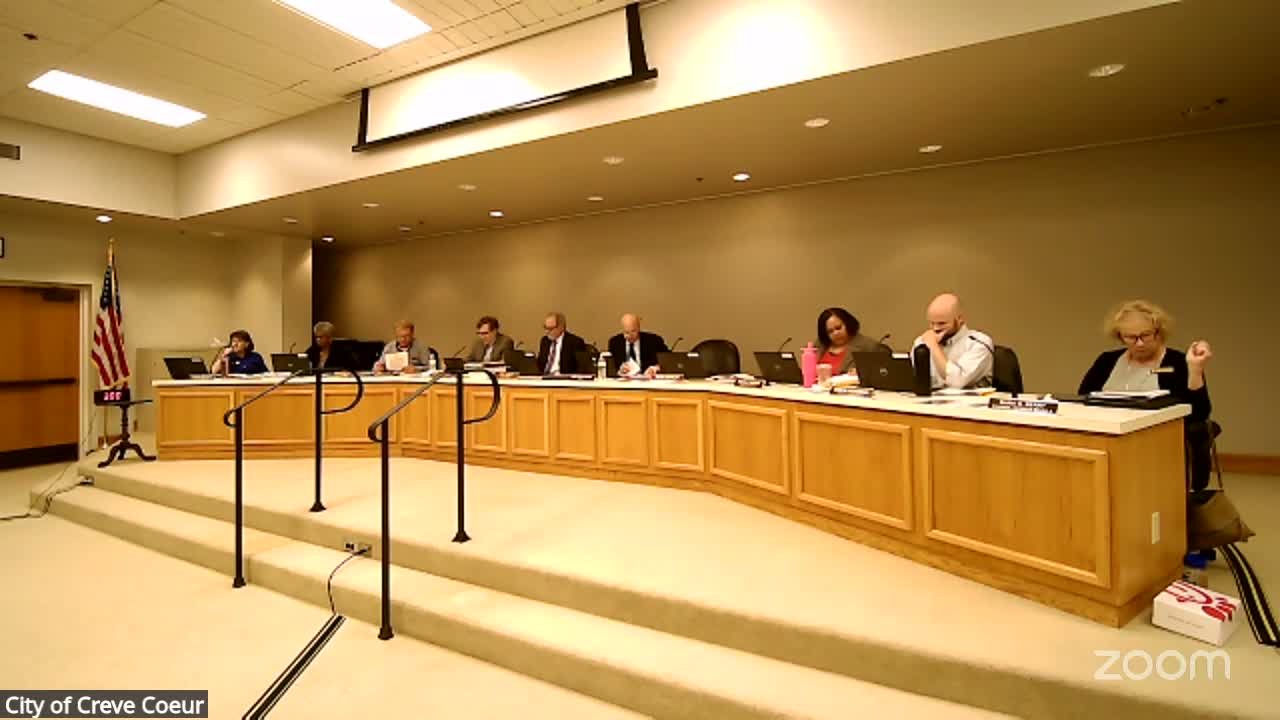
Creve Coeur's City Council on first reading advanced a proposed ordinance to place a local use tax before voters at the Nov. 4, 2025, general election.
At a council meeting, staff presented Bill 6176, which would impose a municipal use tax at the same rate as the city's local sales tax (1.25%) and provide that the use tax would be repealed, reduced or raised to match any change in the local sales tax. Staff cited authority in the Missouri Revised Statutes, sections 144.6 through 144.761, which govern local use taxes and ballot wording.
Mister Perkins (staff) said the draft ballot language was intentionally concise to satisfy election-board word-count guidance. The staff-drafted text lists examples of public services that the local use tax could support, including trash collection and recycling, police services and leaf-and-limb removal, but Perkins told the council the language is intended to provide examples and to preserve flexibility rather than create a legally binding duty to spend revenues only on those items.
Council members asked whether the ballot could do more to explain what types of purchases would be taxed (for example, online out-of-state sales) and whether the city is obligated to use proceeds for the listed services. Perkins said word limits constrain the ballot statement; the city will rely on a planned public education campaign (newsletters, social media, ward town halls, postcards) to provide the public with fuller details about taxable transactions and intended uses of revenue.
Staff also discussed logistics for labeling the measure on the ballot (proposition number or letter) and said they would finalize the designation and the public-education plan before the next reading. City staff stressed the use tax is structured as an "either-or" with sales tax: if a purchase is already subject to local sales tax, it would not be taxed again under the local use tax.
The ordinance was presented on first reading and no final vote was taken. City staff said the council will take the measure up for a subsequent reading where council can finalize ballot text and proposition labeling. If adopted and approved by voters, the use tax would become an alternative revenue source the city could deploy to support general city services.