Get Full Government Meeting Transcripts, Videos, & Alerts Forever!
Get email alerts on the Capital Improvement Program topic
No spam. Unsubscribe anytime.
Creve Coeur council adopts five‑year capital plan as city eyes $25 million in revenue
Summary
After a public hearing, Creve Coeur adopted a FY2026–2030 Capital Improvement Program that directs most spending to streets, sidewalks and stormwater projects and relies on a mix of sales taxes, grants, general‑fund transfers and limited ARPA funds.
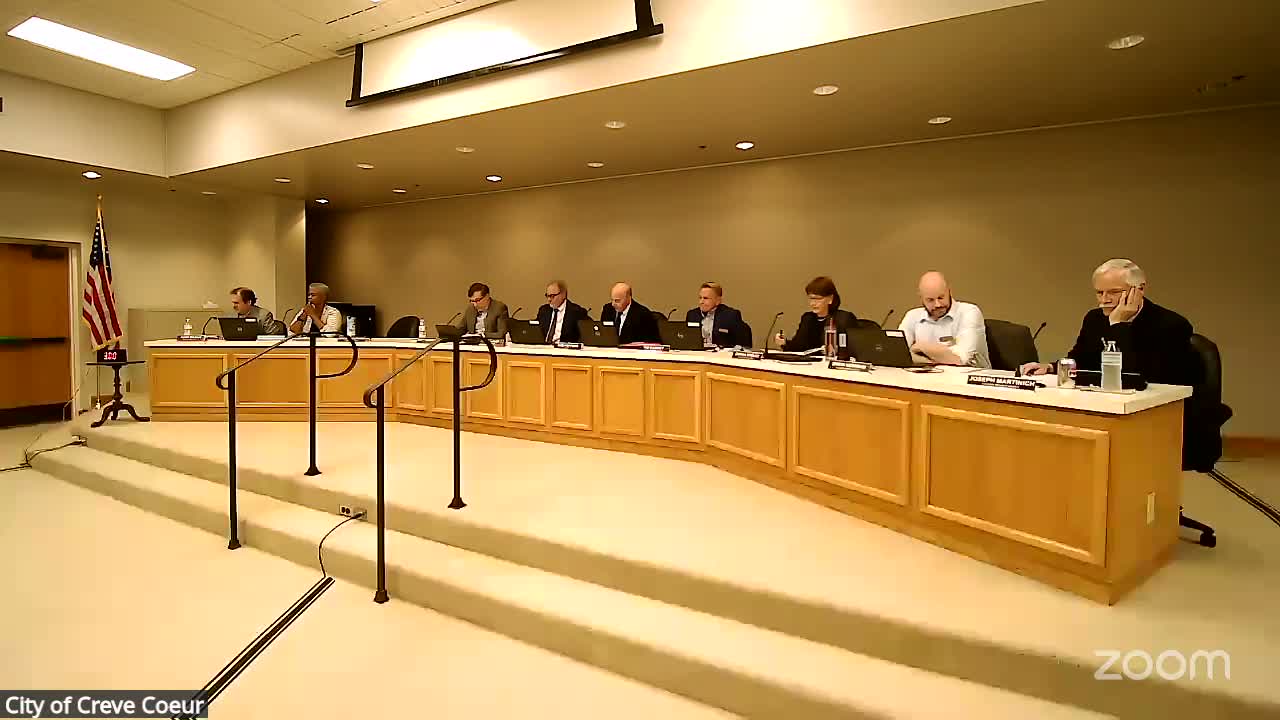
Creve Coeur — The City Council on April 14 adopted a five‑year Capital Improvement Program (FY2026–2030) after a staff presentation and public hearing.
City engineer Steve Perez told the council the proposed CIP projects a total of about $25.1 million in revenue over five years and estimated expenditures of roughly $26.1 million, with the largest share — roughly three‑quarters of planned capital spending — devoted to streets and sidewalks. Perez said the plan relies on a half‑cent sales tax, outside grants, general‑fund transfers and a portion of remaining ARPA funds.
“Streets and sidewalks are the capital improvement program out of student. We have a lot of streets and big investments,” Perez said, summarizing the emphasis on pavement and pedestrian work.
The CIP proposal lists funds across government facilities, parks and stormwater, and public‑works equipment; projects highlighted in presentations included Lake Still Park improvements, a new pedestrian crossing at Olive and City Place Drive, culvert replacement at Beaver Drive, and phase work on ballfields and greenway connections. Perez also described a stormwater program that uses a benefit‑cost ratio to prioritize roughly 45 percent of watershed projects for design or construction by 2030.
At the meeting, staff and council members discussed funding assumptions and grant prospects; council members praised staff for pursuing grants. After discussion, the council voted to adopt Resolution 1790, approving the CIP for the FY2026–2030 period.
What happens next: staff will move forward with project design and grant applications, and specific projects will return to the council for individual contracts and funding approvals.