Get Full Government Meeting Transcripts, Videos, & Alerts Forever!
Get email alerts on the Planning Submittals Appendix A topic
No spam. Unsubscribe anytime.
Hudson subcommittee refines Appendix A submittal rules, keeps many project-specific items in specialty sections
Summary
The Appendix A subcommittee reviewed redline edits to application submittal requirements, agreed to move specialized items into subdivision/site-plan sections, added options for wetland verification, and asked staff for a clean redline to send to the Planning Commission; no formal votes were taken.
The Appendix A subcommittee for the Hudson Planning Commission met July 7 and worked through a redline of proposed changes to Appendix A — the city's submittal and application requirements — agreeing to relocate many project-specific items into the appropriate subdivision and site-plan sections and asking staff to produce a clean, final draft for Planning Commission review.
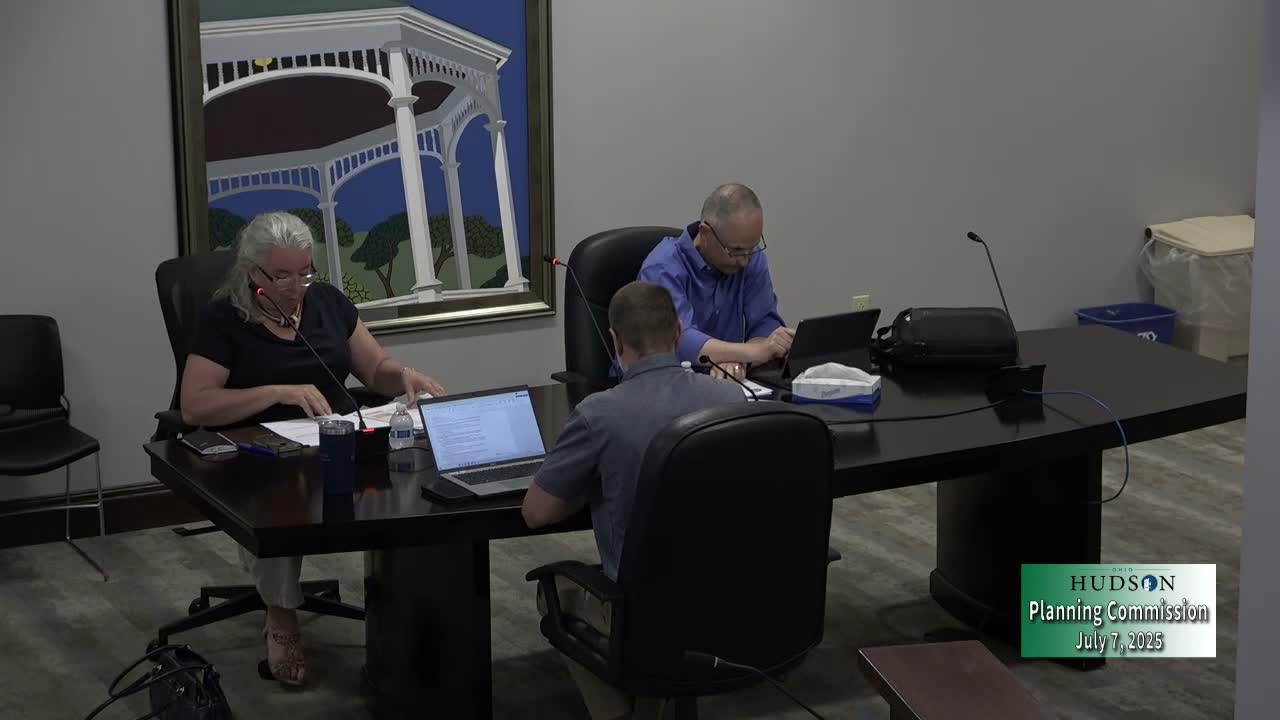
"Our work session and discussion on Appendix A," said Speaker 1 as the meeting opened, and Speaker 2 summarized the plan to present both a redline and a cleaned version so Planning Commission members can "see what happened, what changed." The panel, which the meeting record notes included Nick Sugar (for the city) and Planning Commission members Dave Nystrom and Sarah Norman, discussed dozens of line items and wording changes but took no formal votes.
A central thread of the discussion was where to place application fields so that the "core" submittal requirements apply to every applicant while specialized items appear only where relevant. On whether to keep the "name of development or subdivision" in the core or move it to subdivision standards, Speaker 1 said the phrase "as applicable" was too open to interpretation and preferred putting such items where they "really belong." Speaker 2 recommended adding the field to the subdivision standards (minor, preliminary, and final plats) rather than duplicating it across the document.
The subcommittee also agreed to move the tree and vegetation plan out of the core requirements and into site-plan review or final subdivision plat language, and to require a separate preliminary planting plan for preliminary subdivision plans. Engineering input confirmed that traffic impact studies remain necessary in appropriate cases and that stormwater pollution prevention plans should be required only where applicable (for example, site-development reviews rather than every application).
On environmental checks, Speaker 2 described adding flexibility on wetlands: where wetlands are suspected the city may request either a full wetland delineation or a verification letter from a qualified professional, with the need typically flagged at pre-application meetings. "If there's no known wetlands present, we even say have someone walk in and write a letter," Speaker 2 said, noting the proposal aims to balance verification with workload.
The group discussed an "index of ecological integrity" now embedded in the code; participants said it is largely outdated and would require a code amendment to overhaul, but also provides a backstop when wetlands reports are not required. The committee left that item in place for now and agreed a broader code update could address it later.
Practical edits included splitting combined requirements into separate, renumbered items (for example, separating a "statement of proposed use" into its own required field), standardizing affidavit language across application types, adding a "date and author of estimate" field, and adding photographs to certain nonconforming and architecture-board submittals for consistency. Speaker 1 suggested reformatting the front material into an actionable checklist so staff or commissioners can print only the relevant boxes for a given application type; Speaker 2 agreed this would save time.
A policy question about whether approvals should be "personal" to an applicant or tied to property ownership drew particular attention. Speaker 1 proposed language making approvals nontransferable or otherwise tied to the owner; Speaker 2 said the matter requires legal review. "I think we need Marshall's determination," Speaker 2 said, and the subcommittee asked staff to seek counsel before finalizing where that language should live in the code.
Next steps: staff will clean up the redline, correct numbering and cross-references, and circulate a clean version in the coming weeks for Planning Commission consideration, with the goal of presenting before the August Planning Commission meeting. The meeting adjourned at 07:22 PM.
What happens next: the Planning Commission will consider the cleaned Appendix A language and then make a recommendation that would be forwarded through the usual channels to City Council; no formal motions or votes were recorded during the July 7 subcommittee session.