Get Full Government Meeting Transcripts, Videos, & Alerts Forever!
Get email alerts on the Assisted Living Zoning topic
No spam. Unsubscribe anytime.
Hudson planning commission continues public hearing on assisted-living zoning amendment, requests more data from staff
Summary
The Hudson Planning Commission continued a public hearing on a city-led text amendment that would change how assisted living, continuing care retirement communities and institutional care are regulated, asking staff for occupancy, emergency-service and fiscal data before taking further action.
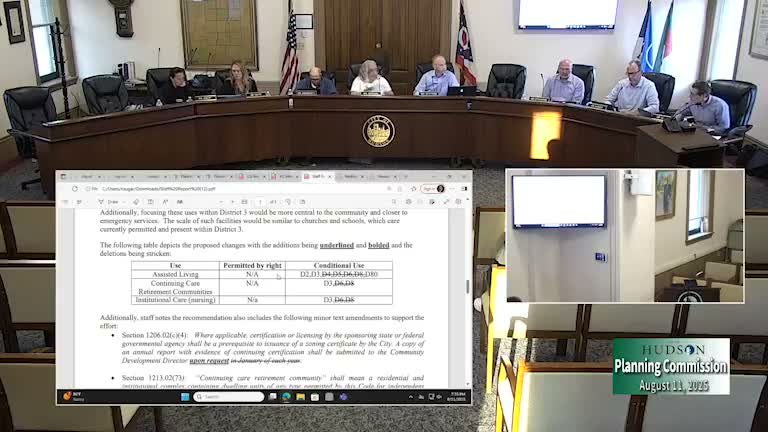
The Hudson City Planning Commission on Aug. 11 continued a public hearing on a staff-led text amendment that would change where assisted living, continuing care retirement communities and institutional care are allowed in the city’s Land Development Code.
The amendment, introduced by city planner Mr. Sugar, would move large-scale living facilities out of several business districts and treat them similarly to conditional uses such as churches and schools. ‘‘This is a city led application, to amend the land development code related to assisted living, use category, continuing care retirement communities, and institutional care,’’ Mr. Sugar said during the staff presentation, adding that the change grew from the comprehensive plan and emergency-services concerns.
Commissioners pressed staff for underlying data. Mr. Nystrom asked for the actual occupancy rates cited in the staff report; Mr. Sugar said the figures came from outreach associated with the comprehensive plan and that he would provide the detailed rates. Staff earlier noted emergency services respond to a ‘‘significant number of calls’’ from these facilities and that in the staff analysis ‘‘up to 40% of their calls can be based on their needs.’’
Public testimony included concerns about property rights and service impacts. David Zelus, a property owner at 5274 Darrow Road, said restrictions near the D8/D9 border could make his parcel harder to sell and asked for clarification about which emergency calls result in hospital transport — which can trigger insurance payments — versus runs that do not.
Commission debate focused on whether assisted-living uses should be regulated as businesses, residential uses or a separate category; commissioners also asked staff to estimate EMS cost per incident and to supply city revenue context, including whether these facilities generate measurable local income tax. Commissioners cited a single facility, Laurel Lake, as accounting for roughly 12% of EMS calls to one site and questioned how limiting new facilities would affect city finances.
After discussion, Mr. Nystrom moved to continue the item to next month so staff could return with additional occupancy and fiscal details; the motion was seconded and passed 5–0. The commission directed staff to provide the occupancy rates referenced in the report, EMS cost-per-incident estimates, and relevant revenue information to inform further deliberations. The hearing will resume at the commission's next regular meeting.