Get Full Government Meeting Transcripts, Videos, & Alerts Forever!
Get email alerts on the Land Use topic
No spam. Unsubscribe anytime.
Laurel Lake retirement expansion continued after commission raises wetlands, density and process concerns
Summary
Hudson’s Planning Commission continued a major site-plan hearing for Laurel Lake Retirement Community to August after questioning whether the revised plan (which would increase units and encroach on the Index of Ecological Integrity) is consistent with a prior Board of Zoning and Building Appeals decision and with city codes on wellhead protection, sidewalks and stormwater.
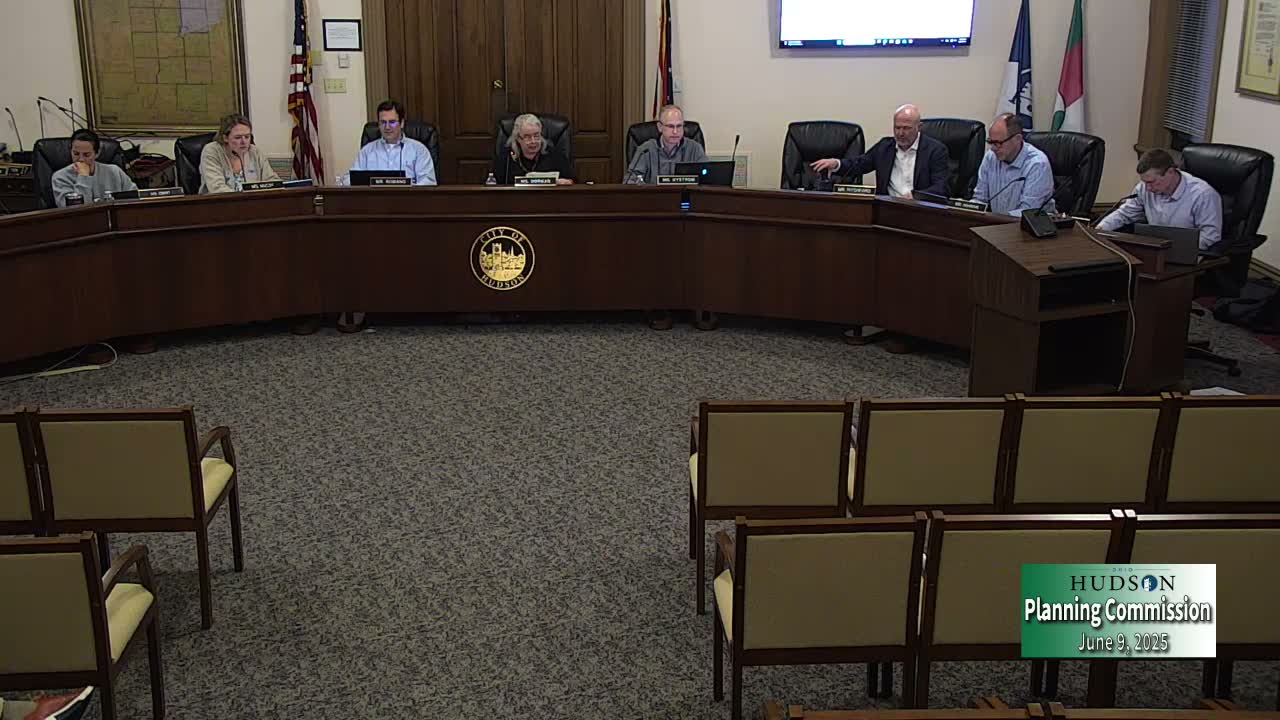
The Hudson Planning Commission on June 9 continued discussion on a major site-plan application from Laurel Lake Retirement Community after a lengthy hearing in which commissioners flagged multiple procedural and environmental concerns.
Staff recapped the file history: the commission issued conditional-use and site-plan approvals in October 2024, the applicant appealed the conditional-use portion to the Board of Zoning and Building Appeals (BZBA), and the BZBA reversed part of the commission’s denial related to three buildings along the pond. The current submission includes changes to Buildings 1, 2 and 5; the applicant’s team said the front buildings were revised to improve traffic safety and preserve more trees in certain areas while restoring duplex layouts the developer considers financially necessary.
Developer Jeff Jardine said the revised layout reintroduces duplexes in the front and shifts some buildings to preserve trees along the northeast side of the site; he said only a small number of trees (four trees for Building 2 and two trees for Building 5) lie within the city’s Index of Ecological Integrity (IEI) and would be removed. Laurel Lake representatives said the community currently operates roughly 411 living units across campus (including 275 independent living units, 61 assisted-living units and a 75-bed skilled-nursing facility), and that market demands drove earlier apartment consolidations.
Commissioners pressed several issues: whether the revised plan effectively proposes six units in front buildings when the BZBA’s conditional-use ruling limited the approved configuration; whether the new footprints and construction staging encroach on the IEI and wetlands-related setbacks; whether the site lies within a five-year time-of-travel wellhead-protection area and what additional restrictions that triggers; stormwater and detention-basin changes and their downstream effect on Laurel Lake; pedestrian safety given the lack of sidewalks; and the proper administrative path (whether the applicant must submit a new conditional-use application or can revise the plan to conform to the BZBA decision).
Staff and the city solicitor advised the commission that the BZBA decision limits what the commission can approve now; if the applicant elects to proceed with a plan that differs materially, the applicant should file a new conditional-use application. Given the outstanding technical, legal and procedural questions, the commission voted to continue the matter to the August meeting to give the applicant time to prepare revised drawings and for staff to refine the record.
Next steps: the applicant may resubmit a plan that conforms to the BZBA decision (five units) or file a new conditional-use application seeking authorization for the additional unit(s); the commission directed staff and the applicant to clarify IEI encroachment, tree counts, wellhead-protection constraints, stormwater measures, and sidewalk/funds-in-lieu calculations prior to the continued hearing.