Get Full Government Meeting Transcripts, Videos, & Alerts Forever!
Get email alerts on the Appendix A Rewrite topic
No spam. Unsubscribe anytime.
Hudson panel reviews rewrite of Appendix A to modernize submittal rules and digital checklists
Summary
City staff and planning commissioners reviewed a line‑by‑line redraft of Appendix A (submittal requirements), agreeing to modernize wording for online filing, shift many items to 'as applicable', require a staff‑provided checklist in Viewpoint, and let engineering determine when a full traffic impact study is needed.
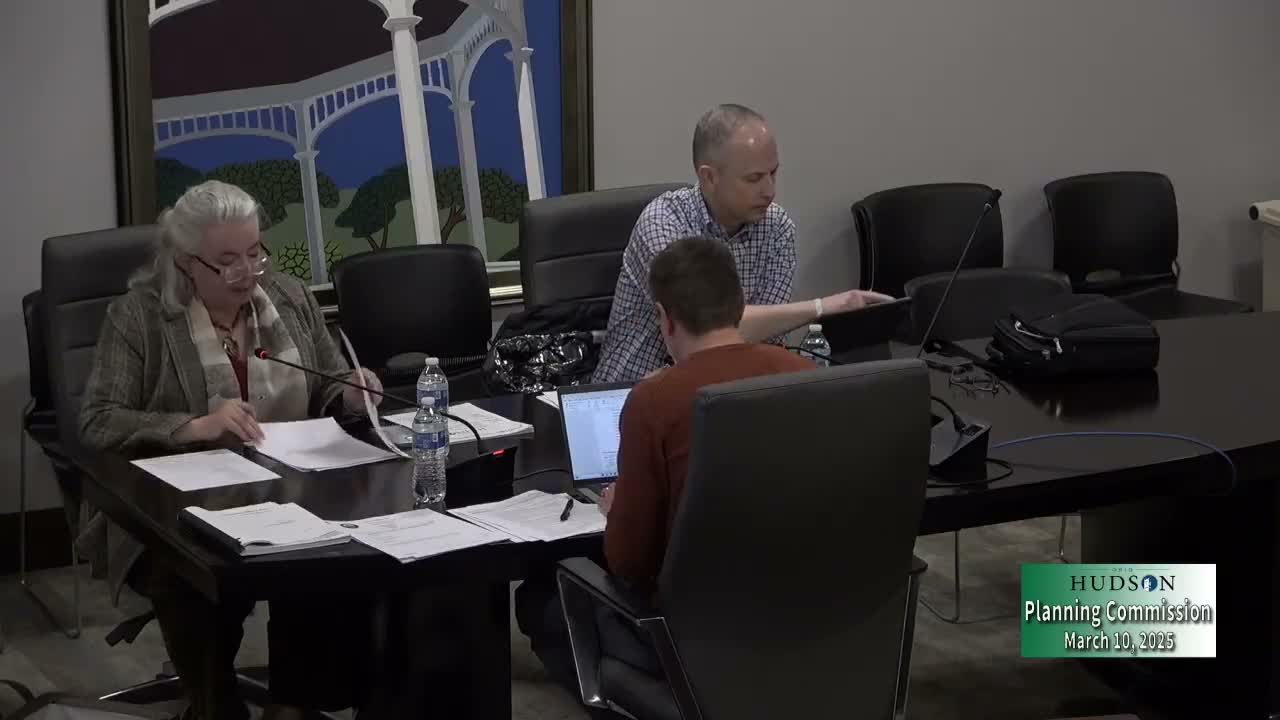
Hudson City staff and planning commissioners spent a work session reviewing a proposed rewrite of Appendix A — the city's submittal requirements for development applications — aiming to modernize language for online filing, reduce unnecessary applicant burden, and clarify which items must be supplied up front.
The review, opened by Speaker 1, focused on distinguishing core requirements that every applicant must provide from items that should be required only for subdivisions, major site plans or when triggered by site conditions. "My thought this evening was that we would go through the listing of the appendix a," Speaker 1 said, signaling the group's intent to redline the document line by line.
Why it matters: Appendix A controls what applicants must submit to the Planning Commission and community development staff; changes will affect how quickly applications can be checked for completeness and how much cost or effort applicants face before an initial review.
Staff and commissioners agreed on several concrete changes. They will reword Item 1 to refer to a "complete application" rather than the old phrasing that assumed paper forms; Speaker 2 said, "A complete application would be better." The group also decided to move numerous items (for example, plat notes, full landscape plans, or detailed utility construction drawings) out of the universal core list and place them instead in subdivision- or improvement‑plan sections or mark them "as applicable." That change is intended to avoid forcing small tenant or conditional‑use applicants to produce engineering packages meant for major developments.
On digital intake and checklists, staff said the city's permitting platform, Viewpoint, will capture many data fields and timestamps and can host the official checklist. Speaker 2 described the suggested approach: "So what we could do is force them to read the submittal requirements before they move on and check a check a box or something," meaning the portal would require applicants to acknowledge requirements and complete a department‑provided checklist. The group agreed the checklist should be provided by Community Development (not drafted by applicants) and that staff will return with draft checklist language and a sample Viewpoint implementation.
Traffic and technical thresholds were a central point of debate. The current draft uses the phrase "traffic impact study," which staff and commissioners said can be read as a high threshold. Speaker 2 recommended allowing either a trip‑generation analysis or a full traffic impact study "as determined by city staff." Commissioners agreed to revise the language to give engineering the authority to require the full study only where warranted, while otherwise accepting a trip‑generation analysis for smaller projects.
Environmental and permit items will be clarified. The panel asked staff to replace vague references such as "special natural area" with specific language permitting an environmental study or report when requested by the planning director. They also discussed when applicants should show federal or state permit documents (for example, U.S. Army Corps of Engineers, Ohio EPA, or NPDES permits) and agreed site‑plan review should either require copies of already‑issued permits or a clear statement of intent to apply where the permit is handled by another agency.
Other technical edits proposed during the session: - Remove or relocate redundant instructions (for example, parcel number and municipality text that the Viewpoint platform already captures). - Keep deed submittal as an item; commissioners argued the deed can reveal recent transfers and helpful context for staff review. - Require certain major reviews to include a surveyed site plan signed and stamped by a licensed engineer and to maintain two‑foot contour intervals for detailed topographic surveys on major site plans. - Consolidate plan content so the site‑specific development plan contains building locations, density/intensity calculations, open‑space mapping and pedestrian network depictions rather than scattering those items across many numbered paragraphs.
Next steps and timing: Staff (Speaker 2) will produce a redline with the agreed edits and draft a department‑owned checklist for Viewpoint. The commission set a tentative follow‑up to continue edits and finalize a version to send to legal counsel and then to the Planning Commission for formal action. Speaker 1 adjourned the session at 09:32.
What wasn't decided: The group did not finalize every threshold (for example exact trip thresholds that trigger a full traffic impact study) and asked engineering staff to recommend numeric thresholds and confirm whether the Hudson traffic manual referenced in the draft should remain. Staff will return with those clarifications before a final draft goes to the Planning Commission.
Attribution: All quotes and paraphrased positions in this article are attributed to unnamed meeting participants as labeled in the planning session transcript (Speaker 1–4). No named official titles were recorded verbatim in the transcript.