Get Full Government Meeting Transcripts, Videos, & Alerts Forever!
Get email alerts on the Development Compatibility topic
No spam. Unsubscribe anytime.
Planning commission denies vinyl fence for Hudson Community Living, cites historic-district compatibility
Summary
After extended questioning and public comment, the Planning Commission voted 5–1 to deny a request to change the previously approved 6-foot wood perimeter fence for Hudson Community Living to a donated vinyl privacy fence, pointing to the land-development code requirement that fencing be wood or vinyl that closely resembles wood when adjacent to the historic district.
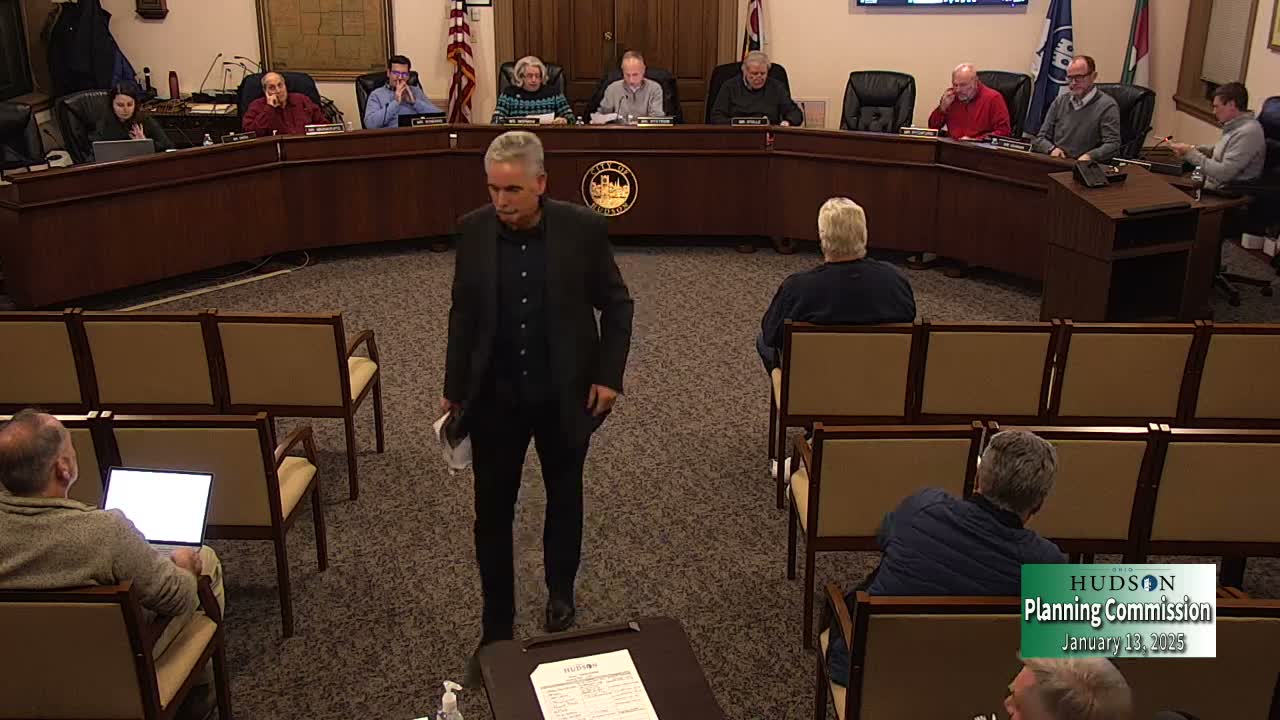
The Hudson Planning Commission on Jan. 13 denied a request from Hudson Community Living to substitute a donated 6-foot vinyl privacy fence for the wood perimeter fence shown on the project's previously approved plans (case 2022‑822).
Staff summarized the modification request and noted compatibility standards in the conditional-use and site-plan code and the Architectural Review (ARC) guidance that limit allowed fencing materials near the historic district to wood, wrought iron, stone/brick or vinyl that closely resembles wood. The applicant presented product samples and said the donated vinyl material is a durable, UV-stabilized resin that “looks like wood,” is delivered in 8-foot sections and interlocking 6-foot-high panels, and was offered with donated labor. Project representatives and supporters said the product will last longer and require less maintenance than wood.
Builder George Roth and architect Joseph Matava highlighted neighborhood support and safety arguments for a smooth, interlocking panel. “This is a beautiful project for a bunch of special folks,” Roth said, urging approval of the donated material. Project staff and counsel emphasized longevity, reduced maintenance and that neighbors immediately adjacent had provided letters of support.
Commissioners pressed whether the vinyl closely resembles wood, whether the applicant had exhausted feasible alternatives and whether allowing vinyl would set an undesirable precedent near the historic district. The record showed the approved plans referenced a wood fence; staff said the change request was received for commission consideration and characterized as a modification rather than an already permitted substitution.
Commissioner Nystrom moved to deny the modification; the motion was seconded and passed on roll call (affirmative votes recorded as Inamorado, Smith, Stolle, Nystrom, Norman). The vote carried 5–1. The commission suggested the applicant consider alternative materials or fundraising to provide a fence consistent with ARC and code requirements.
What happens next: The request to use vinyl was denied; the applicant may return with an alternate proposal consistent with the code or ARC guidance.