Get Full Government Meeting Transcripts, Videos, & Alerts Forever!
Get email alerts on the Budget Finance topic
No spam. Unsubscribe anytime.
Hudson’s revised five‑year plan shows tightening reserves; council agrees to begin hiring for phased hybrid Fire/EMS coverage
Summary
City staff presented an updated 2025–2029 five‑year plan showing a roughly 3.7% drop in 2025 income‑tax estimates, rising capital needs and a projected $1.1M annual increase for a full hybrid Fire/EMS model. Council signaled support for phased hiring (7 a.m.–7 p.m.) and asked staff for financing options and further fiscal modeling.
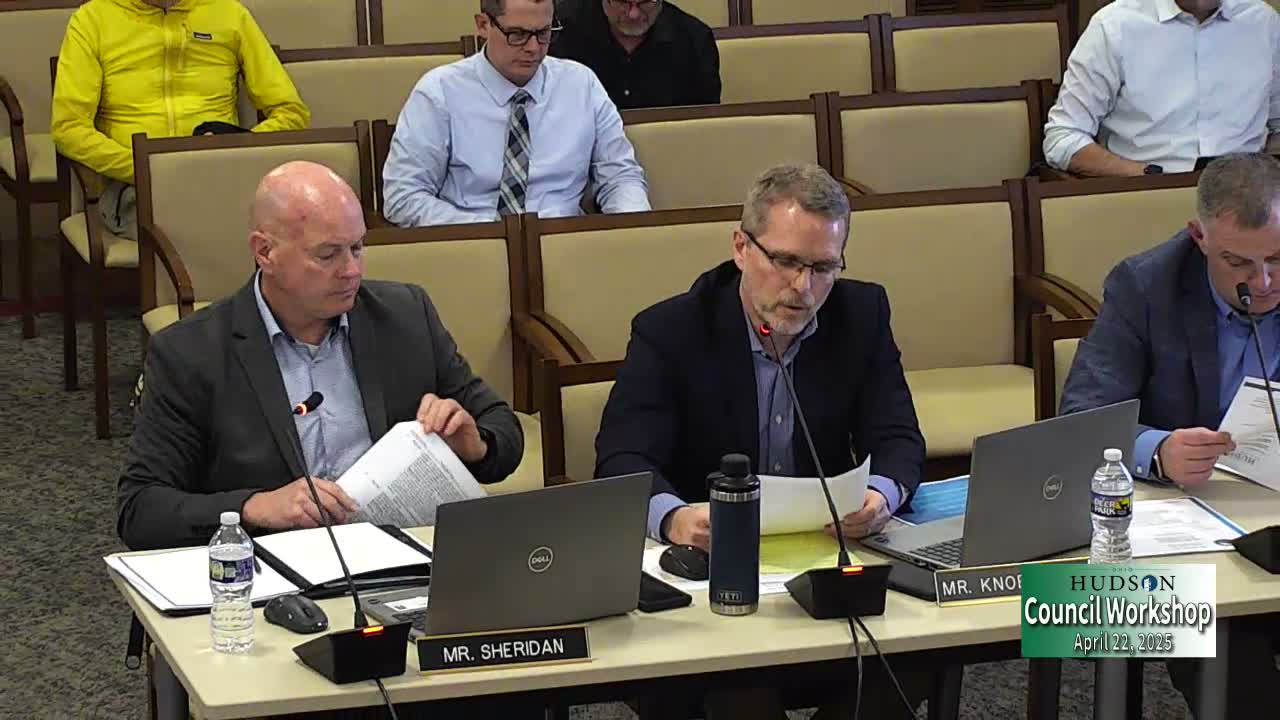
City finance and management staff told the Hudson City Council on April 22 that the city’s revised five‑year plan reflects the loss of a major employer, higher capital costs and a proposed hybrid Fire/EMS staffing model that together tighten reserve projections.
Jeff (city staff) summarized the numeric changes: a 3.7% reduction in estimated 2025 income‑tax collections compared with the 2024 actual, then 2.5% growth thereafter; increased capital costs for recent land purchases and projects (Norfolk Southern rail‑adjacent parcels, Hines Hill bridge design and the YDC cleanup); and higher debt service for the Public Works facility. Jeff said he had adjusted previously projected “excess available” infrastructure dollars to help keep the general fund carryover near the city’s informal 40% target.
On Fire/EMS, staff presented a hybrid staffing model that would add part‑time, 12‑hour shifts and associated equipment costs. Jeff estimated the staffing model plus related debt service for station improvements would increase Fire/EMS ongoing costs by approximately $1.1–$1.2 million per year and would draw down combined Fire/EMS fund balances over the five‑year period. Jeff also noted that the 5‑year plan no longer includes construction of a new fire station; instead, the plan shows renovation costs of roughly $5 million for the existing station.
Council debate focused on how to fund ongoing Fire/EMS personnel (one‑time capital versus perpetual personnel costs), whether to reallocate existing income‑tax distributions, introduce a property‑tax levy, or pursue additional revenues (ambulance fees or other streams). Mr. Sutton said reallocating existing income tax would harm other accounts; he proposed discussing a levy with residents if needed. Several council members supported moving to a phased hybrid model and signaled approval to begin recruiting for the first phase (7 a.m.–7 p.m., seven days a week). Others urged caution and emphasized the long‑term nature of recurring personnel costs.
Procedural next steps: council signaled agreement to start the firefighter interview process and directed staff to prepare a request for proposals (RFP) for the fire‑station renovations (staff estimated design ~5 months and construction ~6 months). Council also asked staff for more detailed financial scenarios showing options to preserve the general fund carryover and long‑term Fire/EMS sustainability.