Get Full Government Meeting Transcripts, Videos, & Alerts Forever!
Get email alerts on the Public Safety topic
No spam. Unsubscribe anytime.
Consultants tell Hudson council a 24/7 four-person engine and a second station would cut response times but cost millions
Summary
A K2M/Matrix study presented Jan. 28 recommended a hybrid staffing model to run a 24/7, four-person fire engine and a second station near 7300 Darrow Road to reduce response times; consultants estimated about $1.2 million in first-year staffing costs plus $300,000 in immediate facility repairs and $15–20 million to build a new station.
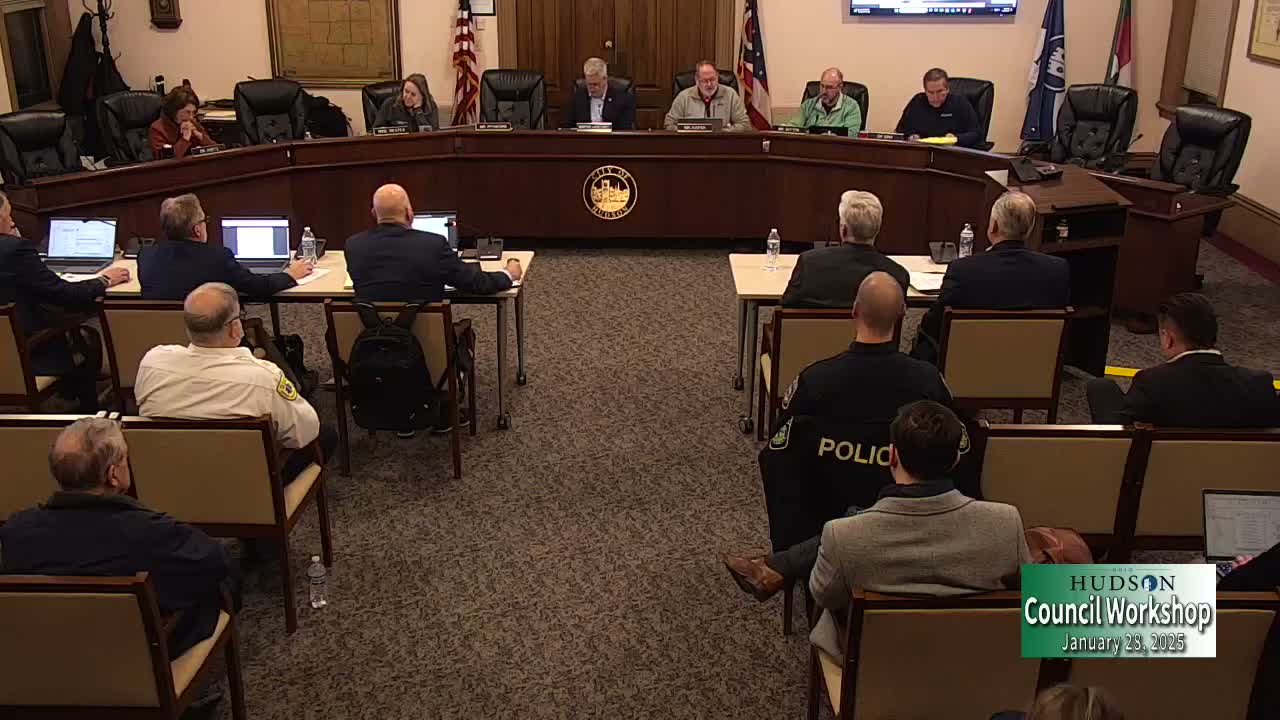
Consultants hired to study Hudson’s Fire and EMS operations told the City Council on Jan. 28 that moving to a staffed engine company and adding a second station would reduce emergency response times but would require large recurring and capital budgets.
“We're trying to offer up recommendations to decrease emergency services response times for fire and EMS,” said Vaughn Miller of K2M Design, outlining the study’s three parts: a facility-condition assessment, a staffing analysis and a conceptual design for a new station. Robert Finn of Matrix Consulting, who led the staffing and performance assessment, said the study corrected anomalies in dispatch data before measuring performance and recommended using 90th-percentile response metrics.
The consultants reported call-processing and turnout times that exceed industry best practices. Finn said the National Fire Protection Association and national dispatch standards use a one-minute target for call processing; Hudson’s measured call processing ran about 2 minutes, 9 seconds. Travel-time benchmarks the team recommended for Hudson—6 minutes, 30 seconds at the 90th percentile for suburban communities—were not being met. The study found a 90th-percentile travel time of about 7 minutes, 3 seconds for EMS and 7 minutes, 53 seconds for fire units.
To narrow that gap, the study recommended a hybrid staffing model combining part-time and full-time employees to create a 24/7 engine company with four personnel on duty. “The 4 person staffing is important because the first unit on scene in order to meet OSHA requirements if two people are inside the hostile environment, there has to be two people outside,” the consultants explained.
The cost estimates given to council: roughly $1,200,000 in the first year to staff an engine company 24 hours a day, seven days a week; about $100,000 to modify existing quarters to support full‑time staff; and roughly $300,000 of immediate facility repairs to keep the current station functioning for about five years. Renovating the existing station to modern code was estimated at roughly $7–8 million; a full replacement station was described as likely in the $15–20 million range.
On station siting, the study’s GIS work showed the current downtown site provides strong east–west coverage but struggles to reach far northern and southwest parts of the city within the recommended 6:30 travel-time window. The consultants recommended a longer-term second-station area in the vicinity of 7300 Darrow Road to expand coverage; they also cautioned the city to re-analyze the site if roadway projects (including a pending bridge) change travel patterns.
Council members asked for comparisons to neighboring departments and more context on the GIS population coverage figures; consultants said staffing and reporting methods differ across agencies and that appendix materials include comparative staffing and budget figures gathered from surrounding departments. Several council members urged staff to return with revised coverage maps that examine relocating the existing downtown station rather than automatically keeping it at its present site.
What happens next: staff told council they will return with mapping options, bonding and cost scenarios and a proposal for how to proceed on staffing hires if council pursues the near-term 24/7 model. No formal action was taken at the workshop; the study is presented for direction, further analysis and budgeting.