Get Full Government Meeting Transcripts, Videos, & Alerts Forever!
Get email alerts on the Charter Review topic
No spam. Unsubscribe anytime.
Charter Review panel presents amendments; council probes term commencement and accountability language
Summary
The Charter Review Commission presented a package of proposed changes to the Charter of Hudson, including tying council term commencement to election certification and new rules to require accountability for entities seeking tax-levy funding. Council members pressed the commission on public comment timing and possible unintended consequences of the changes.
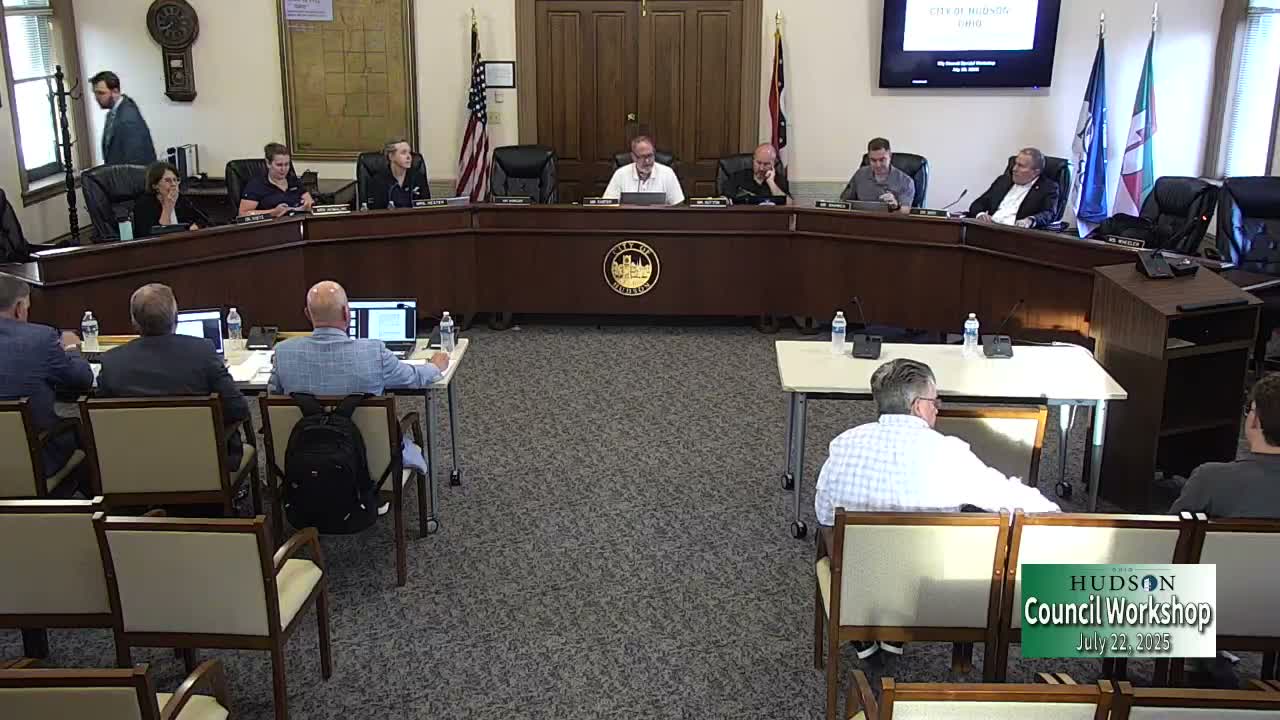
The Charter Review Commission returned to Hudson City Council on July 22 to walk through a slate of proposed charter amendments that would rewrite parts of the charter and submit multiple items to the ballot.
Mr. Caglar, identified in council remarks as the commission chair, and Mr. Kegler, who presented the package, outlined several administrative changes the commission advanced, saying the intent was clarity and accountability. “We came up with the: when someone actually becomes an elected official is when the board of elections certifies the election,” Mr. Kegler said, defending a recommendation that would tie term commencement to certification rather than to a fixed calendar date.
Council members focused questions on two areas: when elected officials would take office, and a proposed requirement (ballot issue 8) that entities receiving municipal levy funds demonstrate accountability to electors. Dr. Goetz asked why other municipalities commonly use January 1 for swearing-in; Mr. Kegler replied that tying commencement to the certification date avoids potential lame-duck gaps and lets newly certified officials assume office as soon as certification occurs.
Several council members, including Mrs. Kowalski, said the commission’s schedule left limited time for the council and the public to give feedback on the final product. Kowalski said the timing made it harder for the public and council as a body to evaluate the recommended text before submission to the ballot. “It really honestly gave council and the public no time to make comment on the output,” she said.
Mr. Kegler and other commissioners responded that the commission held 11 meetings, accepted written comments through April 30, had solicitor involvement at every meeting, and posted tracked comments and responses in the commission packets. He said the commission intentionally separated potentially controversial items into individual ballot issues and removed other changes from omnibus edits so voters could decide specific proposals.
On ballot issue 8, which would require an entity requesting levy funding to satisfy one of several accountability tests (for example, its governing body is elected by municipal electors), Mr. Kegler said the proposed language does not require a specific election format. “It doesn’t have to be an election conducted by the board of elections. It doesn’t have to be, on a November ballot,” he said, adding that the council would determine whether an entity’s method of selecting governing members meets one of the enumerated options when a levy is forwarded.
Council members asked whether the new language could produce unintended effects if an election certification or challenge delayed seating. Commissioners acknowledged the possibility of litigation or challenge but said tying commencement to certification creates a single objective trigger: when the Board of Elections certifies the results.
The commission also described structural changes such as creating a Park and Natural Resource Board to consolidate duties currently handled by separate park, tree, cemetery, and environmental committees. Mr. Kegler said the board’s duties would absorb functions similar to the city’s Environmental Awareness Committee.
The commission’s report will be submitted to the council for placement on the ballot; several charter items are scheduled for second or third readings at the Aug. 5 meeting. The commission indicated near-unanimous support for the omnibus administrative changes and one recorded dissent on ballot issue 8. Council members thanked the commission for its work and closed the discussion with directions to proceed toward formal ordinance language and ballot scheduling.
What’s next: The ordinance to submit the commission’s amendments is scheduled for a third reading on Aug. 5; ballot numbering will be assigned by the Board of Elections.