Get Full Government Meeting Transcripts, Videos, & Alerts Forever!
Get email alerts on the Long Term Care topic
No spam. Unsubscribe anytime.
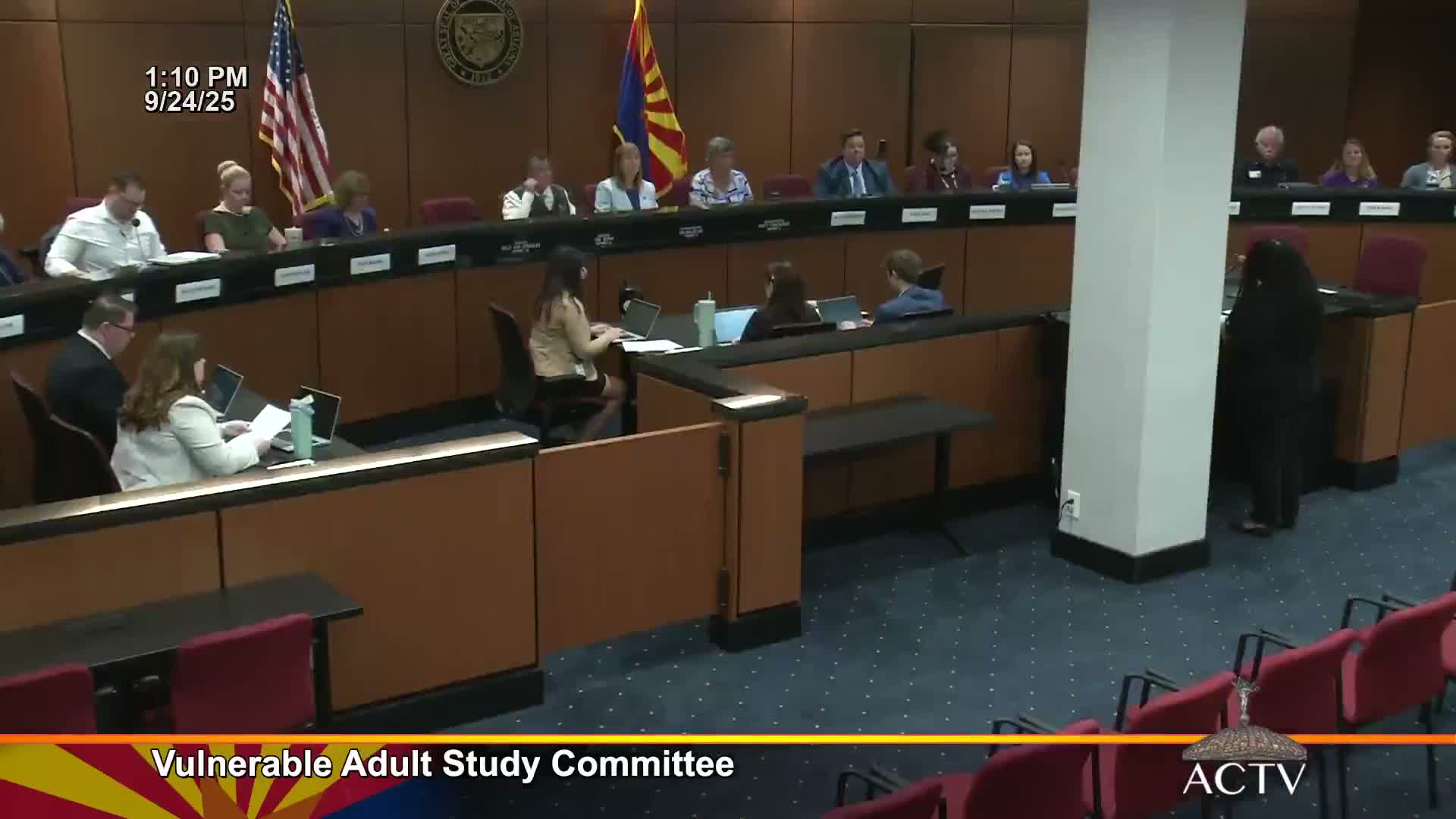
Vulnerable Adults Study Committee endorses seven recommendations on data, training and workforce; electronic monitoring set for separate public hearing
Summary
The Vulnerable Adults Study Committee voted to adopt seven recommendations urging improved interagency reporting and data systems, expanded training and apprenticeship pathways, a voluntary caregiver registry, and collection of involuntary discharge data; electronic monitoring in assisted living will be the subject of a dedicated public hearing and an addendum to the committee report.
The Vulnerable Adults Study Committee adopted seven recommendations aimed at strengthening reporting, training and workforce systems for long-term care and developmental disability providers and agencies.
House research analyst Ajane Graham presented the proposal package, which urged the legislature to remove barriers to interagency collaboration, invest in state data-technology infrastructure and create an easy-to-use online reporting form and a state standard operating procedure for abuse, neglect and exploitation investigations. Graham also recommended an online database to store and cross-reference reports, a central repository for training and prevention resources, apprenticeship or pathway programs to expand the caregiving workforce, a voluntary registry of paid care providers, and systematic collection and analysis of involuntary discharge and eviction data. The packet included a directive to hold another public meeting before 2025-12-31 to collect testimony on electronic monitoring and to issue an addendum to the committee’s 2025-10-01 report with recommendations on the subject.
Committee members expressed broad support for the package but repeatedly noted implementation will require funding and operational planning. Molly McCarthy of the Department of Economic Security warned that “recommendations 1 through 5 have a budget component” and that assigned agency work may require additional FTEs. A state agency representative later estimated a need for roughly 70 new FTEs and said the access budget could increase by about $5,000,000, with consultant costs to redesign assessment tools on the order of $400,000–$500,000.
Tony Brown, chair of the developmental disabilities work group, said a major practical hurdle will be “compatibility of computer systems,” adding that standardizing data and cross-reporting would produce long-term time and manpower savings. John Scott Williams, a provider of assisted-living services, urged apprenticeship-style training that identifies caregivers with strong on-the-job skills even if they struggle with standardized tests, saying that caregivers’ “best skill is mercy.”
On involuntary discharges and evictions, advocates and the Long-Term Care Ombudsman noted frequent complaints and urged better data collection; providers said assisted-living operators already keep termination letters and that formal court evictions are rare in their sector. The committee agreed that more complete, centralized data is needed to understand how often involuntary discharges occur and under what circumstances.
Each recommendation was moved and approved by voice vote. Recommendation 7 — on electronic monitoring in assisted-living facilities — drew insufficient consensus in subcommittees, and the panel voted to hold a dedicated public hearing with testimony and to add the committee’s findings to an addendum to its October report.
The committee’s action does not itself create law. Members directed staff to work with stakeholders and agencies to draft implementation details, funding requests and any bill language as appropriate. The committee adjourned after staff and legislators agreed to coordinate dates for the electronic-monitoring hearing and options to expand public access across the state.
Votes at a glance: the committee adopted Recommendations 1–7 by voice vote; no roll-call tallies were recorded in the transcript.