Get Full Government Meeting Transcripts, Videos, & Alerts Forever!
Get email alerts on the Housing topic
No spam. Unsubscribe anytime.
Home Building Association warns of regional lot deficit, urges local policy steps to increase housing supply
Summary
Elizabeth Greenfield of the Home Building Association of Richmond told Powhatan supervisors the Richmond region faces a large lot deficit and low inventory (Powhatan ~2.7 months of supply), endorsed zoning and permitting reforms and suggested targeted incentives to lower production costs.
Representing builders, developers and the trades across the PlanRVA footprint, Elizabeth Greenfield of the Home Building Association of Richmond briefed the Powhatan County Board of Supervisors on Sept. 5 about regional new‑construction trends and local options to ease housing shortages.
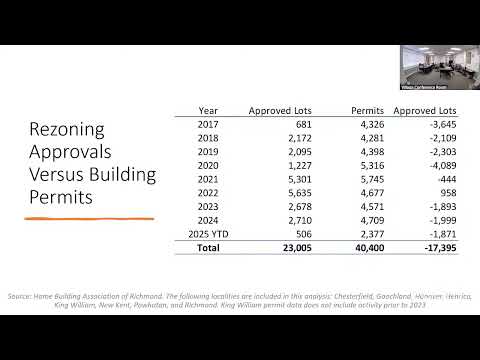
Greenfield said the region has low inventory, elevated demand and rising prices. She reported that Powhatan has about 2.7 months of inventory (a healthy market is roughly 6 months) and described a regional pattern in which roughly 2,300 lots have been approved since 2017 while the market has consumed a far larger number of lots, producing an estimated deficit of 17,395 lots. She told the board that at current permitting and absorption rates the deficit will grow unless the pipeline of buildable lots increases.
The presentation identified several delays that lengthen the timeline from land identification to finished homes: entitlement and rezoning timelines, site infrastructure needs (wetland/stream mitigation), interagency reviews (VDoT, DEQ), construction labor shortages and pandemic-era supply issues. Greenfield said the full cycle from land acquisition through sale can take about 9–10 years, which means that recently visible building activity may reflect projects started years earlier.
To lower the cost of new homes, Greenfield suggested local actions within county authority: reduce or waive certain development fees for targeted products, expedite plan and zoning review, consider reduced minimum lot sizes in areas with infrastructure, and promote housing types that fit community character (for example, duplexes that resemble single‑family homes). She cited Henrico County27s water/sewer connection and fee-waiver programs as models.
Supervisors asked about the role of consumer preferences, interest rates and square footage demand; Greenfield noted that some younger buyers accept smaller living areas while many older homeowners retain low-interest mortgages and thus remain in place, constraining inventory. She offered the Home Building Association as a resource to county staff during the upcoming land‑use‑map update.