Get Full Government Meeting Transcripts, Videos, & Alerts Forever!
Get email alerts on the Regional Planning topic
No spam. Unsubscribe anytime.
Plan RVA outlines 'Pathways to the Future' strategic vision and tools for Powhatan
Summary
Plan RVA updated the board on a new regional strategic plan, scenario planning tools, and several active projects — including housing market analysis, an air‑quality plan to be submitted to EPA, and regional water supply planning where Plan RVA serves as the lead.
Martha Schickel, executive director of Plan RVA, briefed the Powhatan County Board of Supervisors on July 28 about a new regional strategic vision called "Pathways to the Future" and the agency’s planning portfolio.
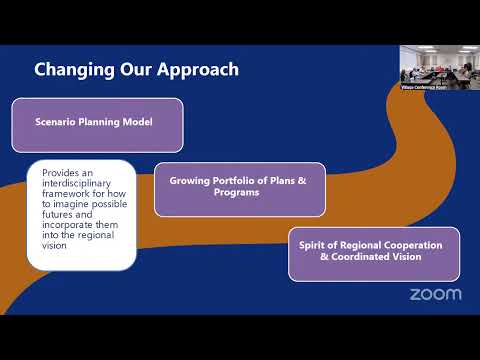
Schickel described the strategic plan as five vision statements — strategic and resilient infrastructure, a healthy environment, attainable housing, a strong economy, and opportunity and choice for everyone — derived from a review of local comprehensive plans and stakeholder engagement across the nine‑jurisdiction Richmond region. She explained Plan RVA’s scenario‑planning model, a dynamic computer tool that projects population, economic and demographic trends and tests alternate futures (for example, large economic announcements or technological changes).
Schickel said Plan RVA is staffing multiple concurrent efforts relevant to Powhatan: the long‑range transportation plan (scheduled for completion in 2026), a comprehensive economic development strategy, an air quality plan to submit to the U.S. EPA by December, a recurring hazard mitigation plan, and a housing market value analysis being conducted by the Reinvestment Fund with final deliverables expected in the January–March period.
For Powhatan specifically, she noted microtransit had expanded to cover the entire county and that the regional transit study is looking closely at demand and potential service types for the county. She also emphasized Plan RVA’s new commitment to increase data capacity for member jurisdictions — the commission designated part of member dues to produce demographic profiles for each locality.
Supervisors asked about timing for the housing market analysis and the model’s ability to incorporate health and power scenarios; Schickel said the housing study will report in January–March and the scenario model can accept new inputs, though modeling direct health outcomes (for instance, predicted changes in asthma incidence) is not feasible in the near term.
The Plan RVA briefing highlighted opportunities for Powhatan to leverage regional analyses and shared data products to support local planning and grant competitiveness.