Get Full Government Meeting Transcripts, Videos, & Alerts Forever!
Get email alerts on the Environmental Review topic
No spam. Unsubscribe anytime.
Maplewood council approves negative declaration for Century Ponds EAW after questions on wetlands, trees and wildlife
Summary
The Maplewood City Council voted Aug. 25 to approve the record of decision and a negative declaration for the Century Ponds Environmental Assessment, concluding no EIS is required while identifying mitigation and permitting actions for wetlands, trees, cultural resources and endangered-species coordination.
The Maplewood City Council voted Aug. 25 to approve the record of decision and issue a negative declaration for the Century Ponds Environmental Assessment, concluding that a more detailed Environmental Impact Statement is not required at this stage.
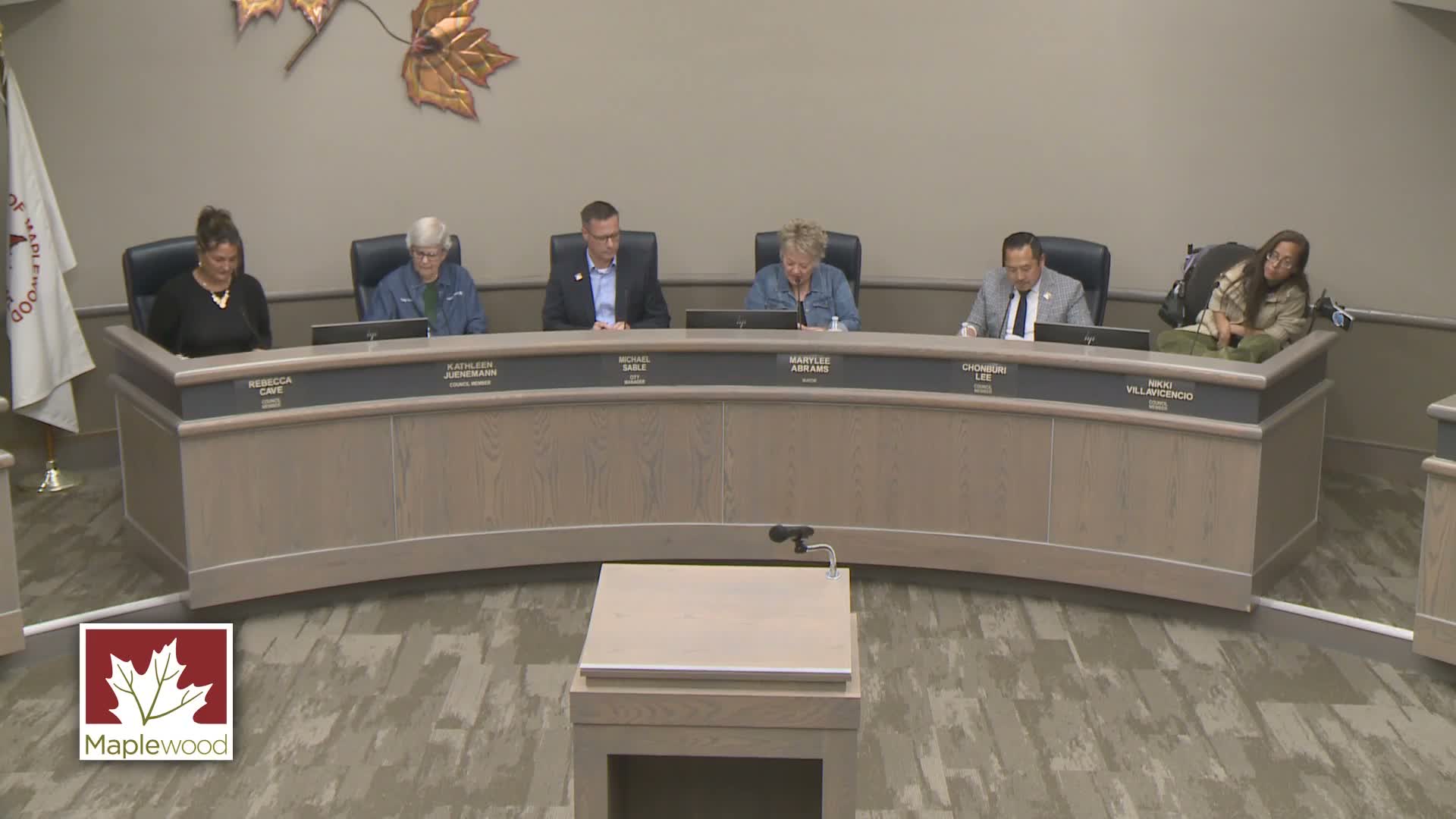
The action covered an environmental review for a proposed residential development on the former Battle Creek Golf Course site. The project proposer (D.R. Horton) has outlined plans for about 207 units on roughly 92 acres, including 104 single-family homes and 73 townhome units, the city’s consultant said. Councilmember Cave moved the resolution; Councilmember Lee seconded, and the motion carried by voice vote.
Why it mattered: The council was deciding only whether the EAW adequately assessed potential environmental effects and whether those effects can be anticipated and mitigated without an EIS, not whether to approve land uses, density or site plans. City staff and third‑party consultant Kimley Horn presented findings and summarized agency comments from MnDOT, MPCA, Met Council, Minnesota DNR and the Ramsey Washington Metro Watershed District.
Key points and mitigations: Erin Solti of Kimley Horn told the council an EAW "does not approve or deny a project" but compiles environmental studies and proposed mitigation. The EAW identifies measures and permitting steps across topics including climate adaptation, water resources, wetlands, contamination, protected species, historic properties, noise and transportation. The consultant said regulated wetlands on the site are anticipated to be avoided and that stormwater will be pretreated in on‑site basins and routed to meet Ramsey Washington Metro Watershed District rules.
On species and habitat, the project team said the site is within the known range for the Henslow’s sparrow and contains other sensitive resources; the proposer intends to preserve buffers around wetlands, establish native plantings and coordinate with the Minnesota DNR on potential survey and take‑permit needs. The team described measures to avoid tree clearing during sensitive nesting windows where possible and to perform pre‑clearing surveys when avoidance is not feasible.
Cultural resources and trees: The State Historic Preservation Office recommended a Phase I archaeological review; D.R. Horton confirmed a Phase 1A (desktop) survey has been ordered and that on‑site work would follow if the desktop review finds potential resources. In response to council questions, project staff provided tree-preservation metrics, saying roughly 2,100 caliper inches of trees are proposed for removal while more than 5,500 caliper inches would be preserved, and that many interior golf-course trees would be removed while perimeter trees would remain to protect neighborhood buffers.
Council concerns and staff responses: Council members pressed developers on how suggested items from the Met Council — such as energy-conservation planting strategies — would be implemented. The developer said landscape plans include additional tree plantings and native grassland areas and that the team is coordinating with the city’s sustainability coordinator, Sean Finnwall, on cooling and energy‑saving plant placement. Council also asked about dust mitigation and long‑term habitat management; the proposer described scheduling clearing outside breeding windows where possible, performing surveys immediately prior to clearing, staging grading to reduce dust and committing to multi‑year contracts for native‑plant establishment and maintenance (staff described a 3–5 year target for vegetation establishment, with longer timelines possible depending on conditions).
Public-agency comments: Agency reviewers raised issues including wastewater capacity and flows, comp‑plan amendment coordination through Met Council, soil‑contamination investigation status and the need for additional coordination with the DNR on state‑listed species. The project team said wastewater connections will be to Saint Paul Regional Water Services and that no upgrades were anticipated to serve normal domestic wastewater flows.
What happens next: City staff and the proposer still must complete permitting steps, including any required comp‑plan amendments, planning‑commission reviews and subsequent land‑use approvals. The EAW decision clears the environmental review threshold but does not authorize construction or change zoning; those items will return to the council in later proceedings.