Get Full Government Meeting Transcripts, Videos, & Alerts Forever!
Get email alerts on the Water Infrastructure topic
No spam. Unsubscribe anytime.
Saint Paul Regional Water Services briefed Maplewood on lead-line removals, meters and new treatment plant
Summary
Saint Paul Regional Water Services told Maplewood council it has a 10-year plan to remove lead service lines across its service area (26,000 total; Maplewood: 7 confirmed, ~90 records unknown), outlined an AMI meter-register renewal and said a new treatment plant (with ozone) has begun partial operations; officials highlighted affordability programs and a low-income assistance fund.
Raquel Vaske of Saint Paul Regional Water Services updated the Maplewood City Council on regional water projects and customer-impact plans, focusing on lead-service-line replacement, meter upgrades and the new treatment plant.
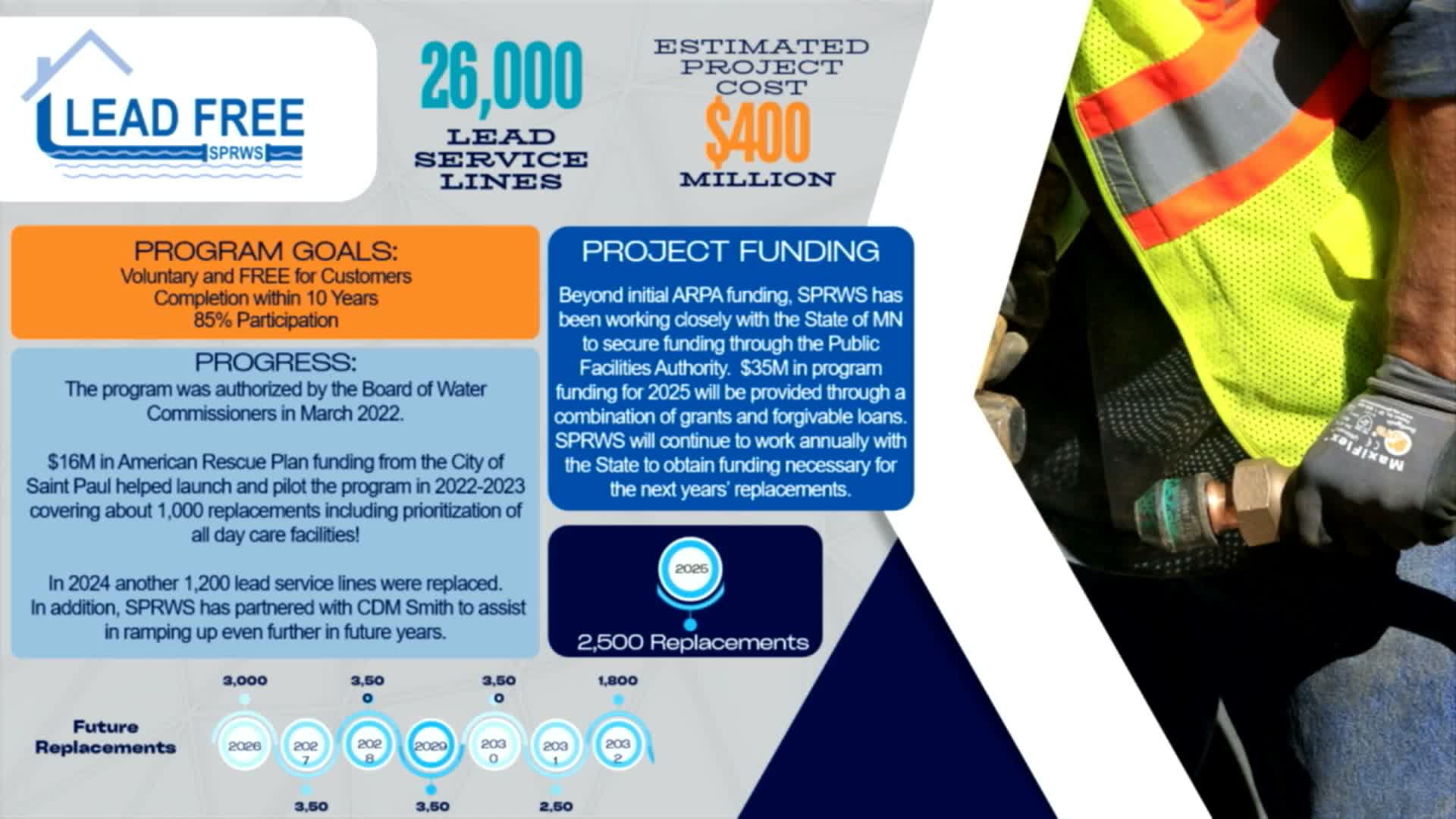
Vaske said SPRWS serves roughly 97,000 active accounts and nearly 450,000 people, drawing water from the Mississippi River. The utility outlined a 10-year "Lead Free" program to replace approximately 26,000 lead service lines across the service area; Maplewood has seven confirmed lead service lines and about 90 accounts with "unknown" records. The utility's lead-replacement pilot received local American Rescue Plan funding commitments (the transcript cites a $16 million commitment by Mayor Carter in the SPRWS service-area pilot), and Vaske said state funding for 2025 and 2026 is largely in place but must be preserved to continue the program beyond 2026.
Vaske also described a meter-register replacement and advanced meter infrastructure (AMI) rollout: meter registers replaced in 2010 will begin failing as batteries reach end of life; collectors and antennas will enable reads every 15 minutes (instead of quarterly drive-by reads), improve leak detection and support a potential shift to monthly billing in the future. SPRWS reported unit charges in 2025 at $4.38 per unit in winter and $4.52 in summer (one unit = 748 gallons), yielding an average household treated-water bill of approximately $37 per month under current use.
On treatment infrastructure, Vaske said the new plant had begun pumping water through the system and will undergo testing through September; the utility will seek to shut down the legacy plant later in the year and complete construction-related work into the next year. The new plant adds ozone treatment to address taste, odor and contaminants of emerging concern.
Vaske highlighted affordability measures: SPRWS has committed the equivalent of 5% of revenue to a Water Works Low Income Assistance Program (up to $300 per qualifying household per year), is replacing inefficient toilets in low-income apartment complexes, and has pledged not to resume customer water shutoffs as a primary collection tactic.
Council members asked clarifying questions; Vaske and staff offered to share more specifics with residents (scheduling for lead replacements, AMI outreach) and asked council assistance in notifying affected customers. The council thanked SPRWS for the presentation and described interest in future coordination.