Get Full Government Meeting Transcripts, Videos, & Alerts Forever!
Get email alerts on the Corrections Safety topic
No spam. Unsubscribe anytime.
Lawmakers probe Arizona prison safety after triple homicide, press ADCRR director on classification, staffing and MAT rollout
Summary
Lawmakers and witnesses at an ad hoc legislative hearing pressed Arizona Department of Corrections Director Ryan Thornell over the April 4 Cimarron Unit triple homicide, disputed inmate reclassification decisions, staffing shortfalls and complications from a rapid medication‑assisted treatment rollout; the director offered data and agreed to provide case files for follow‑up.
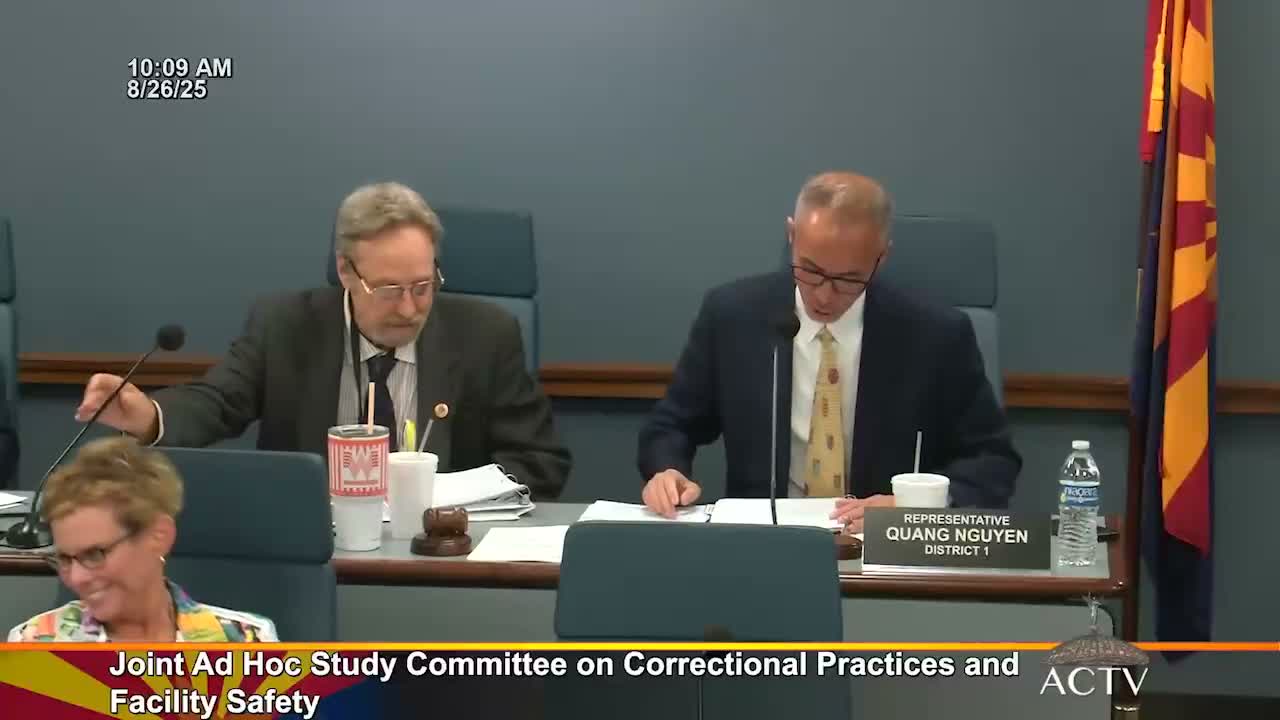
The Arizona Legislature’s ad hoc study committee on correctional practice convened to examine a string of inmate deaths and rising violence in state prisons, focusing on whether classification overrides and understaffing contributed to a deadly April 4 incident and whether the Department of Corrections, Rehabilitation and Reentry (ADCRR) has been sufficiently transparent and resourced.
Co‑chair Senator Payne opened the hearing by saying the session was “a response to the growing alarm from inside Arizona’s prison system,” and asked the department to produce documents legislators had requested in June. “Press releases are just words on paper. Action is what matters,” he said.
Formerly incarcerated advocates, retired wardens and long‑service correctional officers described a system under strain. John Fabricius, executive director of Praxis Initiative (formerly ATEC), told the committee he had reviewed documents showing an inmate with a history of violence had been moved to a lower custody level and urged better access to records to explain how that occurred.
Donna (Donaham/Hamm), an outside advocate who testified she had recent contact with the inmate at the center of the April 4 killings, told the panel the inmate possessed a large rock and a knife and said the department ignored repeated warnings. “Their blood is on the director’s hand,” she told the committee.
Long‑time corrections staff and supervisors cited three recurring concerns: large‑scale overrides that moved many inmates from restrictive housing into lower custody yards, chronic staffing shortages and the rapid rollout of the medication‑assisted treatment program (MAT). Former warden Stacy Abar gave counts she said reflected recent months: 126 overdose deaths, 11 homicides and multiple pending determinations, which she said indicated a “serious breakdown in structure, control and sound security practice.”
Retirees who had served decades at ADCRR described operational changes they view as unsafe. Robin Swift, a retired officer, showed video of violent assaults and argued that converting dedicated control rooms into general workstations, combined with dead radios and slower response times, increased risk for both staff and inmates.
Director Ryan Thornell, ADCRR’s director since January 2023, acknowledged the difficulty of the year and said the department had taken multiple steps to address violence and staffing. Thornell said ADCRR had reduced its correctional officer vacancy count from more than 1,500 at his arrival to under 1,000 and highlighted new measures including a contraband interdiction task force, implementation of RFID logging for staff duties, body‑worn cameras, expanded correctional officer training, and two licensed mental‑health inpatient units.
On the central classification question — how a long‑term violent inmate was moved into a lower custody housing assignment — Thornell described the process used by ADCRR: unit teams, deputy wardens and wardens make recommendations that are then reviewed by central office. He said the inmate’s unit team twice recommended an override from the classification instrument and that the department relied on the unit‑level documentation and behavior seen over time when permitting a move to a close‑custody placement as part of a transition plan.
Lawmakers challenged Thornell on whether the department had obtained out‑of‑state disciplinary records for that inmate, and on why a staff notification and internal warnings did not prevent the placement that preceded the April 4 killings. Thornell said ADCRR turned investigatory materials to the county attorney for prosecution and that some out‑of‑state records were not available when the inmate returned to Arizona.
The hearing also centered on MAT. Multiple witnesses criticized the speed of the program’s expansion and said inadequate staffing and security protocols made diversion easier; Thornell said the MAT rollout followed court‑ordered requirements in Jensen v. Thornell (formerly Parsons v. Ryan), that the department assembled a cross‑discipline steering committee and that clinical oversight and operational safeguards were in place. He said ADCRR tracks suspected overdoses and that MAT is intended to reduce overdose deaths, but he acknowledged illicit drugs entering facilities complicate outcomes.
Committee members pressed for data. Legislators asked for the unit‑level and case‑level documentation required by ADCRR policy for each person moved out of restrictive housing (one‑ and six‑month reviews), investigations tied to recent homicides, exit‑interview results, and staffing/pension data. Thornell offered to sit down with committee leaders to review the 11 homicide cases and the department’s underlying materials.
The panel concluded with a directive to continue oversight: members asked ADCRR for detailed case files, investigative materials held by county prosecutors as allowable, monthly trend reports on deaths and assaults, and a deeper review of classification and custody decisions. The committee said it will prepare an objective report and may pursue legislative follow‑ups based on the document review and subsequent briefings.
What’s next: ADCRR agreed to meet with committee chairs for a detailed document review; legislators said they will examine whether statutory changes, clarified reporting requirements, or other policy actions are needed to prevent further deaths and restore public confidence.