Get Full Government Meeting Transcripts, Videos, & Alerts Forever!
Get email alerts on the Cadence Law topic
No spam. Unsubscribe anytime.
Survivor and policy experts press Arizona panel to adopt federal 'Cadence Law' protections for custody cases
Summary
A mother who lost her daughter told Arizona lawmakers courts ignored threat assessments and awarded parenting time to a dangerous father; policy experts said Congress adopted Cadence Law in 2022 as part of VAWA and authorized incentives for states to adopt standards on training, evidence review and limits on reunification therapies.
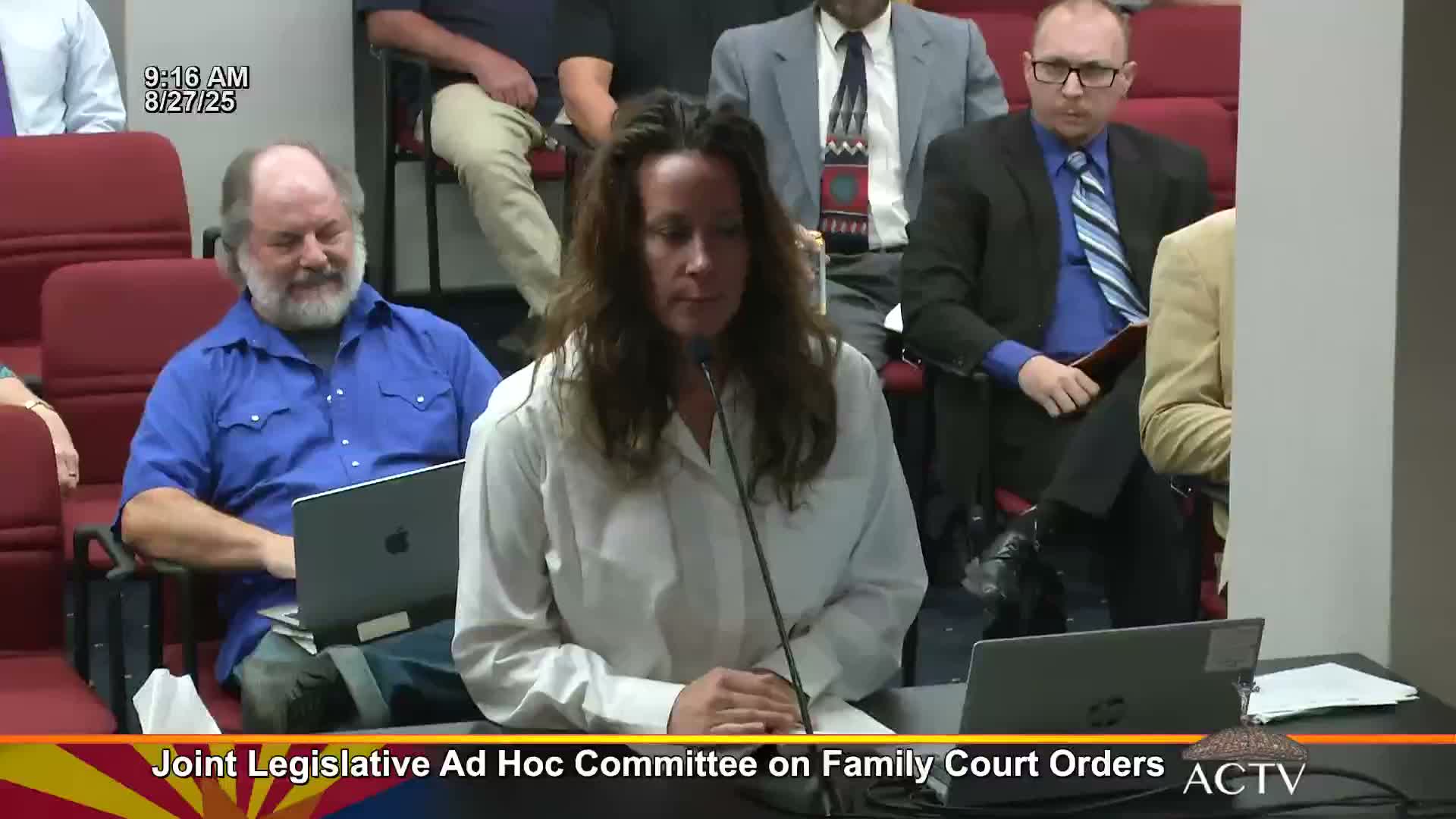
Kathy Sherlock, the mother of 7-year-old Caden Mancuso, told a joint legislative ad hoc committee that family courts awarded parenting time to her daughter's biological father despite evaluations indicating he was suicidal and unstable, and that the court’s decision preceded her daughter's murder. "No parent should have to bury their child, especially where it could have been so easily prevented," Sherlock said during the testimony.
Danielle Pollock, policy manager at the National Family Violence Law Center at George Washington University and co‑author of the model known as Cadence Law, told the committee Congress enacted the provisions in 2022 as part of the Violence Against Women Act (Title 15) and authorized $25 million to incentivize state adoption. "Cadence Law was enacted by Congress in 2022 as part of the Violence Against Women Act," Pollock said, and she described four core components: evidence‑based training for court professionals, requirement that courts consider past and present abuse evidence, stricter standards for who may offer expert testimony, and severe limitations on court‑ordered reunification treatments.
Pollock and Sherlock together urged lawmakers to consider state adoption of the federal model because child custody is governed by state law. Pollock said roughly 10 states had enacted related measures since the federal enactment and offered to provide the committee with the empirical citations that Congress cited in its findings.
Committee members pressed for particulars. Members asked whether threat assessments existed in Sherlock’s case; she said they did and that evaluators noted suicidal risk, but she told the panel judges were not required to consider the evaluations. Pollock said the law requires courts to record written findings when they place children with a parent despite abuse evidence and to exclude “junk science” from expert training and testimony. She described AFCC, the Association of Family and Conciliation Courts, as a trade organization that often shapes custody practice and sometimes opposes Cadence Law.
The panel did not take a vote. Members asked Pollock to provide source citations for the empirical research referenced in the federal findings; she said she would supply them to the committee. The committee chair reserved further time to continue hearings and invited the witnesses to remain for additional questions and follow up.
The committee is expected to produce a short report in the coming weeks and may consider draft legislation reflecting these federal provisions at the state level.