Get Full Government Meeting Transcripts, Videos, & Alerts Forever!
Get email alerts on the Four Day Week topic
No spam. Unsubscribe anytime.
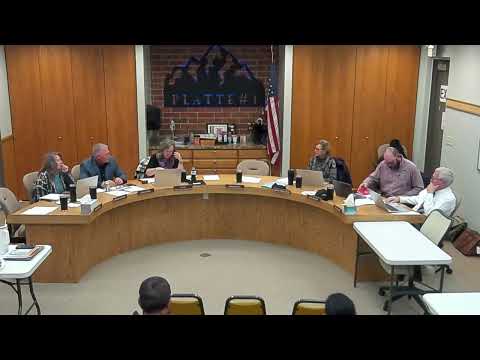
Board reviews Glendo four-day week results and staffing options for possible high-school programming
Summary
Board members heard FastBridge winter-test comparisons and community testimony supporting the four-day week at Glendo; the board discussed staffing models, funding questions and next steps to explore a high-school option that would blend face-to-face teachers with virtual certified instructors.
Board members reviewed assessment snapshots and community feedback related to Glendo's four-day school week and discussed whether to expand high-school programming at the site.
Tom (Speaker 7) presented FastBridge comparisons from the winter assessment. He said he reviewed the same students who tested last year and this year (57 total tests): 72% (41 of 57) of those tests were in the low-risk or at/above-grade categories; 14 tests were at "some risk" and eight tests were high risk. For the ELA/math subset (44 tests), he reported 41 of 44 were low risk or above. Tom cautioned that FastBridge is a one-day snapshot and results can vary by test day.
Parents and teachers from Glendo spoke in favor of the four-day week. One parent said the extra day allows for family time and practical learning (ranch work, sports) and that their child remained academically engaged; a teacher (Speaker 14) said adding roughly 35 minutes per day (about 2 hours and 10 minutes weekly) preserved instructional minutes and helped manage a multi-grade classroom.
Board members asked practical questions about high-school staffing. The discussion covered options such as hiring a certified content teacher who could teach face-to-face and support junior-high classes, using paraprofessionals for supervision, or contracting virtual certified Wyoming teachers for tutoring and grading (paid per license or by group arrangements). Speaker 13 noted state funding and Average Daily Membership (ADM) implications; Jamie was asked to check state funding rules for small-school staffing and reimbursement timelines.
Board members acknowledged trade-offs: adding staff requires upfront funds and the district must prioritize within a finite budget. They asked staff to research funding mechanics, staffing permutations, and how a blended model would affect ADM and block-grant allocations. No formal staffing decision was taken at the session.
Next steps: staff will investigate funding and staffing scenarios and report back to the board for further deliberation.